


The history of pancreatic cancer treatment has reached a milestone. On August 26, local time, the U.S. Food and Drug Administration (FDA) announced the approval of Rasonque (generic name daraxonrasib), a pancreatic cancer new drug developed by U.S. biotech company Revolution Medicines, making it the first “first-in-class” targeted therapy targeting the key molecular pathogenic mechanism of this disease, marking one of the most important breakthroughs in pancreatic cancer treatment in many years.
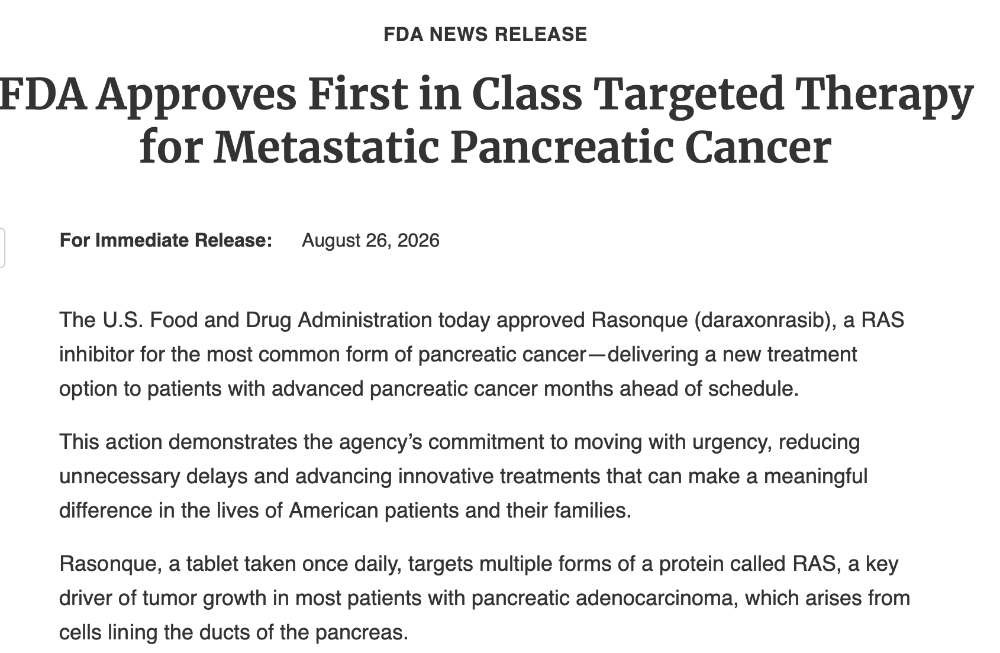 FDA Press Release Screenshot
Daraxonrasib is an oral RAS inhibitor indicated for adult patients with metastatic pancreatic adenocarcinoma who have received at least one prior systemic therapy or who are not suitable for multi-agent combination systemic therapy. Clinical trial data showed that it reduced the risk of death by 60%, with median overall survival nearly doubled.
Pancreatic cancer is known as the “king of cancers,”with an extremely low survival rate. Over the past two decades, treatment for pancreatic cancer has seen no major breakthroughs, with limited therapeutic options and very modest efficacy. It is precisely for this reason that when daraxonrasib's data were presented at this year's American Society of Clinical Oncology (ASCO) Annual Meeting, the audience rose to its feet with thunderous applause.
“It’s not just a home run — it's a grand slam,” said ASCO Chief Medical Officer Julie Gralow. Previously, no drug had ever demonstrated a median overall survival benefit exceeding one year in advanced pancreatic cancer.
Notably, the approval came several months ahead of schedule. The FDA granted daraxonrasib Breakthrough Therapy designation, Orphan Drug status, and Priority Review, and included it in the “National Priority Review Voucher” pilot program, ultimately approving it approximately 6.5 months ahead of the Prescription Drug User Fee Act (PDUFA) review deadline.
“Unprecedented”Data
As one of the most aggressive cancers, pancreatic cancer is highly malignant and insidious in onset, with approximately 80% of patients already in advanced stages at diagnosis, often with systemic metastasis. Its overall 5‑year survival rate is only about 10%, and once distant metastasis occurs, the 5‑year survival rate drops to less than 3%.
Prof. Yuan Ding, Vice President of the Second Affiliated Hospital of Zhejiang University School of Medicine and Chief Physician in the Department of Hepatobiliary and Pancreatic Surgery, told MedJ that the vast majority of pancreatic cancers are driven by oncogenic RAS proteins, which can arise from different types of RAS gene mutations or from other non‑mutation factors (wild‑type).
“Although the target is well defined, RAS has poor druggability — inhibitors tend to dissociate after binding. At the same time, there are many types of RAS mutations, and current targeted therapies are only applicable to a very small subset of patients, with none yet approved for pancreatic cancer indications,” said Ding.
This is precisely where daraxonrasib’s revolutionary nature lies. It is a novel pan‑RAS inhibitor that targets multiple types of pancreatic cancer driven by oncogenic RAS, covering a far broader range than previous targeted therapies that only focused on single mutations, effectively encompassing virtually all types of pancreatic cancer patients.
On May 31 of this year, the phase 3 clinical trial RASolute 302 data for daraxonrasib were published in the New England Journal of Medicine (NEJM). This global, multicenter, randomized, open‑label study enrolled 500 patients with advanced metastatic pancreatic cancer who had failed first‑line therapy, randomizing them 1:1 to the daraxonrasib group or the standard chemotherapy group. The results showed that across all key endpoints, daraxonrasib demonstrated unprecedented advantages over the current standard of care.
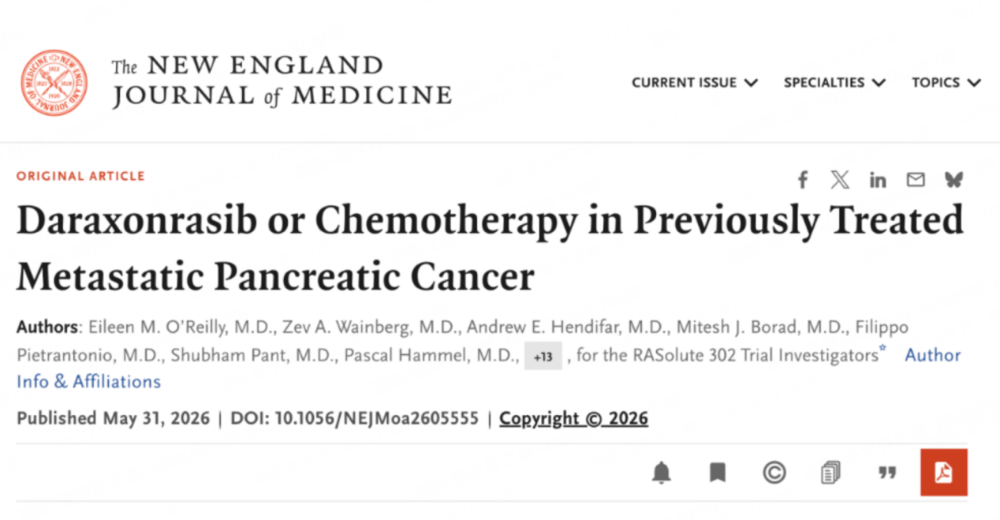
Specifically, in the intention‑to‑treat population, the median overall survival for patients treated with daraxonrasib was 13.2 months, compared with only 6.7 months in the conventional chemotherapy group — daraxonrasib reduced the risk of death by 60% (hazard ratio 0.40). Median progression‑free survival was 7.2 months for daraxonrasib versus 3.6 months for chemotherapy. The objective response rate in the daraxonrasib group was approximately three times that of the chemotherapy group, with more patients experiencing tumor shrinkage or even disappearance.
At the same time, as tumors shrank, patients' quality of life also improved substantially. In the study, the median time to worsening of pain symptoms was approximately 9 months in the daraxonrasib group, compared with only about 3.7 months in the chemotherapy group.
In terms of safety, the incidence of grade ≥3 treatment‑related adverse events was 43.6% in the daraxonrasib group, lower than the 57.5% in the chemotherapy group; the discontinuation rate was only 1.2% in the daraxonrasib group, far lower than the 11.2% in the chemotherapy group.
According to Revolution Medicines, daraxonrasib is priced at USD 39,800 per month (approximately RMB 260,000), with an annual cost of USD 478,000 (approximately RMB 3.24 million), the vast majority of which will be covered by insurance, with the patient's out‑of‑pocket portion varying by individual.
“This is one of the most breakthrough pancreatic cancer research achievements in decades,”commented The Guardian. Researchers also noted that many patients continued taking daraxonrasib after the data analysis cutoff, suggesting that the survival benefit data will further expand.
A Milestone in Pancreatic Cancer Treatment
To understand the milestone significance behind daraxonrasib's approval, one must first return to pancreatic cancer treatment itself.
According to the 2024 National Cancer Report released by China's National Cancer Center, there were approximately 119,000 new cases of pancreatic cancer and about 106,000 deaths in China in 2022. Ding told MedJ that for a long time, the mainstays of pancreatic cancer treatment have been surgery and chemotherapy. For unresectable pancreatic cancer, doctors assess whether surgical opportunities can be pursued through neoadjuvant therapy and other means based on the specific situation. For patients with metastatic or recurrent metastatic disease, chemotherapy is one of the few treatments that can extend survival.
However, even for patients with resectable pancreatic cancer, postoperative recurrence rates have remained persistently high. As for chemotherapy regimens, despite some progress, there has never been a major breakthrough — patients not only have limited survival benefits but also must endure a range of side effects including fatigue, nausea, vomiting, and myelosuppression.
Even immunotherapy, which has been highly successful in other cancer types, has shown limited efficacy against pancreatic cancer. “It can be said that the entire academic community has been waiting for a novel therapy that can dispel the gloom of pancreatic cancer,”said Ding.
It is against this backdrop that the academic community turned its attention to a key gene — RAS. RAS gene mutations are the primary oncogenic drivers of pancreatic cancer, with over 90% of pancreatic cancer patients carrying this abnormality. “Although the target is well defined, RAS has poor druggability — inhibitors tend to dissociate after binding. At the same time, there are many types of RAS mutations, and current targeted therapies are only applicable to a very small subset of patients, with none yet approved for pancreatic cancer indications,” Ding said. These challenges have plagued generations of scientists until daraxonrasib emerged.
As a novel pan‑RAS inhibitor, daraxonrasib works through a “tri‑complex” mechanism, first recruiting a chaperone protein and then binding to RAS, covering nearly all mutation types of pancreatic cancer patients.
At the same time, Ding explained that if the RAS target is likened to a “switch,” traditional RAS inhibitors can only bind to RAS in the “OFF” state and lock it in an inactive state, lacking specific binding to RAS in the “ON” state. “Daraxonrasib targets RAS(ON) — binding to the switch in the ‘ON’ state — which fundamentally limits the cancer‑promoting factor RAS, improves drug targeting, reduces off‑target effects, and minimizes impact on RAS in normal cells,” Ding said.
More importantly, daraxonrasib’s success has opened a window for the entire RAS‑targeted therapy field. Previously, exploration of RAS inhibitors had long been confined to single mutation sites. Sotorasib and adagrasib, approved by the FDA in 2021 and 2022 respectively, only target the specific KRAS G12C mutation, which accounts for less than 2% of pancreatic cancer patients. Daraxonrasib has demonstrated that pan‑RAS inhibition is feasible. “Other pharmaceutical companies can also learn from this breakthrough and may develop similar drugs with better efficacy and fewer side effects in the future,”said daraxonrasib’s researchers.
Ushering in a New Era of Pancreatic Cancer Treatment
“In the past, when we encountered patients with advanced pancreatic cancer in the clinic, we all felt regret because there really weren’t many ways to help them,” Ding told MedJ. But the situation is now changing.
In fact, expectations for this research had been building for some time. As early as December of last year, daraxonrasib's clinical trial was listed by Nature Medicine as one of the most noteworthy clinical trials of 2026 that could reshape medicine. Even before the drug's formal approval, in May of this year, the FDA issued a “safe to proceed” letter, allowing the sponsor to initiate an expanded access program, enabling patients with metastatic pancreatic cancer who had failed prior therapy to access this investigational drug without participating in clinical trials.
“This will be the first targeted therapy in history effective for the majority of pancreatic cancer patients,” said Wells Messersmith, an oncologist at the University of Colorado Hospital who participated in daraxonrasib’s clinical research.
In addition to second‑line therapy for patients with advanced pancreatic cancer, daraxonrasib is also being evaluated in multiple ongoing clinical trials, including combination with chemotherapy for first‑line treatment of metastatic pancreatic cancer, postoperative adjuvant therapy for patients with resectable disease, and expansion of indications to RAS‑mutant non‑small cell lung cancer and other cancer types.
Ding believes that certain uncertainties remain regarding daraxonrasib in pancreatic cancer treatment — for example, whether it can replicate the excellent efficacy seen in clinical trials in real‑world settings with more complex conditions and larger patient populations, and whether serious side effects not yet discovered may emerge. Based on the published safety profile, common adverse reactions include rash, diarrhea, stomatitis, nausea, fatigue, vomiting, abdominal pain, edema, decreased appetite, and bleeding, all of which require close observation during long‑term use.
But in any case, “it has injected a powerful ‘boost’ into pancreatic cancer treatment and may rewrite global guidelines for pancreatic cancer management. Daraxonrasib’s success has inspired accelerated research worldwide. In the future, surgery, chemotherapy, targeted therapy, immunotherapy — these different technological approaches — may also be combined to form new regimens, ultimately enabling pancreatic cancer patients to achieve longer and higher‑quality survival,” Ding said.

