


Recently, a virus with no effective treatment or vaccine and a fatality rate as high as 75% has infected five healthcare workers in India.
This deadly virus, known as Nipah virus, can be transmitted to humans through contaminated food and other sources, and it can also spread from person to person. Indian authorities have urgently quarantined nearly 100 individuals and are tracing close contacts in a race against time to contain the spread.
According to the latest reports, the first infected individual, a female nurse, is in critical condition and remains in a coma. Another infected male nurse is showing improvement and has been taken off ventilator support.
Statistics show that since 2001, India has experienced multiple outbreaks of Nipah virus infection. As of May 2024, a total of 754 confirmed human cases of Nipah virus infection have been reported across five countries—Bangladesh, India, Malaysia, the Philippines, and Singapore—resulting in 435 deaths.
Five healthcare workers infected at the hospital
Nipah virus is a zoonotic virus transmitted by fruit bats that can infect humans and other animals, with an extremely high fatality rate. In 1998, it caused hundreds of infections and deaths in Malaysia and Singapore. Since then, multiple outbreaks have occurred in other Southeast Asian countries. In 2018, the World Health Organization listed Nipah virus as one of the ten priority pathogens requiring accelerated research and development of treatments and vaccines.
According to a report by The Daily Telegraph, the current outbreak first emerged in Kolkata, West Bengal, India. At the end of last year, two nurses at a private hospital developed symptoms including high fever and breathing difficulties between New Year’s Eve and January 2 after treating a patient with severe respiratory infection. On January 12, the two nurses were officially confirmed to be infected with Nipah virus. The female nurse is currently in critical condition and receiving treatment in the intensive care unit, while the male nurse remains in relatively stable condition.
It is also reported that the patient previously treated by the two nurses has since died, but there is currently no evidence indicating that this patient was infected with Nipah virus. Epidemiological investigations suggest that in mid-December last year, the infected female nurse returned to her village to attend a family wedding. Indian authorities are now conducting an in-depth investigation into the source of the outbreak.
Shortly after the two nurses were confirmed, three additional healthcare workers at the same hospital were found to be infected, including one doctor, one nurse, and one sanitation worker. The infected doctor is believed to have contracted the virus while treating the critically ill female nurse.
“This disease can be transmitted through bodily fluids such as saliva, feces, urine, and blood,” the Cleveland Clinic in the United States warned. “This means that if you are caring for someone infected with Nipah virus, you could become infected when the patient coughs or sneezes.”
Following the outbreak, India’s health authorities urgently issued notices to all states, calling for strengthened surveillance and testing measures.
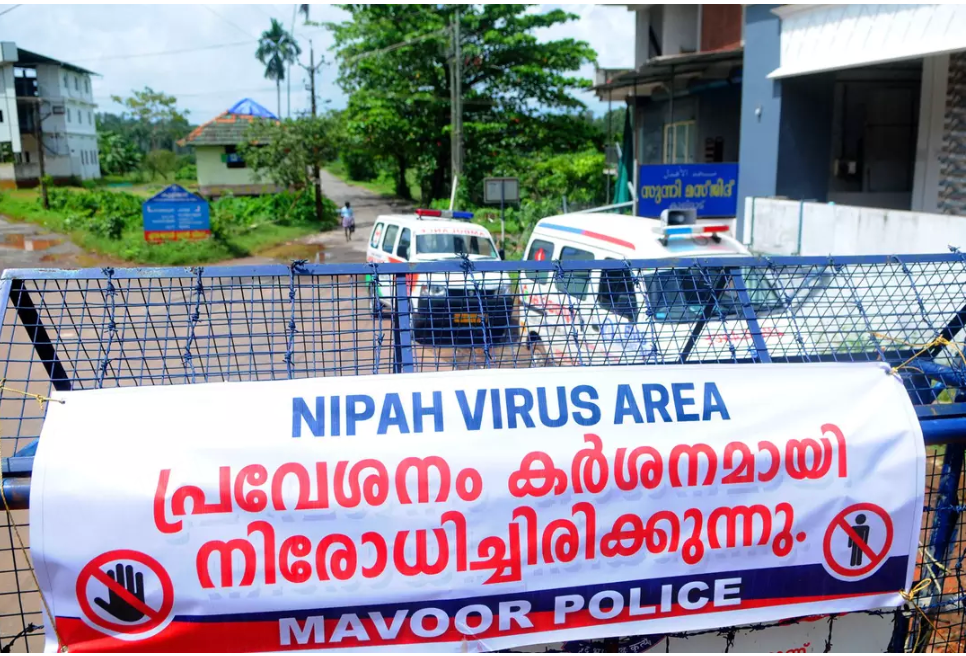
Local health departments emphasized that while considering the possibility of hospital-acquired infection, it is essential to enhance contact tracing and quarantine measures. All individuals must strictly follow quarantine guidelines to protect healthcare workers. In addition, the Indian central government has dispatched a national emergency response team to closely monitor the situation and prevent further spread.
To date, India has completed testing on hundreds of close contacts, all of whom have tested negative. However, experts note that the incubation period of Nipah virus is typically 4 to 14 days, and in rare cases can extend up to 45 days. Therefore, even after the 21-day quarantine period ends, close contacts will still require follow-up testing.
Will It Spread Across Borders?
As a zoonotic virus, Nipah virus primarily attacks the human respiratory system and central nervous system. Early symptoms of infection resemble those of influenza, including fever, headache, dizziness, and vomiting. The condition can then rapidly deteriorate, leading to confusion, severe encephalitis, and respiratory distress or respiratory failure. Clinically, there is currently no specific antiviral treatment for Nipah virus infection. Management relies mainly on supportive care, including respiratory support and monitoring and treatment of complications, particularly neurological complications.
Professor Dongyan Jin of the School of Biomedical Sciences, HKU Li Ka Shing Faculty of Medicine, told MedJ that Nipah virus is extremely virulent and can easily trigger systemic inflammatory responses, leading to cytokine storms. “It may also cause encephalitis and damage the nervous system. Even if patients ultimately survive, they may be left with severe long-term sequelae.”
However, from the perspective of transmissibility, Prof. Jin noted that Nipah virus has very low efficiency of human-to-human transmission. He explained that, compared with influenza viruses, “Nipah virus is not easily transmitted through aerosols or ordinary respiratory droplets. Infection usually requires direct contact with bodily fluids of infected individuals, such as saliva, urine, or blood, which limits transmission distance.”
On the other hand, “most infected individuals develop symptoms, and the proportion of asymptomatic infections is relatively low, accounting for only about 10%. As long as infected individuals and their close contacts are isolated, further community transmission can be effectively interrupted,” Prof. Jin said. For this reason, although Nipah virus infections have occurred sporadically since 1998, the scale of outbreaks has remained very limited.
For this reason, although infections have occurred from time to time since 1998, the overall global scale of outbreaks has been extremely limited.
In 2024, researchers from the Beijing Institute of Microbiology and Epidemiology and other institutions published a study in a subsidiary journal of The Lancet, showing that among 489 previously infected individuals in countries such as India, 336 had a history of animal exposure, while only 127 individuals (26%) reported human-to-human contact. Infections among livestock and agricultural workers accounted for 80% of cases. At the same time, a risk model developed in the study predicted that, compared with India’s 40,000 square kilometers of potential risk areas and 36 million people at risk, China’s corresponding risk figures would be only 100 square kilometers and 100,000 people.
Prof. Jin stated that Nipah virus is a typical example of a highly virulent but weakly transmissible pathogen. Current prevention and control efforts should focus on enhanced surveillance, particularly symptom screening for travelers arriving from affected regions. It is understood that in December 2024, China’s National Administration of Disease Control and Prevention and the General Administration of Customs included Nipah virus in the List of Monitored Infectious Diseases. “At present, the risk of this virus being imported into China is extremely low. With scientific border quarantine and public health surveillance systems, it can be effectively prevented, and the public does not need to be anxious,” Prof. Jin said.
According to reports, on January 23, Nepal, a neighboring country of India, ordered strengthened quarantine surveillance at airports and border checkpoints. Thailand’s Ministry of Public Health has also begun deploying screening measures at Suvarnabhumi Airport and Don Mueang Airport in Bangkok to screen travelers arriving from India for Nipah virus, distribute health advisory cards, and urge travelers to conduct self-monitoring for symptoms.

The Indian government stated that residents in affected areas should be urged to avoid contact with sick animals, especially bats and pigs, and to thoroughly wash fruits that may have been exposed to wildlife, in order to reduce the risk of transmission.

