


Obesity is an important risk factor for many common chronic diseases, affecting multiple systems throughout the body and having a significant impact on patients. With the development of medical technology, corresponding treatment methods are also advancing. Currently, China has approved multiple weight loss drugs, and bariatric surgery is becoming more popular among obese patients. The acceptance of drug and surgical treatment methods in addition to lifestyle interventions is gradually increasing. So, which is more clinically significant for obese patients: weight loss drugs or bariatric surgery? How should we choose clinically to provide patients with precise personalized treatment? These questions may still be troubling us.
From November 13th to 16th, 2024, the 26th Academic Conference of the Diabetes Branch of the Chinese Medical Association (CDS 2024) was held in Nanjing. On the 15th, in the special discussion on "Etiology and Treatment of Obesity," Professor Zhang Peng from Beijing Friendship Hospital, Capital Medical University, brought us a wonderful topic sharing, discussing the clinical significance and future exploration of bariatric surgery, traditional standardized treatment, and new weight loss drugs (AOM) for patients with obesity-related metabolic diseases. The medical community has organized the exciting content of this sharing into an article for readers.
The therapeutic effect of bariatric surgery is superior to traditional treatment plans
Non-alcoholic fatty liver disease (NAFLD) is the most common cause of chronic liver disease worldwide, affecting 55% of patients with type 2 diabetes and 75% of obese patients. It can progress to non-alcoholic steatohepatitis (NASH), characterized by liver cell damage and inflammation, which can induce liver fibrosis, leading to end-stage liver disease (cirrhosis, liver failure, and cancer), and is associated with an increased risk of cardiovascular disease. NASH patients are usually advised to lose weight, but weight loss goals are rarely achieved with lifestyle interventions alone.
Professor Zhang Peng introduced that the BRAVES study explored the effectiveness and safety of bariatric surgery (Roux-en-Y gastric bypass or sleeve gastrectomy) versus lifestyle intervention + drug treatment (hypoglycemic drugs) for NASH patients, with the primary endpoint being the remission of NASH after one year without progression of fibrosis; the secondary endpoint was an improvement of at least one grade in liver fibrosis without progression of NASH.
The results showed that the percentage of subjects in the surgery group reaching the primary endpoint was significantly higher than that in the lifestyle intervention + drug treatment group (57% vs 16%; P<0.0001); compared with the lifestyle intervention + drug treatment group, the probability of NASH remission in the Roux-en-Y gastric bypass group was 3.60 times higher, and in the sleeve gastrectomy group, it was 3.67 times higher. The liver enzyme concentrations in the surgery group were significantly reduced both clinically and statistically after surgery, while the changes in liver enzymes after lifestyle intervention + drug treatment were small and statistically insignificant (Figure 1).
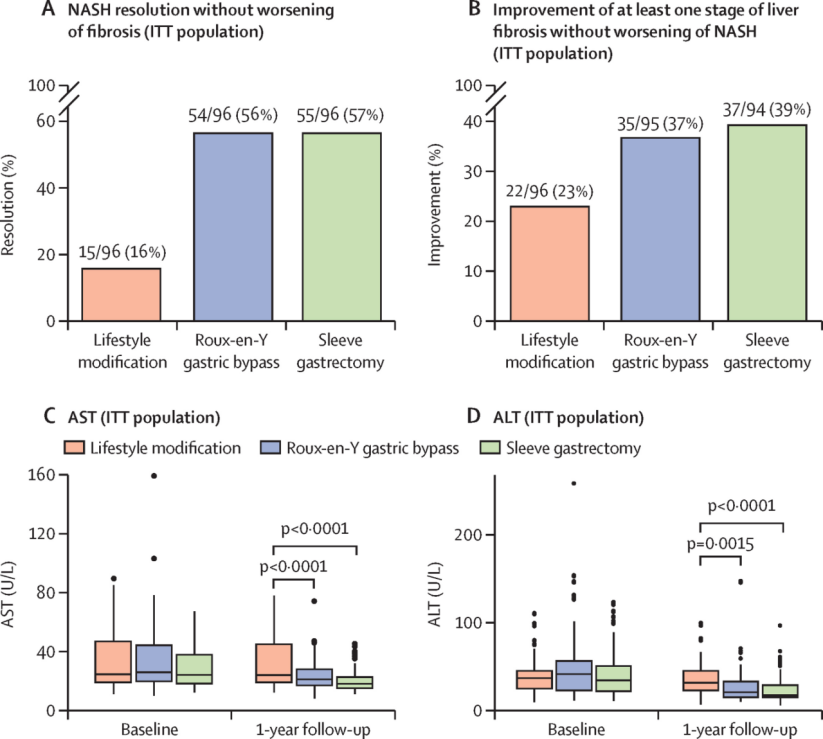
Figure 1 Primary Endpoint, Secondary Endpoint, Liver Enzyme Results
Another study explored the effectiveness of bariatric surgery in treating hypertension in obese patients, with the clinical endpoint being a reduction of at least 30% in antihypertensive medication and good blood pressure control after treatment intervention. After a 5-year follow-up, 80.7% of subjects in the Roux-en-Y gastric bypass group reached the clinical endpoint, while only 13.7% of subjects in the drug treatment (antihypertensive) group reached the clinical endpoint (Figure 2).
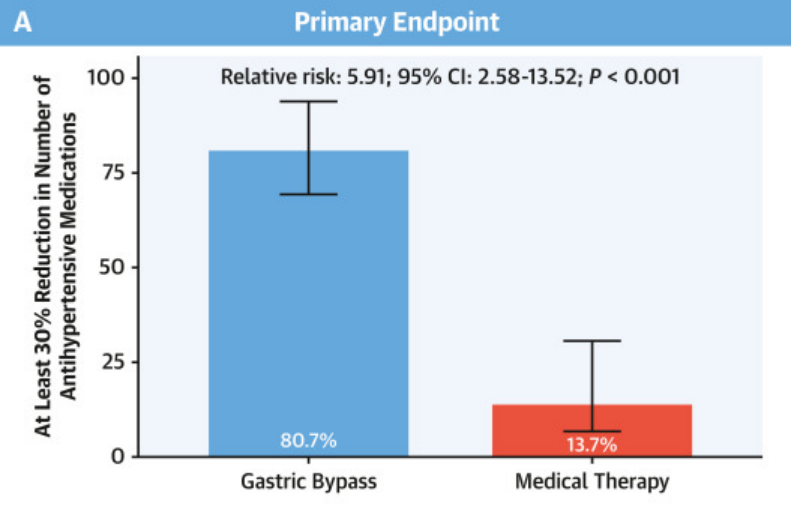
Figure 2
In summary, the application of bariatric surgery is superior to "traditional intensified drug treatment," Professor Zhang Peng concluded, but with the advent of AOM, the situation is gradually changing.
AOM is developing rapidly and setting new records
Professor Zhang Peng introduced, "In recent years, weight loss drugs based on the glucagon-like peptide-1 (GLP-1) target have been continuously developed, and the weight loss outcomes have set new records. These include GLP-1 receptor agonists liraglutide, semaglutide, glucose-dependent insulinotropic polypeptide (GIP)/GLP-1 dual receptor agonist tirzepatide, GLP-1/glucagon (GCG) dual receptor agonist mazdutide, GLP-1/GIP/GCG triple receptor agonist Retatrutide, and so on."
Multiple studies have confirmed the weight loss effects of AOM, such as the 11 STEP series studies of semaglutide, which show that it can achieve relatively ideal weight loss effects in different populations and significantly improve obesity-related cardiovascular outcomes. The main phase 3 randomized controlled trial (RCT) of tirzepatide, the SURMOUNT study, also shows that it can achieve excellent weight loss effects in various obese patients; in the SYNERGY and SUMMIT studies, its improvement in obesity-related comorbidities is also observed, including NASH, obstructive sleep apnea (OSA), and heart failure.
Future exploration of what constitutes "achieving weight goals"
Overall, the weight loss effect of AOM is about 10%-25%, while the efficiency of bariatric surgery is about 15%-35%, and weight loss medical devices are about 10%-20%. However, surgery with too high a weight loss efficiency can cause severe nutritional problems. Studies also show that after 3 and 5 years, the weight loss efficiency of Roux-en-Y gastric bypass is 26.8% and 23.4%, respectively, and sleeve gastrectomy is 20.2% and 18.6%, respectively. That is to say, the weight loss effects of the above several weight loss treatment methods are already very close, making it more difficult for clinical doctors to choose a plan.
Professor Zhang Peng pointed out that we need to consider how much the weight loss goal should be. For an obese patient with a body mass index (BMI) of 40kg/m2, after losing 15% or 20% of their weight, their BMI drops to 34kg/m2 or 32kg/m2, still belonging to the obese state. Is this weight loss sufficient? In addition, obese patients will also face the issue of "rebound" after weight loss. Therefore, as a disease, obesity needs to define "achieving treatment goals," which is one of the directions we need to explore in the future.
Professor Zhang Peng pointed out that weight loss treatment for obese patients can also apply the thinking of tumor treatment. Conventional treatment can first undergo surgery and then apply AOM to reduce weight to a normal state as much as possible, reducing the risk of weight regain, i.e., "adjuvant therapy"; for moderate to severe obesity, patients can undergo AOM weight loss first, followed by surgical treatment as "neoadjuvant therapy"; for drug-sensitive obesity or easily cured mild obesity, "curative treatment" can be achieved simply through AOM; and in the end-stage obesity where surgical risk is extremely high, systemic treatment is needed to control the progression of the disease and try to relieve obesity-related diseases, which is suitable for "palliative treatment" for incurable severe obesity. Moreover, obesity treatment in the future can also explore targeted therapy and immunotherapy patterns like tumor treatment, aiming to achieve weight "achieving goals" and truly reverse the disease.
Summary
Overall, for obesity-related metabolic diseases, bariatric surgery is superior to traditional "intensified drug treatment" (i.e., hypoglycemic drugs for diabetes and antihypertensive drugs for hypertension), and whether bariatric surgery or AOM is better still requires more clinical evidence to confirm.
At present, AOM is developing rapidly, with more and more new drug targets and increasing effectiveness, while the development of bariatric surgery is relatively slow. In the future, the combined application of surgery and drugs will be a major direction for exploration, and we will also focus on precise typing, accurate diagnosis, and precise treatment of obesity, and there is hope for achieving weight goals and reversing obesity-related metabolic diseases.
Reference:
[1] Verrastro O, Panunzi S, Castagneto-Gissey L, et al. Bariatric-metabolic surgery versus lifestyle intervention plus best medical care in non-alcoholic steatohepatitis (BRAVES): a multicentre, open-label, randomised trial. Lancet. 2023 May 27;401(10390):1786-1797. doi: 10.1016/S0140-6736(23)00634-7.
[2] Schiavon CA, Cavalcanti AB, Oliveira JD, et al. Randomized Trial of Effect of Bariatric Surgery on Blood Pressure After 5 Years. J Am Coll Cardiol. 2024 Feb 13;83(6):637-648. doi: 10.1016/j.jacc.2023.11.032.

