


Hypereosinophilic syndrome, or HES, is a disease with highly heterogeneous clinical manifestations. Its core features are eosinophilia and clinical symptoms mediated by eosinophils. Patients can present with a wide range of severity and often have involvement of multiple organ systems. Because HES is a rare disease, diagnosis and treatment are often seriously delayed. Since eosinophilic inflammation and the resulting end-organ damage occupy a central place in the pathophysiology of HES, treatment that precisely targets eosinophils and reduces them efficiently may bring greater clinical benefit to patients.
Benralizumab is a humanized monoclonal antibody that binds to the interleukin-5 receptor alpha subunit expressed on the surface of eosinophils. Through antibody-dependent cell-mediated cytotoxicity, it rapidly and efficiently reduces eosinophils in peripheral blood, bone marrow, airway sputum, skin, the esophagus, and gastrointestinal tissues. A phase 2 study conducted in patients with FIP1L1::PDGFRA fusion-negative HES showed that after 12 weeks of treatment, 90% of patients achieved a reduction of at least 50% in absolute eosinophil count from baseline, tissue eosinophil infiltration in patients with severe disease also improved, and the effect was sustained. On March 31, 2026, Nature Medicine published the results of the phase 3 NATRON study, which systematically evaluated the efficacy and safety of benralizumab versus placebo in patients with FIP1L1::PDGFRA fusion-negative HES.
Exacerbations Fell Sharply and Efficacy Was Confirmed: Benralizumab Reduced the Risk of HES Exacerbation by 65%
NATRON was a 24-week multicenter, randomized, double-blind, placebo-controlled phase 3 trial with an open-label extension. It enrolled patients aged 12 years or older with FIP1L1::PDGFRA-negative disease, an absolute eosinophil count of at least 1,000 cells/uL, a recent history of HES exacerbation, and stable treatment regimens. During the double-blind period, patients were randomly assigned to benralizumab 30 mg every 4 weeks (n = 67) or placebo (n = 66).
A total of 133 patients received at least one dose of study treatment, including 67 in the benralizumab group and 66 in the placebo group.
Baseline characteristics were generally balanced between the two groups and were consistent with those of the target HES population. Overall, 75.2% of patients had idiopathic HES and 12.0% had lymphocytic-variant HES. The median time from diagnosis to enrollment was 1.9 years, and the median number of exacerbations in the 12 months before enrollment was 2. In addition, before oral corticosteroid responsiveness assessment and randomization, the median absolute eosinophil count at enrollment was 1,600 cells/uL, and 76.7% of patients were receiving background systemic oral corticosteroids.
The study showed the following results:
Primary Endpoint
HES exacerbation was defined as clinical manifestations or laboratory abnormalities leading to an increase in oral corticosteroids to the equivalent of prednisone at least 10 mg per day for at least 2 days; the addition or increase of cytotoxic drugs and/or immunosuppressants; or hospitalization. Thirteen patients in the benralizumab group, or 19.4%, experienced HES exacerbation, compared with 28 patients, or 42.4%, in the placebo group. Compared with placebo, benralizumab significantly delayed the time to first HES exacerbation and reduced the risk of exacerbation by 65% (HR 0.35, 95% CI 0.18-0.69; P = 0.0024).
To assess the effect of background-treatment adjustments during the double-blind period on time to first exacerbation, the study conducted a sensitivity analysis. After censoring 9 patients with potentially relevant treatment changes at the time of treatment switching, including 5 in the benralizumab group and 4 in the placebo group, the results remained consistent with the primary analysis. In addition, across all prespecified subgroups, the benefit of benralizumab versus placebo was consistent and uniformly favored the benralizumab group.
Key Secondary Endpoints
At week 24, 22.4% of patients in the benralizumab group, or 15 of 67, had experienced HES exacerbation or withdrawn from the study, compared with 45.5% of patients in the placebo group, or 30 of 66. Compared with placebo, benralizumab reduced the risk of exacerbation or study withdrawal by 69% (OR 0.31, 95% CI 0.14-0.69; P = 0.0033) and reduced the proportion of patients with exacerbation by 52% (RR 0.48, 95% CI 0.29-0.80; P = 0.003).
With respect to the annualized HES exacerbation rate, the rate in the benralizumab group was 0.41 per year, a 66% reduction compared with 1.23 per year in the placebo group (RR 0.34, 95% CI 0.18-0.63; P = 0.0008).
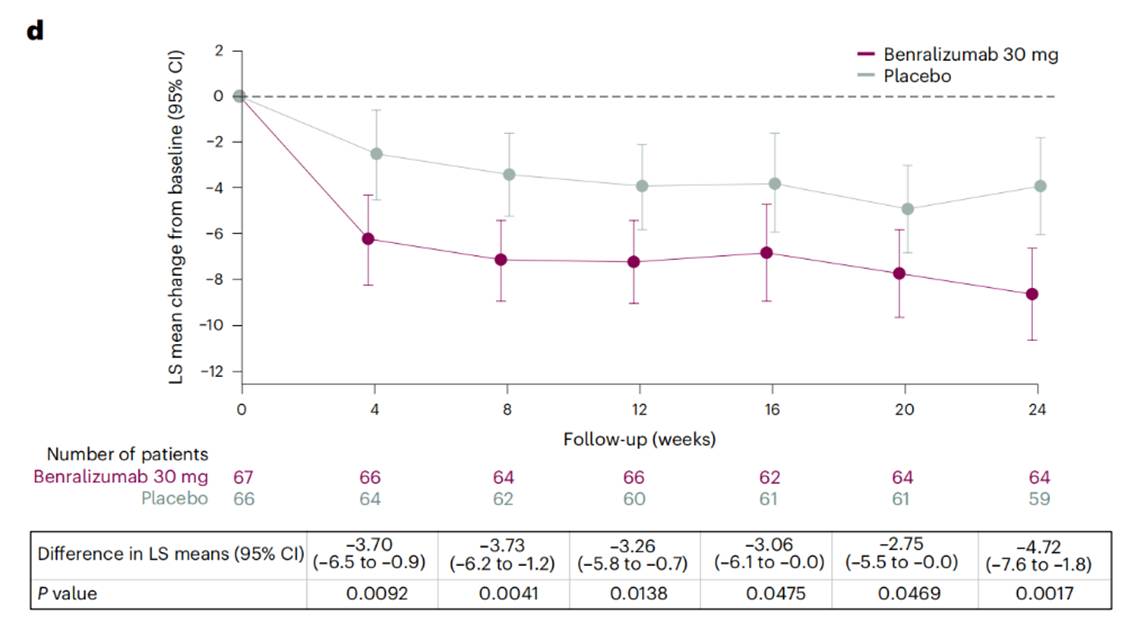
At week 24, the least-squares mean change from baseline in PROMIS fatigue score was -8.6 points (95% CI -10.6 to -6.6) in the benralizumab group and -3.9 points (95% CI -6.0 to -1.8) in the placebo group. The difference in least-squares means between groups was -4.72 (95% CI -7.64 to -1.80; P = 0.0017). This difference was already apparent at the first assessment at week 4, suggesting that benralizumab can improve fatigue rapidly and durably.
Other Secondary Endpoints
The proportion of patients with hematologic relapse or study withdrawal was only 9.0% in the benralizumab group, or 6 of 67, versus as high as 63.6% in the placebo group, or 42 of 66 (OR 0.05, 95% CI 0.02-0.13; P < 0.0001). At the same time, during the 24-week period, 91.0% of patients in the benralizumab group, or 61 of 67, maintained an absolute eosinophil count below 500 cells/uL, compared with only 12.1% in the placebo group, or 8 of 66 (OR 87.87, 95% CI 26.09-295.97; P < 0.0001).
During the double-blind period, the proportion of patients who required an increased corticosteroid dose was also lower in the benralizumab group, at 25.4% or 17 of 67, compared with 48.5% or 32 of 66 in the placebo group (OR 0.35, 95% CI 0.16-0.73; P = 0.005). The cumulative oral corticosteroid dose was likewise lower, with a least-squares mean difference between groups of -344.9 mg (95% CI -637.6 to -52.3; P = 0.0213).
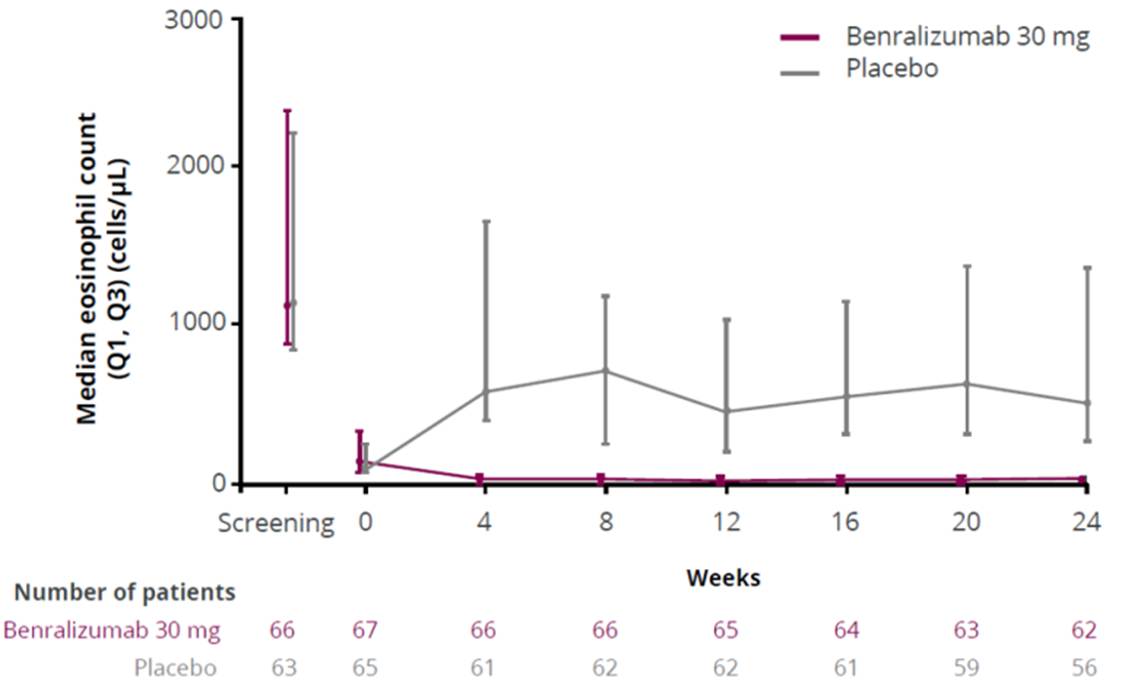
After the protocol-specified oral corticosteroid responsiveness assessment, blood eosinophil levels had declined in both groups at randomization. Notably, after treatment, blood eosinophils in the benralizumab group were reduced rapidly and efficiently and remained at low levels, whereas eosinophil levels in the placebo group rose again and remained higher than those in the benralizumab group throughout the double-blind period.
Safety Assured and Tolerability Good: The Safety Profile of Benralizumab Was Consistent With Known Data
During double-blind treatment, the proportions of patients experiencing adverse events were similar in the benralizumab and placebo groups, at 64.2% and 66.7%, respectively. The most common adverse events were headache (16.4% in the benralizumab group and 7.6% in the placebo group), upper respiratory tract infection (7.5% and 7.6%, respectively), and COVID-19 (6.0% and 6.1%, respectively). Five patients in each group experienced serious adverse events, and all were judged unrelated to the study drug. Overall, the safety profile of benralizumab was consistent with its known data and was also favorable in adolescent patients.
Summary
· Benralizumab significantly delayed time to first HES exacerbation and reduced exacerbation risk by 65% versus placebo.
· The annualized exacerbation rate in the benralizumab group was only 0.41, a 66% reduction from 1.23 in the placebo group.
· Improvement in fatigue score was evident by week 4 and was sustained through week 24.
· Ninety-one percent of patients maintained an absolute eosinophil count below 500 cells/uL, with blood eosinophils approaching zero.
· Safety was good, with adverse-event rates similar to those in the placebo group, and adolescent patients also tolerated treatment well.
Overall, the study further confirms the central role of eosinophils in the pathophysiology of HES and provides strong evidence in support of the therapeutic strategy of targeted eosinophil suppression. The findings show that benralizumab offers both good efficacy and good safety in patients with FIP1L1::PDGFRA-negative HES, and that clear clinical benefit can be observed early in treatment. This is particularly important for patients with active organ involvement who urgently need disease control, and it provides a new feasible option for rapidly stabilizing the condition in clinical practice.
Reference:Princess U. Ogbogu, Florence Roufosse, Praveen Akuthota, et al. Benralizumab versus placebo for hypereosinophilic syndrome: a randomized, placebo-controlled phase 3 trial. Nature Medicine. Published: 31 March 2026. https://doi.org/10.1038/s41591-026-04315-8.

