


The “supermale syndrome” has once again hit the hot search. This time, the voice of “abortion” is still loud and clear.
Recently, according to “Jiu Pai News” and other media reports, a pregnant woman in Sichuan Province in the maternity test detected a fetus suffering from “supermale syndrome”, more than 100,000 netizens advised her to “abortion”. 20 July. The pregnant woman's family said on the Internet that the termination of pregnancy had been completed.
Before this, “supermale syndrome” has been on the hot search many times, netizens advised “abortion” voice each time the majority, the reason is that “supermale syndrome” children grow up to be violent personality, more likely to commit crimes. The reason is that children with “supermale syndrome” will grow up to be violent and more likely to commit crimes.
Dr. Lin Lin of the Department of Obstetrics and Gynaecology at the Sixth Affiliated Hospital of Sun Yat-sen University told "MedJ" that the scary violent tendencies and antisocial personalities highlighted on the Internet are in the minority. Most people with “supermale syndrome” are not very different from normal people.
Do I have to have an “abortion” if I detect “supermale syndrome”?
Prior to the termination, the pregnant woman had posted a prenatal diagnostic report card online. The report card indicated that the fetus was 25 weeks and 5 days old, and that amniocentesis revealed a high number of Y chromosomes in the sample, presumed to be XY and XYY chimerism, or some other complex karyotype.
The pregnant woman asked on the Internet what she should do, and a large number of netizens advised her to terminate the pregnancy. Some netizens said that the “super male” child has one more Y chromosome than an ordinary male, and there is a high probability that he will have a violent personality, do things with a strong aggressiveness, and even have a clear anti-social personality. There are also netizens who support “abortion”, saying that the point of taking a pregnancy test is not to screen out unstable factors and leave behind quality genes?
This is not the first time that the “supermale syndrome” has hit the hot search. Earlier this year, after the release of the movie “Crossing the Angry Sea”, the character Li Miaomiao in the movie and the “Chaoxiong Syndrome” triggered discussions among netizens. At that time, a large number of netizens also said that fetuses with “supermale syndrome” should not be born because such children are more likely to become criminals in the future.
The link between “supermale syndrome” and crime can be traced back to the 1960's. In 1965 and 1966, American geneticist Patricia Jacobs published articles in Nature, The Lancet, etc., claiming that males carrying the XYY chromosome are more likely to become criminals than the general public. According to her research, the rate of “supermale syndrome” in the general population is about 1 per 1,000, but the detection rate in male criminals is as high as 20%.
In the following years, scientists “replicated” similar studies and found that males with sex chromosome XYY were particularly common in prisons and psychiatric hospitals. As a result, a hypothesis slowly emerged: patients with “supermale syndrome” lacked self-control, had poor emotional control, were aggressive, aggressive, had antisocial behavior, and were prone to crime.
Although some scientists have since pointed out that such studies are too small, unrepresentative and do not take into account both genetics and the environment, such calls have not been able to reverse the dominant view in academia and society. Many media reports have dramatized the issue and referred to carrying the XYY sex chromosome as “Superman Syndrome”, and the idea that XYY males are more likely to harm others and even commit crimes has become increasingly popular.
However, as research progressed, scientists gradually realized that there was no significant correlation between “supermale syndrome” and crime. 1990 onwards, a study began to follow children with “supermale syndrome” from birth onwards, and found that they may have a slightly lower IQ, and have some difficulty learning, but they are not “born criminals”. They may have a slightly lower IQ and some learning difficulties, but they are by no means “born criminals”.
“Currently, 'supermale syndrome' is widely recognized as a complex congenital physical and mental disorder, and the intellectual development of some patients may mildly lag behind that of their peers, leading to their learning difficulties and poor academic performance.” Wang Liquan, director of the obstetrics department at the Second Hospital Affiliated to Zhejiang University School of Medicine, told "MedJ".
In addition, due to an underlying susceptibility to neuropsychiatric abnormalities, the “supermale syndrome” may affect patients' social adjustment and negatively impact their quality of life.
Lin Lin, who has many years of experience in genetic counseling, told "MedJ" that according to the National Health Commission, if a pregnant woman's prenatal ultrasound examination reveals six categories of lethal malformations that can lead to the death of the fetus, including anencephaly, severe brain enlargement, severe open spina bifida, severe abdominal wall defect with visceral ectropion, single-chambered heart and lethal chondrodysplasia, doctors should recommend termination of the pregnancy. chondrodysplasia, the physician should recommend termination of the pregnancy.
In addition, serious genetic diseases such as thalassemia major may lead to fetal death, poor prognosis for newborns, and the medical care of patients may incur huge family and social burdens, and once diagnosed, doctors will also advise pregnant women and their families to consider termination of pregnancy.
“'Hyperextension syndrome' is not a lethal disease and has a relatively good prognosis, and is not an absolute medical indication for termination of pregnancy.” Lin Lin said. She emphasized that according to China's laws, the decision to keep the fetus or not belongs to the pregnant woman herself and her husband (or the biological father of the fetus). For the vast majority of non-fatal malformations or chromosomal abnormalities, a physician qualified in genetic counseling should explain the manifestations of the disease and its prognosis, and assist the pregnant woman and her family to make a decision with full knowledge and understanding.
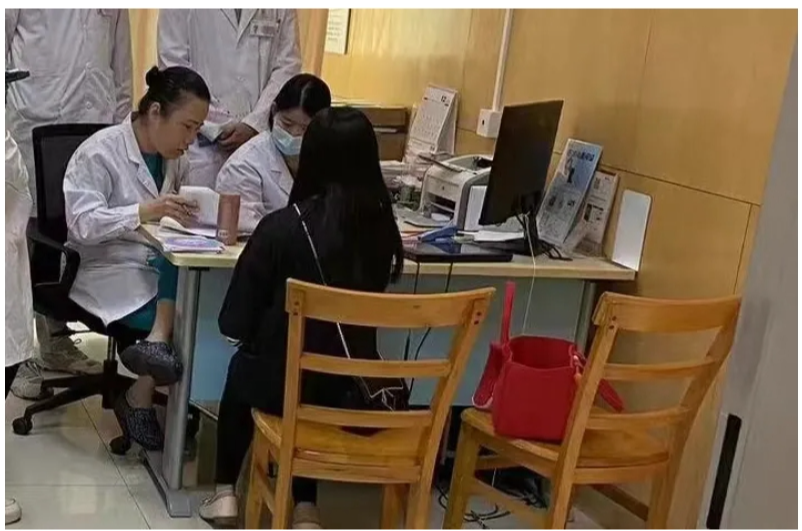
Fig.1 Dr. Lin Lin (far left) in an obstetrics clinic. Photo by the interviewee
“We have also met some pregnant women who finally got pregnant after several IVFs, only to be found to be 'supermale' and unwilling to give up.” Wang Liquan told "MedJ" that he would tell pregnant women and their families about possible complications and other things to help them think and make decisions.
Other complications require clinical intervention
Although XYY syndrome does not fall into the absolute category of pregnancy termination, patients may have varying degrees of physical and psychosomatic abnormalities. The Brenner Encyclopedia of Genetics (Second Edition) describes the incidence of XYY in males as 1 in 1,000. Patients usually have normal appearance, sexual development, and fertility, but may have above-average height and are at risk for cognitive, language, and behavioral deficits.
Some studies have shown that people with “supermale syndrome” have a quantifiable average reduction in IQ deficits of about 10 percent compared to their siblings. Other studies have found that people with “supermale syndrome” have a higher risk of developing autism spectrum disorders than normal, with a higher likelihood of symptoms such as anxiety and depression. This may be due to the fact that such patients are more likely to have a specific gene that is associated with social reactivity and autistic symptoms.
Some patients with “supermale syndrome” may have varying degrees of sperm defects, manifested as severe oligospermia or azoospermia. Delayed development of sexual characteristics or small testes, as well as an increased incidence of epilepsy and oral disease, have also been reported.
Children with “supermale syndrome” are also at higher risk for structural malformations. A review article in China cited data from the Shenzhen People's Hospital, which noted that of the 26 children diagnosed prenatally with “supermale syndrome”, three had abnormal prenatal ultrasound and two had no abnormal prenatal ultrasound but were found to have structural malformations after birth.
But in Linlin's view, these risks are not unmanageable. The severity of the disease (disease phenotype) of “supermale syndrome” depends mainly on the patient's own chromosomal karyotype, and some patients may have no manifestations throughout their lives, but only because of other diseases and accidentally found abnormal. “At present, many medical institutions in China have carried out early childhood development training and psycho-spiritual rehabilitation treatment, which can help patients with psycho-neurodevelopmental abnormalities to realize the goal of social functioning and quality of life as much as possible to be the same as or close to normal people.”
Is it necessary to test for “supermale syndrome”?
After the “supermale syndrome” rushed to the hot search, some netizens said that their own pregnancy should also take the initiative to do a test to see if the fetus has “supermale syndrome”.
However, Wang Liquan told the"MedJ", for “supermale syndrome” test is not in the scope of the routine obstetric examination. Unless a pregnant woman has a clear indication for prenatal diagnosis, she will not be specifically screened.
Lin Lin also said that the incidence of “supermale syndrome” is very low, although the performance of typical patients is daunting, most patients and normal people do not have much difference, and will not have a negative impact on family life and social order. Therefore, there are no laws, regulations or industry guidelines or consensus emphasizing the need for targeted testing for “supermale syndrome”.
What are the circumstances under which a clinician's permission for prenatal diagnosis can be obtained? According to Wang Li-Quan, conditions that may suggest a pregnant woman for prenatal diagnosis include either spouse having been tested for a chromosomal genetic abnormality; having a history of giving birth to a baby with severe congenital defects; exposure to radiation and other substances that may cause birth defects in the fetus during early pregnancy; abnormal development or suspected malformations of the fetus; and a pregnant woman who is over the age of 35 and has too much or too little amniotic fluid.
Broadly speaking, prenatal diagnosis covers a wide range of methods, categorized into invasive and non-invasive forms. Non-invasive tests mainly refer to diagnostic imaging such as ultrasound and magnetic resonance. Usually, the public is familiar with prenatal diagnosis as invasive and invasive tests, such as chorionic villus sampling (chorionic villus penetration), amniocentesis (amniocentesis) and umbilical vein puncture (umbilical puncture). Wang Li-Quan explained that imaging tests mainly look at the fetus to see if there are any developmental malformations of the organs. The “supermale syndrome” is a chromosomal abnormality, which must be diagnosed through invasive and invasive tests.
In recent years, maternal awareness of prenatal diagnosis has been significantly strengthened, and more and more pregnant women are taking the initiative to consult their doctors about prenatal diagnosis. Wang Liquan said that in addition to the “super male syndrome”, other chromosomal problems, including women with more than one X chromosome superfemale syndrome, men with more than one X chromosome Kirschner's syndrome, women with less than one X chromosome Turner's syndrome and so on, in the prenatal diagnosis of clinical work is not uncommon.
The increase in the number of women with advanced pregnancies and technological advances that have helped many couples with genetic diseases and carriers of disease-causing genes, who were previously unlikely to have children, realize their desire to have their own biological children have brought new challenges to prenatal diagnosis. “Knowledge of eugenics is becoming increasingly popular, publicity on birth defect prevention and treatment is stronger, and the state has relevant financial subsidies to help women in need to complete prenatal diagnosis. With more people doing it, we are indeed under more pressure than before. But for the sake of the health of the next generation, it is worthwhile to work even harder. We also have to continue to work hard and study our skills to provide better prenatal diagnosis services for pregnant women.” Lin Lin said.
Reference:
1.P A Jacobs, et al. Aggressive behavior, mental sub-normality and the XYY male. Nature. 1965, Dec 25;208(5017):1351-2. doi:10.1038/2081351a0.
2.L Re, et al. The 47,XYY syndrome, 50 years of certainties and doubts: A systematic review.Aggression and Violent Behavior. DOI:10.1016/j.avb.2015.02.003
3.L Margari, et al. Autism spectrum disorders in XYY syndrome: two new cases and systematic review of the literature. European Journal of Pediatrics. DOI:10.1007/s00431-014-2267-9
4.https://www.sciencedirect.com/topics/biochemistry-genetics-and-molecular-biology/xyy-syndrome
5.高莎,等. XYY综合征患儿的认知. 中华妇幼临床医学杂志. 2019,15(04):459-462.
6.石苇,梁灼健,纪媛君,等.胎儿Y染色体增多的产前诊断以及遗传咨询[J].中国产前诊断杂志(电子版), 2021, 013(003):17-23.

