


More than half of hypercholesterolemia patients worldwide fail to reach guideline-recommended LDL-C targets. Statins laid the foundation, injectable PCSK9 inhibitors added firepower, but needle aversion remains a barrier. Now, Merck's Phase III CORALreef AddOn data show its oral PCSK9 inhibitor Enlicitide (MK-0616) reduced LDL-C by 64.6% from baseline at 8 weeks in patients already on other oral non-statin therapies.
Enlicitide's Differentiated Advantage
The CORALreef AddOn trial was a multicenter, randomized, double-blind, placebo-controlled Phase III study evaluating Enlicitide versus other oral non-statin agents (ezetimibe monotherapy, bempedoic acid monotherapy, and ezetimibe plus bempedoic acid) in adults with hypercholesterolemia who had a history of, or risk factors for, atherosclerotic cardiovascular disease (ASCVD).
On a background of statin therapy, Enlicitide achieved a mean 64.6% LDL-C reduction at 8 weeks. Its LDL-C-lowering magnitude exceeded bempedoic acid by 56.7 percentage points, ezetimibe by 36 percentage points, and the bempedoic acid plus ezetimibe combination by 28.1 percentage points. For key secondary endpoints, apolipoprotein B (ApoB) fell by 54.6% and non-HDL-C by 58.0%.
PCSK9 binds to LDL receptors on hepatocytes and promotes their degradation, reducing LDL-C clearance. PCSK9 inhibitors block this interaction, preserving receptor density and enhancing hepatic LDL-C uptake. Existing injectable PCSK9 inhibitors deliver strong efficacy but require biweekly or monthly injections, limiting compliance.
Enlicitide is the first oral PCSK9 inhibitor to enter Phase III trials and report positive data. Its macrocyclic peptide structure retains high binding affinity for PCSK9 while resisting gastrointestinal enzymatic degradation, enabling oral bioavailability and fundamentally improving dosing convenience.
Reshaping the Competitive Landscape
Cardiovascular disease remains the leading cause of death globally. In China, dyslipidemia prevalence among adults reached 38.1% during 2020-2022, and most ASCVD high-risk patients fall short of LDL-C targets. Statins remain the cornerstone of therapy, but doubling any statin dose yields only an additional 6% LDL-C reduction.
Currently marketed injectable PCSK9 inhibitors include Amgen's evolocumab (biweekly), Sanofi/Regeneron's alirocumab (biweekly), and Novartis's inclisiran (biannual). LDL-C reductions for these agents range from 50% to 70%. Enlicitide's 64.6% reduction matches this efficacy range with the added benefit of oral dosing. Alirocumab generated approximately $526 million in 2025 (up 9.3% YoY); inclisiran reached $1.198 billion (up 57%). Enlicitide's oral formulation could capture significant share by removing the injection barrier.
Credit Suisse estimated Enlicitide's peak sales at $5 billion; Scotiabank projected peak revenues in the tens of billions, calling it one of Merck's most undervalued pipeline assets. In December 2025, the FDA granted Enlicitide a Commissioner's National Priority Review Voucher (CNPV).
Merck's Cardiovascular Strategy
Merck has over 70 years in cardiovascular medicine, having developed lovastatin, simvastatin, and ezetimibe. With Keytruda facing patent expiry in 2028 and HPV vaccine growth slowing, the company designated cardiovascular disease as a core growth pillar in 2022, targeting eight new therapies by 2030 with combined peak sales exceeding $10 billion.
The 2021 acquisition of Acceleron Pharma (~$11.5 billion) secured sotatercept, approved by the FDA in March 2024 as the first activin signaling pathway inhibitor for pulmonary arterial hypertension. Sotatercept generated $419 million in year one and $1.443 billion in 2025, with analysts projecting $5 billion+ by 2030.
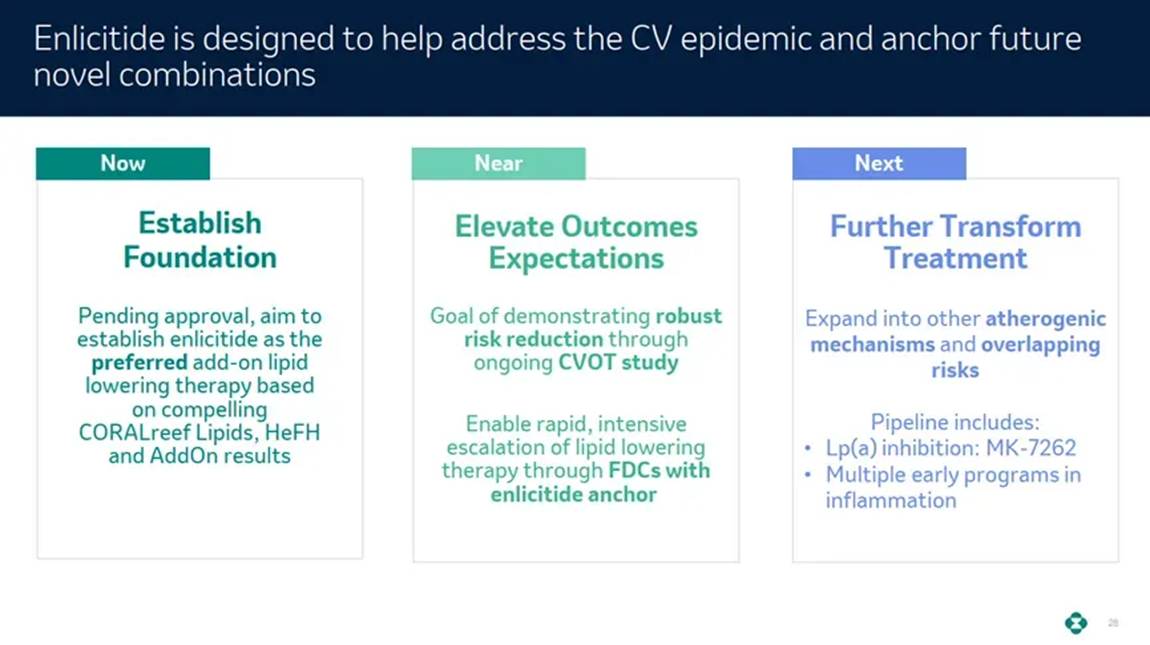
Merck has outlined a three-phase strategy for Enlicitide. Phase one establishes it as the preferred add-on therapy via the CORALreef Lipids, HeFH, and AddOn trials (earlier data showed 50%-60% LDL-C reductions at 24 weeks). Phase two targets cardiovascular outcomes through the CORALreef Outcomes mega-trial. Phase three expands indications through combination with the Lp(a) inhibitor MK-7262 (HRS-5346) and other novel agents.
Merck has also pursued external deals: a global license for Hansoh's oral GLP-1 agonist HS-10535 (late 2024) and a ~$2 billion agreement with Hengrui for ex-Greater China rights to the oral Lp(a) inhibitor HRS-5346 (March 2025).
Outlook
If approved, Enlicitide would validate oral macrocyclic peptides as a viable drug modality and provide a reference path for oral biologics. For Merck, it would advance the company toward its 2030 cardiovascular revenue target and diversify its portfolio beyond oncology and vaccines.

