


In July this year, a study revealing a brand-new mechanism for kidney cancer treatment was reported on the cover of the Science sub-issue. It is a SCI paper of CAS Zone 1 TOP and a master's thesis. The first author is Li Zhongbo, a graduate student from Xinxiang Medical College. He has just been proposed to be admitted as a doctoral student in Surgery with the direction of Oncology by China Medical University.
7 years, a medical student can do scientific research to what point? The answer given by Li Zhongbo is 12 SCIs, 4 of which he is the first author/corresponding author (including co-authors), 3 of the Chinese Academy of Sciences (CAS), 1 of the second area, 4 total impact factor of 39.658, which is a lot of doctoral graduates, and even senior doctors can not reach.
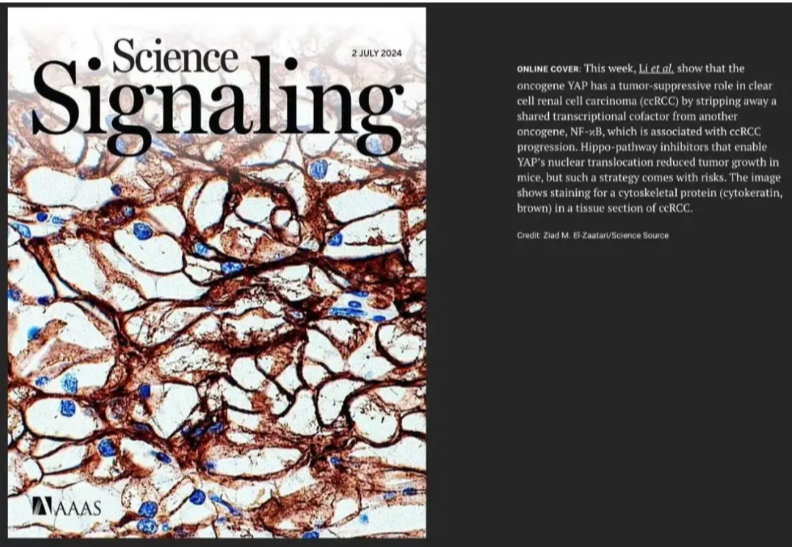
Fig.1 In July 2024, C.B. Lee's research was reported on the cover of Science Signaling
Outstanding Graduates of Henan Province, Innovation Star of Postgraduates of Henan Province, First Class Scholarship for three consecutive years, approved a national invention patent, various types of academic report competition awards is to get "soft", "scientific research hanging" behind, is Li Zhongbo play life like hard work. From the beginning of college, Li Zhongbo almost did not have a complete weekend, vacation other students go home, he still stayed in the laboratory and "experimental cancer cells as a companion".
The employment of medical students is becoming more and more voluminous, and Li Zhongbo's starting point is not high, to achieve today's results, there is luck, but also hard work. Li Zhongbo used to have a famous school complex, think "can not go to 211 life is ruined". But now he said, if we go back to the past, even if the score enough to get 211 institutions, he did not go.
Below is a blurb from C.B. Lee: Undergraduates doing research
Unlike those who have had the "medical dream" since childhood, I didn't know much about medicine when I filled out my application at the end of the college entrance examination, and no one in my family was engaged in this profession. I originally wanted to go to Zhengzhou University, which is the only 211 institution in Henan. But I didn't do well and was very frustrated, feeling that my life was ruined if I didn't get into the 211.
I finally chose medicine because I instinctively felt that this specialty might be easier to employ in the future. However, when I applied for the clinical medicine-related majors of Xinxiang Medical College, my score was not enough for the clinical-related majors either, so I ended up choosing the medical testing technology major.
When I first enrolled in school, I did not have much so-called ideal and career planning. Later on, I became interested in medical research and published so many articles thanks to the special teaching and training system of the university. Our major has a research innovation class program, which selects 20 students from freshmen every year and assigns them one-on-one with a doctoral degree research mentor, which is equivalent to receiving postgraduate training in the first year of college.
Many people participate in this program because they think it is always good to have more learning opportunities, and it may also be helpful for further education in the future, but they did not expect that research would be so hard. Our professional class is at 8:00 in the morning, and we have to rush to the lab after lunch. If we had a class in the afternoon, we had to go to class again, otherwise we had to stay until the evening. Because of the novelty, we all thought it was nothing at first, but later on, nearly half of the people in our class dropped out of the program.
Every weekend, roommates can play games in the dormitory, or about to go to dinner, singing, and I still have to do experiments in the laboratory, winter vacation can only take a spring break. After the end of the college entrance examination I bought a game laptop, was ready to play League of Legends with everyone, I did not realize that later this computer is loaded with all the experimental data.
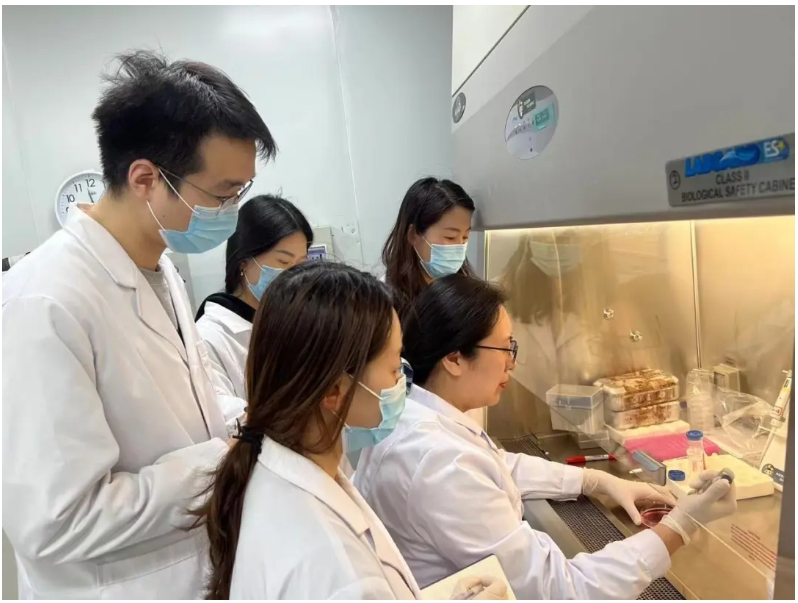
Fig.2 Li Zhongbo and his classmates carry out experiments under the guidance of instructor Zhuang Ting
When I first entered the lab, I was helping my older siblings, learning how to think about research projects and some basic lab operations. My mentor, Prof. Ting Zhuang, is an oncologist, and in the second semester of my sophomore year, she gave me a project to study new therapeutic targets for triple-negative breast cancer, and asked me to design my own plan and arrange the time to advance the project.
The challenge of this project was very great. I didn't know where to start, not to mention that many of the experimental operations involved I had never touched before, and I felt very confused at first. Thanks to my mentor, she gave us advice on the problems we encountered in the experiments at the weekly group meetings, guiding us on how to proceed step by step, what literature we needed to consult and what preparations we needed to make.
Triple-negative breast cancer is one of the deadliest subtypes of breast cancer, and to date there is a lack of effective therapeutic targets, with most patients relying on chemotherapy. I worked on this topic for 4 whole years and didn't publish it until graduate school. It confirms that the overexpression of a protein called RBCK1 can inhibit the progression of triple-negative breast cancer cells in vivo and in vitro, providing a new and feasible direction for the targeted treatment of triple-negative breast cancer cells.
I think most students have the same feeling that "choosing the right tutor" is sometimes even more important than "choosing the right specialty". The atmosphere in our lab is particularly good, regardless of seniority and reputation, encouraging innovation and not robbing the results, whoever contributes more will be a work. The fact that the payoff is proportional to the contribution is one of the important reasons for me to keep going.
I have not thought about transitioning to the clinical direction, I even went to the hospital laboratory internship in my junior year of college. But now the employment of medical students is really too voluminous, for students like us who are not top medical schools, even graduate students are very difficult to enter the "big hospitals". Undergraduates can either go to primary hospitals or go to enterprises to do sales. I hope that I can make some achievements in my specialty, the clinical path is not feasible, then rely on their own efforts, there is always hope in the direction of research.
During the four years of my undergraduate study, I was involved in publishing a total of three SCIs, which gave me a solid foundation for my scientific research ability, even though I was only the ninth or tenth author. Sometimes when I return to my dormitory in the middle of the night, I see my roommates playing games with the lights on, and I get the itch to play a couple of games. But when I think of waking up early tomorrow to do experiments, I can't help but shuffle off to bed.
Cover story for a subissue of Science
I never thought I had any "medical talent", not the kind of "genius" who could get good grades just by reading a little. Because I spent a lot of time in the lab, I was on the verge of failing almost every year for four years of undergraduate study, and I ended up with an average GPA of just over 2 points, which ranked me relatively low in the whole program.
The scientific research and innovation class allows senior students to suspend their experiments for half a year and devote themselves to the examination for higher education. Because of the professional courses in front of too much left behind, that half a year I went to the library at 7:00 am every day, after 11:00 pm back to the dormitory, in addition to eating and sleeping, the other time is all in the book, a lot of knowledge from the freshman start to memorize again.
In the end, I scored the first place in the whole program, more than 100 points higher than the national line. I still enrolled in Professor Zhuang Ting's graduate school and continued to study tumor-related experiments in the School of Medical Technology.
If undergraduates can still approach scientific research with the mindset of learning, then graduate students who want to make achievements must have the mindset of a leading researcher and be fully responsible for the research project. Our laboratory is on another campus, those three years just in time for the epidemic, sometimes there is a suspected case in the neighborhood, can not get out of the school, a few days later all the cells raised dead, and have to start again from scratch to do.
I have been working on that project since I was an undergraduate, and I started to submit the manuscript in the first semester of my first year of study, and in the middle of it, I was rejected many times, and I was asked to further revise and improve the data. Sometimes I questioned my choice, whether I had the talent to do research or not, and the pressure was very strong. At that time, the only way for me to vent my emotions was to take time to exercise and clean up my mind before re-entering the experiment.
In October 2022, this article was finally published in the journal of Chinese Academy of Sciences (CAS), with an impact factor of 7.525, knowing that at that time, the project of the first-year freshmen had just started, and my paper had already been published. It is hard to describe the excitement, this article poured my four years of hard work and effort, and finally got the return.
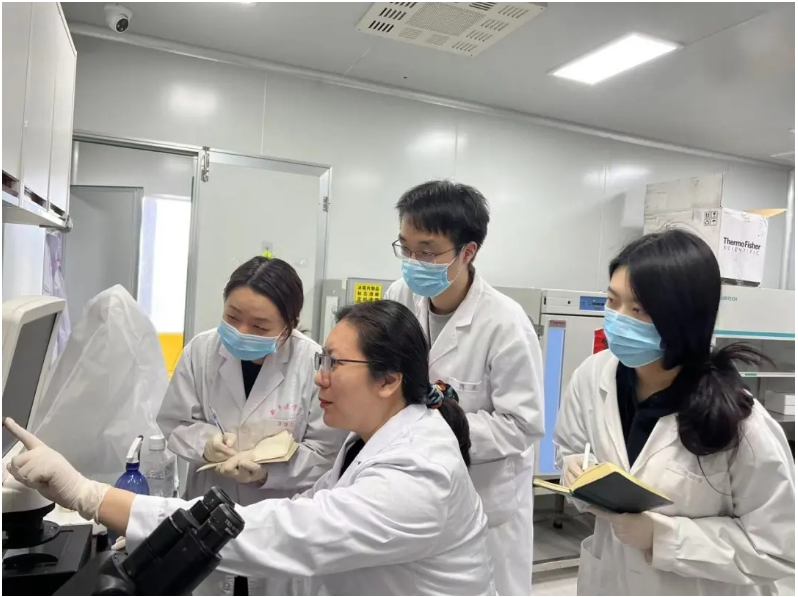
Fig.3 Li Zhongbo and his classmates carry out experiments under the guidance of instructor Zhuang Ting
Another project of my graduate school is to study the growth mechanisms and therapeutic targets of renal cancer. Previously, my teachers, Prof. Jian Zhu and Prof. Ting Zhuang, discovered the phenomenon that over-activation of YAP protein can inhibit renal clear cell carcinoma cells. They gave me this topic and encouraged me to further investigate the mechanism mechanism behind it and to confirm this conjecture through scientific experiments.
During the experiment, it involves a kind of experiment called CHIP-seq, which is used to study the interaction between proteins and DNA in vivo. The learning curve of this technique is high and the operation process is tedious. I have never been in contact with it before, and I gradually figured it out by checking the literature a little bit, asking people everywhere, and doing experiments over and over again. At one time, I used more than half of the cell culture dishes and culture reagents in the whole lab.
This year, the article was featured on the cover story of a Science subissue, which involved a great deal of brand new experimental data and mechanisms. Professor Leslie Ferrarelli, a postdoctoral fellow at the National Institutes of Health and senior editor of Science Signaling, wrote that while YAP protein is traditionally associated with tumor progression, our study confirms that activation of the YAP protein inhibits renal clear cell carcinoma in mice, which is a "counterintuitive" and innovative finding. This is a "counterintuitive" and innovative finding.
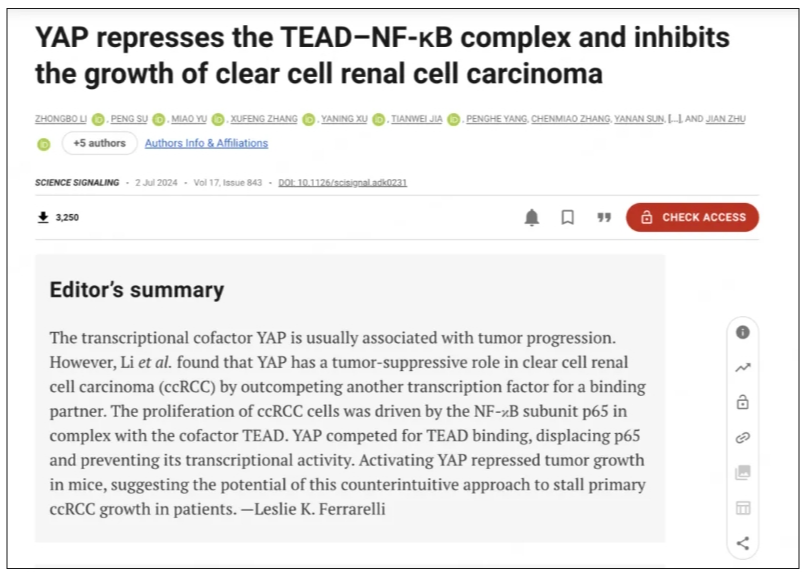
Fig.4
During my graduate studies, I also co-authored two SCIs as co-authors/corresponding authors on gastric cancer, and I was mainly responsible for designing the experimental routes, coordinating the process, keeping an eye on the different phases of the experiments and adjusting the routes in a timely manner.
There is no shortcut to all this work, it is all "smashed" out with time and experience. During the whole 7 years, I traveled only a handful of times, and seldom went home during summer and winter vacations. I am not a "top student", but my greatest strength is diligence, spending a lot of time to search and organize the literature, reviewing every failure and summarizing the lessons learned, and communicating with my mentor in a timely manner, which is what I am good at.
A New Journey, Doctor of Oncology
Not long ago, I passed the selection test of China Medical University and was admitted as a doctoral student in the field of oncology in Surgery, supervised by Prof. Zhu Jian. Prof. Zhu Jian has been maintaining research cooperation and communication with our lab, and his guidance has helped me a lot during my graduate stage.
Medical research is a very abrasive job, it will force you to give up a lot of hobbies, every day between the dormitory and the laboratory two point one line. I didn't have a colorful college life, but I don't regret it.
Henan this year, there is a three hospital testing professional recruitment, I heard that there are more than 500 people enrolled, Concordia, Fudan, Wudan ...... what famous school students have come. And unlike those first echelon medical school graduates, my starting point is not high, to achieve today's results, I feel that all their efforts are worthwhile.
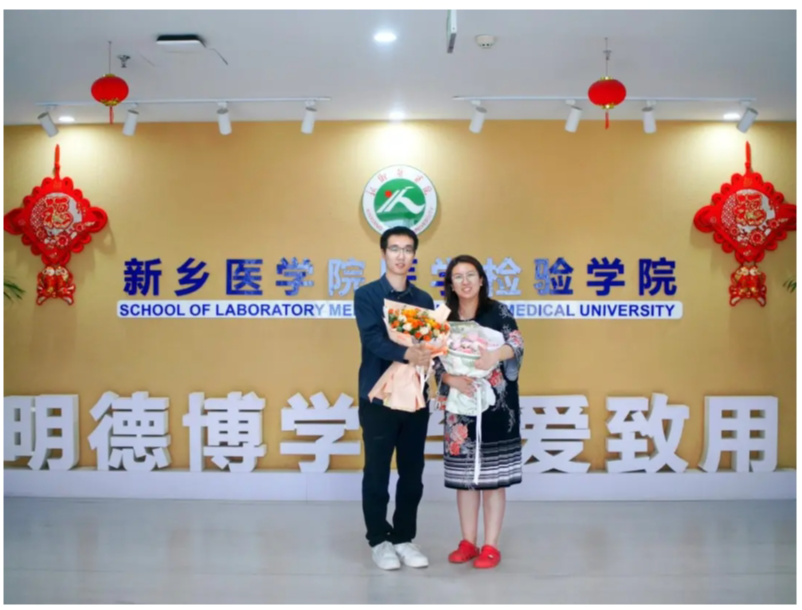
Fig.5 Li Zhongbo graduated from his master's degree and took a photo with his supervisor, Prof. Zhuang Ting
At the same time, after experiencing the hardships of scientific research, I admire those doctors who can balance clinical and scientific research even more. I have met many surgeons who have to do surgery, manage patients, participate in teaching during the day, do research and literature checking during the day, and can't stay idle at night. Compared with them, I feel that I am much more relaxed.
Seven years of research has also made me realize more deeply how important a good mentor is. I often think that if I hadn't met Mr. Zhuang Ting and Mr. Zhu Jian, and hadn't had their guidance and encouragement, I might not have been able to persist in my research, and gradually lost my interest in research, and just wanted to get through to graduation. From this point of view, I feel that I am very lucky.
Regarding my next PhD study, I hope to further research on more practical tumor therapeutic targets that can be transported to the clinic. I am ashamed to say that despite all the publications, I have not yet been exposed to clinical translation, and my results are only at the laboratory level.
My resume is not destined to be a clinician. However, I hope to have more opportunities to participate in clinical translational work in the future. After all, the greatest achievement and contribution of a researcher is when scientific research is ultimately applied to the clinic to cure diseases and save lives.

