


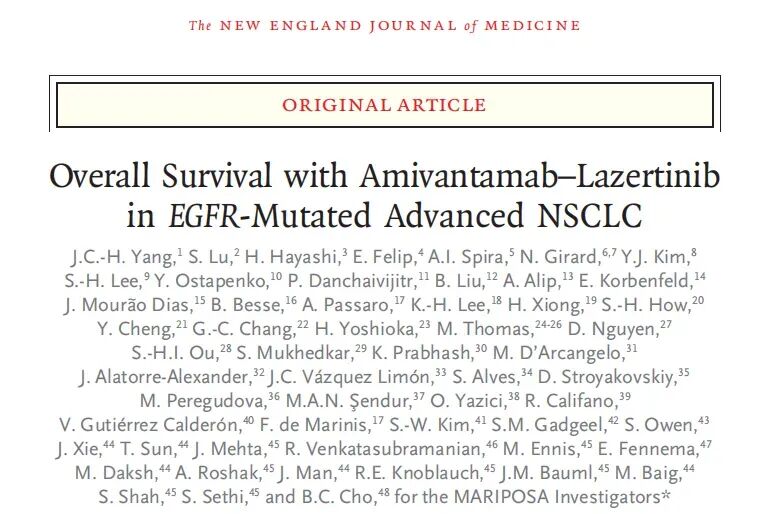
Amivantamab, a novel EGFR/cMET-targeted agent, has accumulated substantial evidence in the treatment of non-small cell lung cancer (NSCLC). The Phase III MARIPOSA study, led by Dr. Shun Lu of Shanghai Chest Hospital, evaluated the clinical benefits of amivantamab combined with lazertinib versus osimertinib as first-line treatment for advanced NSCLC with classic EGFR mutations (Ex19del or L858R). The findings have been presented multiple times at international oncology conferences and were previously published in the New England Journal of Medicine [1]. Today, the final overall survival (OS) data from MARIPOSA were published again in the New England Journal of Medicine. Results showed that the median OS in the amivantamab + lazertinib group exceeded four years, extending survival by more than one year compared with the osimertinib group, with a median OS of at least 48.7 months. These data demonstrate a statistically significant and clinically meaningful improvement (HR = 0.75, P < 0.005), representing the lowest OS HR value reported to date in Phase III clinical studies. A consistent OS benefit was also observed in the Asian subgroup (HR = 0.75), breaking through the limitations of previous third-generation EGFR-TKIs. The encouraging intracranial efficacy further underscores the value of this regimen. Together, the results reaffirm the therapeutic significance of amivantamab combined with lazertinib as first-line treatment for advanced NSCLC with classic EGFR mutations.
MedJ invited Dr. Shun Lu to provide an in-depth interpretation of the latest MARIPOSA results, aiming to offer clinicians, patients, and stakeholders a comprehensive understanding and to advance the development of lung cancer diagnosis and treatment.
Updated Final OS Results from MARIPOSA: Dual-Target Therapy Achieves Long-Term Survival in First-Line Advanced NSCLC with Classic EGFR Mutations
The final OS results from MARIPOSA, published on September 7, 2025, in the New England Journal of Medicine, are particularly remarkable [2]. At a median follow-up of 37.8 months, the median OS in the amivantamab + lazertinib group exceeded four years in the overall population, reaching at least 48.7 months—significantly extending survival by more than one year compared with osimertinib (HR = 0.75, P < 0.005). This represents the lowest OS HR observed to date in Phase III clinical trials. The absolute OS benefit rates at 2, 3, and 3.5 years were 5%, 9%, and 12%, respectively, with the survival advantage of amivantamab + lazertinib becoming more pronounced over time, demonstrating the sustained efficacy of this combination in prolonging survival.
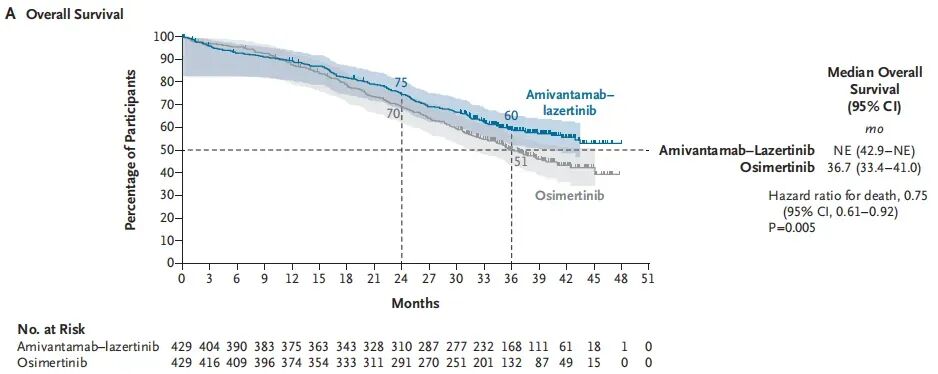
Figure 1. OS Data from the MARIPOSA Study
Subgroup analysis showed that the Asian population had a consistent OS benefit compared with the overall cohort, with amivantamab + lazertinib reducing the risk of death by 25% relative to osimertinib (HR = 0.75). In the context of current research, third-generation EGFR-TKIs have not demonstrated significant OS benefits in first-line treatment of advanced NSCLC with classic EGFR mutations in Asian patients. As a therapy confirmed in Phase III trials to deliver significant OS improvements in Asian populations, amivantamab + lazertinib holds groundbreaking clinical significance. Regarding progression-free survival (PFS), data presented at the 2023 ESMO Asia Congress showed that amivantamab + lazertinib achieved a median PFS of 27.5 months in treatment-naïve advanced NSCLC with classic EGFR mutations, extending PFS by 9.2 months compared with osimertinib (HR = 0.65) [3]. These findings strongly support broad clinical application of this combination regimen in Asian populations, including Chinese patients.
Intracranial Efficacy
Lung cancer is the most common primary tumor associated with brain metastases, making central nervous system (CNS) activity a key focus in current targeted therapy research. The MARIPOSA study predefined baseline brain metastases as a subgroup and conducted serial intensive brain imaging to detect metastases early and prevent neurological damage. While frequent follow-up and imaging may have led to earlier detection of progression and influenced intracranial efficacy data, results presented at the European Lung Cancer Congress (ELCC) confirmed that OS benefits in the brain metastasis subgroup were even more pronounced than in the overall population. In this subgroup, amivantamab + lazertinib reduced the risk of death by 33% compared with osimertinib (HR = 0.67). The 3-year intracranial progression-free survival (icPFS) rate was consistent with earlier reports (36% vs. 18%), underscoring the strong intracranial antitumor activity of this regimen [2].
Further results from MARIPOSA, presented at the 2024 World Conference on Lung Cancer (median follow-up 31.1 months), reinforced these findings. The 3-year icPFS rate in the amivantamab + lazertinib group was more than double that of osimertinib (38% vs. 18%). Although the intracranial objective response rate (icORR) was 77% in both groups, the median intracranial duration of response (icDoR) was longer with amivantamab + lazertinib (NE vs. 24.4 months), with the 3-year icDoR rate showing a striking advantage (51% vs. 0%). These results highlight the regimen’s durable intracranial efficacy, driven by the synergistic triple mechanism of action: dual extracellular target inhibition, intracellular kinase blockade, and a sustained immune-tail effect [5].
Clinical Impact and Guideline Recognition
This achievement reflects the commitment and leadership of numerous Chinese experts, whose contributions are providing new strategies for global lung cancer management while delivering tangible survival benefits for Chinese patients. Currently, the NCCN Guidelines list amivantamab + lazertinib as a Category I recommendation for first-line treatment of advanced NSCLC with classic EGFR mutations [6]. Similarly, the 2025 CSCO NSCLC Guidelines have included the regimen as a Grade III recommended option for first-line treatment of advanced NSCLC with sensitive EGFR mutations [7]. Notably, on August 5, 2025, China’s National Medical Products Administration (NMPA) officially approved amivantamab + lazertinib for first-line treatment of adult patients with locally advanced or metastatic NSCLC harboring EGFR mutations (Ex19del or L858R).
This approval marks the beginning of a new era of “dual-target therapy” in the first-line treatment of advanced NSCLC with sensitive EGFR mutations, offering broader benefits to Chinese lung cancer patients.
Reference:
[1]Cho BC, Lu S, Felip E, et al. Amivantamab plus Lazertinib in Previously Untreated EGFR-Mutated Advanced NSCLC. N Engl J Med. 2024;391(16):1486-1498.
[2]Cho BC, Lu S, Felip E, et al. Overall Survival with Amivantamab–Lazertinib in EGFR-Mutated Advanced NSCLC. N Engl J Med.
[3]Lu S , Byoung CC, Jong-Seok L, et al. Amivantamab Plus Lazertinib vs Osimertinib as First-line Treatment Among Asian Patients With EGFR-mutated, Advanced Non-small Cell Lung Cancer (NSCLC): MARIPOSA Subgroup Analysis. 2023 ESMO Aisa. LBA10.
[4]Shirish MG, Byoung CC, Lu S, et al. Amivantamab Plus Lazertinib vs Osimertinib in First-line EGFR-mutant Advanced NSCLC: Longer Follow-up of the MARIPOSA Study. 2024 WCLC. OA.02.03.
[5]Passaro A, Wang J, Wang Y, et al. Amivantamab plus chemotherapy with and without lazertinib in EGFR-mutant advanced NSCLC after disease progression on osimertinib: primary results from the phase III MARIPOSA-2 study. Ann Oncol. 2024;35(1):77-90.
[6]NCCN Guidelines: Non-Small cell Lung cancer. Version 3.2025.
[7]中国临床肿瘤学会(CSCO)非小细胞肺癌诊疗指南(2025年).

