


Recently, a new urticaria drug was approved in China and may greatly relieve symptoms in patients with chronic spontaneous urticaria (CSU), even if they have tried a range of previous therapies.
This is the world’s first oral targeted drug for CSU. According to a previous Novartis announcement, the innovative drug remibrutinib is mainly indicated for adult CSU patients inadequately controlled by H1 antihistamines and has been approved by China’s National Medical Products Administration.
Statistics show that more than 10 million people in China currently have CSU, and about 50% respond poorly to standard antihistamine treatment. These patients long face limited options and repeated attacks, and in severe cases airway edema may even become life-threatening.
Dr. Chunjun Yang, chief physician of dermatology at the Second Affiliated Hospital of Anhui Medical University, told MedJ: “Although its real-world efficacy remains to be verified in clinical practice, the clinical trial data suggest that it fills an important unmet need for CSU patients whose disease is not controlled by antihistamines, and it may improve long-term treatment adherence.”
The price of remibrutinib in China has not yet been disclosed. It is understood that the drug was previously launched in the United States at a treatment cost of about $4,500 per month.
30% of patients became completely hive- and itch-free
CSU is an autoimmune disease characterized by recurrent pruritic wheals and angioedema. It is far from ordinary “skin allergy.” Dr. Yang told MedJ that CSU is defined as daily or intermittent attacks lasting more than six weeks and can seriously interfere with patients’ normal work and life.
“CSU attacks occur randomly and unpredictably, and severity varies by patient and by time. It typically manifests as wheals and generalized itching and may also cause tissue swelling of the lips, eyelids, and other sites,” Dr. Yang said. “If airway edema occurs, severe cases can lead to breathing difficulty and even suffocation.”
At present, non-sedating antihistamines are the first-line treatment for CSU, but in clinical practice about 50% of patients still fail to achieve adequate disease control.
“At that point, doctors have to increase the antihistamine dose, combine biologics, or even consider immunosuppressants,” Dr. Yang said. “But biologics are not ideal for every patient and their accessibility is limited. Immunosuppressants carry risks such as hepatic and renal impairment and secondary infection, so they are reserved for the small number of patients with extremely severe symptoms and require close monitoring.”
That is why the emergence of remibrutinib has been hailed as a new milestone in the history of CSU treatment.
As a new oral Bruton’s tyrosine kinase (BTK) inhibitor, remibrutinib works by selectively inhibiting BTK activity, blocking the BTK cascade upstream in the disease pathway, and thereby preventing the release of histamine that causes itchy wheals and swelling.
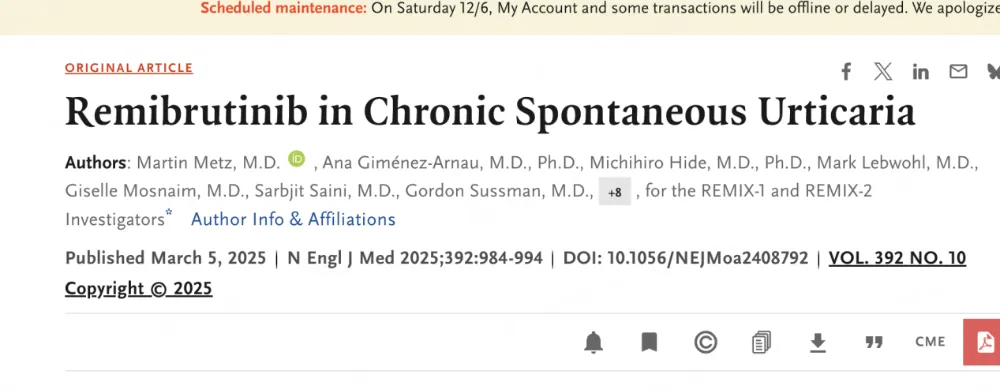
Approval of remibrutinib was mainly based on the Phase III REMIX-1 and REMIX-2 trials, which enrolled 470 and 455 adult CSU patients, respectively, who remained symptomatic despite antihistamines. The study was published in The New England Journal of Medicine in March this year.
In these trials, enrolled CSU patients had had the disease for an average of more than five to six years, and about 60% were in a state of severe CSU, with mean Urticaria Activity Score over 7 days (UAS7) close to 30.
The results showed that after just one week of remibrutinib, CSU symptoms in the treatment group improved significantly. By week 12, patients in the treatment arm of REMIX-1 had a mean UAS7 reduction of 20 points, compared with only 13.8 points in the placebo group. REMIX-2 showed a similar result of 19.4 points versus 11.7 points.
Even more noteworthy was the proportion of patients achieving deep remission. By week 12, 49.8% and 46.8% of treatment-group patients in the two studies had reduced their UAS7 scores to 6 or less, and about 30% became completely hive- and itch-free. “That has been difficult to achieve in previous CSU treatment,” Dr. Yang told MedJ.
In terms of safety, the incidence of adverse events was similar in the remibrutinib and placebo groups. Most were mild or moderate, mainly nasopharyngitis and headache, and no serious trial-related adverse events were found.
According to the study data, Dr. Yang said, for patients whose antihistamine treatment has failed and who would otherwise move on to biologics, oral BTK inhibitors offer a brand-new, and potentially better, option. “But it should be noted that from clinical trials to real-world use, the efficacy and safety of remibrutinib still require longer observation.”
“This drug has only just been approved in China. Whether its real-world efficacy is as good as the trial data, how long patients need to take it, and whether it can be stopped smoothly all require experience to accumulate in future clinical use and more objective evaluation,” Dr. Yang said.
Can CSU be completely cured?
Dr. Yang told MedJ that from a clinician’s perspective, the significance of remibrutinib lies not only in providing a new option, but also in its potential to change the long-term treatment and management model of CSU.
Based on the clinical trial data, “on the one hand, remibrutinib is clearly superior to antihistamines in symptom control and speed of onset. For CSU patients whose disease strikes unpredictably with sudden itching and wheals, that means they may return to normal life more quickly and it may even challenge first-line therapy in the future,” Dr. Yang said.
On the other hand, the oral nature of remibrutinib may improve adherence. Dr. Yang told MedJ that, like many other chronic diseases requiring long-term management, adherence is a major challenge in CSU care.
At present, biologics are the standard second-line option for the 50% of CSU patients who fail first-line therapy. “But they require patients to go to the hospital regularly every month for injections. For people who live far away or are busy at work, long-term persistence is objectively difficult. In clinical practice, it is very common for patients to stop the drug on their own once symptoms improve slightly,” Dr. Yang said.
By contrast, as an oral drug, remibrutinib “fits better with most patients’ medication habits and expectations, while simplifying treatment into home use, significantly reducing the burden of frequent hospital visits and providing convenience for long-term, standardized therapy,” Dr. Yang said.
Notably, the price of remibrutinib in China has not yet been disclosed. In September this year, remibrutinib was first approved in the United States, and without considering insurance or other payment methods, monthly treatment costs about $4,500.
Although the new drug is a breakthrough, Dr. Yang stressed that for a chronic disease such as CSU, control still requires patients and doctors to work together using a comprehensive strategy.
The development of CSU is believed to be closely related to immune dysregulation, but the specific triggers are numerous and hard to define. “It may be related to genetic predisposition, or to various external stimuli. Helicobacter pylori infection, mental stress, an irregular lifestyle, smoking, and drinking may all trigger or aggravate the disease,” Dr. Yang said.
Therefore, Dr. Yang recommends that along with standardized drug treatment, patients should also pay attention to lifestyle adjustment, including actively screening for and treating Helicobacter pylori infection, maintaining a regular routine, learning to manage stress, and avoiding known triggers.
As for whether CSU can be completely cured, Dr. Yang told MedJ: “With drug treatment combined with lifestyle management, over time the abnormal immune activation state in some patients may gradually subside. Clinically, doctors usually try gradual dose reduction or even drug withdrawal after the disease has remained stable for a period. But this requires individualized assessment, and there is currently no uniform standard.”
It is understood that the Phase III extension study of remibrutinib is still ongoing to assess whether patients can safely discontinue treatment after effective therapy. At the same time, the study will explore the feasibility of intermittent treatment—whether the drug can be stopped first and restarted after relapse—to evaluate the future potential of on-demand treatment.

