


In immune therapy for non-small cell lung cancer (NSCLC), immune checkpoint inhibitor (ICI) monotherapy delivers clear survival benefit in patients with high PD-L1 expression. The PD-L1-negative subgroup — accounting for nearly half of all patients with advanced NSCLC — has long been a tough nut to crack. Because of their tumors’ low immunogenicity, these patients derive limited benefit from currently available combinations of a PD-1/PD-L1 inhibitor with chemotherapy.
Recently, LungCadX — a multicenter, single-arm, phase II study led by Prof. Chunxia Su of Shanghai Pulmonary Hospital, Tongji University; Prof. Tianqing Chu of Shanghai Chest Hospital, Shanghai Jiao Tong University; and Prof. Chuangzhou Rao of Ningbo Second Hospital — was published in Nature Communications. It is the first prospective clinical study dedicated to first-line treatment of PD-L1-negative advanced NSCLC, evaluating the efficacy and safety of cadonilimab, a PD-1/CTLA-4 bispecific antibody, plus chemotherapy, and exploring the value of peripheral blood cell-free DNA (cfDNA) methylation as a non-invasive biomarker.
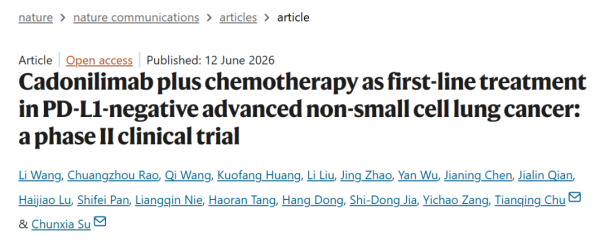 Fig. 1. Study Screenshot
Cadonilimab Plus Chemotherapy: A Breakthrough from the “Immune Desert”
1.Study Design. LungCadX was an open-label, multicenter, single-arm phase II study conducted at three centers in China.
2.Enrollment Criteria. Patients with PD-L1-negative (22C3 assay, TPS <1%) advanced NSCLC (unresectable stage IIIB/IIIC or stage IV/recurrent) without EGFR/ALK driver-gene mutations, with ECOG performance status 0–1.
Of 55 patients screened, 50 were enrolled (safety analysis set: 50; full analysis set [FAS]: 47).
3.Treatment Regimen. Cadonilimab 10 mg/kg every three weeks for four cycles, combined with platinum-based doublet chemotherapy (non-squamous: pemetrexed + carboplatin; squamous: paclitaxel + carboplatin), followed by cadonilimab + pemetrexed maintenance therapy.
4.Baseline Characteristics. The FAS comprised 47 patients. Median age was 63.4 years; 91.5% were male; 80.9% had stage IV disease; squamous and non-squamous histologies were roughly balanced (48.9% vs. 51.1%). Notably, patients with brain, liver and bone metastases made up 8.5%, 10.6% and 19.1% of the cohort, respectively — a group with relatively high baseline tumor burden.
5.Endpoints. The primary endpoint was the 12-month progression-free survival (PFS) rate, with a pre-specified threshold of 40%. Secondary endpoints included overall survival (OS), PFS, objective response rate (ORR), duration of response (DOR), disease control rate (DCR), and safety.
Efficacy: An Encouraging Signal Beyond Historical Controls
1.Primary Endpoint: 12-Month PFS Rate of 42.1%
After a median follow-up of 12.9 months (interquartile range 9.0–16.6 months), the study met its pre-specified primary endpoint.
Table 1. Efficacy Data in the Overall Population
|
Efficacy Endpoint |
Results in Full Population |
|
12-month PFS rate (Primary Endpoint) |
42.1% (95% CI 29.6%-60.0%) |
|
Median PFS |
9.7 months (95% CI 7.3-13.8) |
|
ORR |
66.0% (95% CI 50.7%-79.1%) |
|
DCR |
100% (95% CI 92.5%-100%) |
|
DOR |
9.5 months (95% CI 6.0-NE) |
|
OS |
Not reached |
To put this result in context, the authors compared it with key historical studies.
Table 2. PFS Comparison Across Studies
|
Regimen |
Population |
ORR |
Median PFS |
12-month PFS Rate |
|
Cadonilimab Monotherapy + Chemotherapy (LungCadX) |
PD-L1 Negative |
66.00% |
9.7 months |
42.10% |
|
Pembrolizumab Monotherapy + Chemotherapy (KN189/407 Pooled) |
PD-L1 Negative |
50.60% |
6.5 months |
30.10% |
|
Nivolumab Monotherapy + Ipilimumab Monotherapy + 2 Cycles Chemotherapy (CheckMate 9LA) |
PD-L1 Negative |
31.10% |
5.8 months |
31% |
Cross-trial comparisons must be interpreted with caution, but the cadonilimab-chemotherapy combination showed numerically superior PFS and ORR values, suggesting that it may deliver a larger survival benefit in PD-L1-negative patients. LungCadX therefore offers, for the first time, an encouraging efficacy signal from a prospective trial specifically designed for this population.
2.Squamous Subgroup: ORR of 87% in PD-L1-Negative Squamous NSCLC
Subgroup analysis revealed a striking signal — patients with squamous-cell carcinoma derived markedly greater benefit than those with non-squamous disease.
Table 3. Squamous Subgroup Results
|
Indicator |
Squamous Cell Carcinoma (n=23) |
Non-Squamous Cell Carcinoma (n=24) |
|
ORR |
87.00% |
45.80% |
|
Median PFS |
12.9 months |
8.9 months |
|
12-month PFS rate |
54.20% |
30.00% |
This finding carries important clinical implications. Lung squamous-cell carcinoma patients generally lack targetable driver-gene mutations, leaving treatment options limited and prognoses poor.
An ORR of 87% and a median PFS of 12.9 months with cadonilimab plus chemotherapy in PD-L1-negative squamous NSCLC clearly offers new hope for this hard-to-treat subgroup, and suggests that PD-1/CTLA-4 bispecific antibodies may elicit stronger immune activation in the even less immunogenic squamous type.
3.Safety: Chemotherapy-Driven Toxicity Dominates; Bispecific Design Shows Advantages
Table 4. Summary of Safety (Overall Cohort, n=50)
|
Safety Endpoint |
Incidence |
Patients (n=50) |
|
Any-grade TRAEs |
92.00% |
46 |
|
≥ Grade 3 TRAEs |
52.00% |
26 |
|
Any-grade irAEs |
36.00% |
18 |
|
≥ Grade 3 irAEs |
12.00% |
6 |
|
Treatment discontinuation due to TRAEs |
10.00% |
5 |
|
Treatment-related death |
0.00% |
0 |
Cross-trial, the ≥grade 3 treatment-related adverse event (TRAE) rate for cadonilimab plus chemotherapy (52.0%) was lower than the 59.1% reported for pembrolizumab plus chemotherapy in KEYNOTE-189/407, and well below the 80% rate reported for another PD-1/CTLA-4 bispecific, MEDI5752, plus chemotherapy.
Although this regimen used four cycles of chemotherapy (more than the two cycles in CheckMate 9LA), its ≥grade 3 TRAE rate (52.0%) is broadly comparable to the CheckMate 9LA regimen of nivolumab plus ipilimumab plus two cycles of chemotherapy (about 47%), suggesting that the single-molecule bispecific design did not add extra toxicity.
The toxicity profile is dominated by myelosuppression-related adverse events, indicating that safety risk is driven mainly by chemotherapy rather than by the intrinsic immune toxicity of the bispecific antibody. This is consistent with cadonilimab’s design rationale of reducing Fc-mediated toxicity.
4.cfDNA Methylation: A Liquid-Biopsy Window 105 Days Ahead of Imaging
Another highlight of the study was an exploratory analysis of cfDNA methylation profiling as a predictor of efficacy and a tool for prognostic stratification. The team performed whole-genome methylation sequencing on samples collected at baseline (C1D1) and on day 1 of cycle 3 (C3D1), and calculated a differential methylation fragment (DMF) score.
Findings: Molecular response preceded imaging response by about five cycles. Clinical response rates rose with time on therapy and reached a significant correlation at C8D1 (P = 0.039). At C3D1, the DMF score in responders (defined by imaging at C8D1) was significantly lower than at baseline (P = 0.006), while non-responders showed no significant change (P = 0.134).
The result indicates a significant correlation between methylation status at C3D1 and imaging findings at C8D1, suggesting that molecular assessment may predict treatment response about 105 days earlier than conventional imaging.
Baseline DMF score was an independent prognostic factor. Using a median of 10 as a cutoff, the low-risk group had a median PFS of 11.4 months versus 6.9 months in the high-risk group (P = 0.032). Multivariate analysis confirmed low molecular risk as an independent protective factor (HR = 0.419, P = 0.041).
Notably, change in molecular response at C3D1 did not predict better PFS; non-responders even trended toward longer PFS (11.4 vs. 9.0 months, P = 0.096). This may reflect confounding by baseline tumor burden — molecular responders had higher baseline tumor burden, and baseline burden itself is a stronger determinant of PFS.
This finding suggests that a baseline methylation score may have greater value for prognostic stratification than routine clinical variables.
Clinical Implications
First, this is the first prospective clinical study worldwide dedicated to first-line treatment of PD-L1-negative advanced NSCLC, filling the gap that left this population without a specific evidence base.
Second, the efficacy signal observed with cadonilimab plus chemotherapy is, in numerical terms, no worse than, and possibly better than, historical data for current standard regimens, with a manageable safety profile.
Third, cfDNA methylation — as a non-invasive biomarker — offers a new approach to early efficacy prediction and long-term prognostic stratification.
Conclusion
Cadonilimab plus chemotherapy has shown encouraging efficacy and manageable safety in PD-L1-negative advanced NSCLC, with a particularly striking signal in the squamous subgroup. Based on these LungCadX findings, multiple phase III randomized controlled trials are now underway. The hope is that their final results will bring genuine therapeutic progress to this long-overlooked, hard-to-treat population.
Reference
[1] Wang L, Rao C, Wang Q, et al. Cadonilimab plus chemotherapy as first-line treatment in PD-L1-negative advanced non-small cell lung cancer: a phase II clinical trial. Nat Commun. 2026 Jun 12;17(1):7483.

