


Milestone
This is not a single-drug approval story. The milestone is the maturation of lung-cancer ADCs into a field with enough breadth and data density to alter treatment strategy across both non-small cell and small cell disease. The field now includes 293 lung-cancer ADC pipelines globally, including 62 bispecific ADCs, and five products have already been approved in NSCLC. That scale matters because it implies the modality is shifting from experimental adjunct to therapeutic architecture.
Disease burden and why the opportunity is so large
Lung cancer remains the world's leading cancer killer. Approximately 2.5 million new cases and 1.8 million deaths occurred worldwide in 2022, with about 1.06 million new cases and 730,000 deaths in China. Traditional surgery, radiotherapy and chemotherapy still matter, but survival remains poor, with five-year survival for stage III disease around 20% overall. Targeted therapy and immunotherapy have improved subsets of NSCLC, yet large EGFR wild-type populations still confront limited options after progression, while EGFR-mutant disease faces inevitable TKI resistance. In SCLC, relapse is rapid and effective later-line therapy remains scarce.
Mechanistic rationale
ADC relevance in lung cancer depends on antigen selection. HER2, HER3, TROP2, c-MET, DLL3, B7-H3 and PD-L1 all offer different entry points into tumor-selective payload delivery. The field is also evolving beyond single-target logic. Bispecific ADCs such as EGFR x HER3 and dual-epitope HER2 constructs aim to improve binding breadth, internalization or resistance coverage. In a disease as heterogeneous as lung cancer, that is not a cosmetic innovation. It may be necessary for durable category success.
Clinical evidence in SCLC
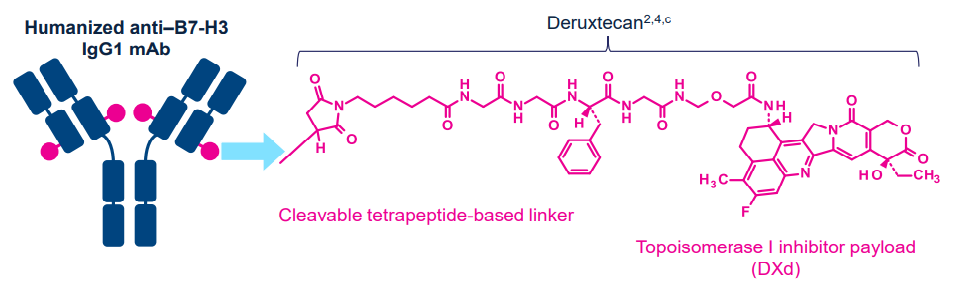
Some of the strongest evidence comes from high-need SCLC programs. DLL3 is expressed on about 80% of SCLC cells and has become a prime ADC anchor. Hengrui's SHR-4849 reportedly produced an objective response rate of 83.3% and disease control rate of 100% in 18 patients with brain metastases. Daiichi Sankyo and Merck's ifinatamab deruxtecan achieved confirmed ORR of 48.2%, DCR of 87.6% and median overall survival of 10.3 months in pretreated extensive-stage SCLC at 12 mg/kg, with intracranial ORR of 46.2% in patients with baseline brain metastases. QLC5508, another B7-H3 ADC, showed ORR of 42.2%, DCR of 84.4%, median PFS of 5.95 months and median OS of 11.73 months.
Clinical evidence in NSCLC
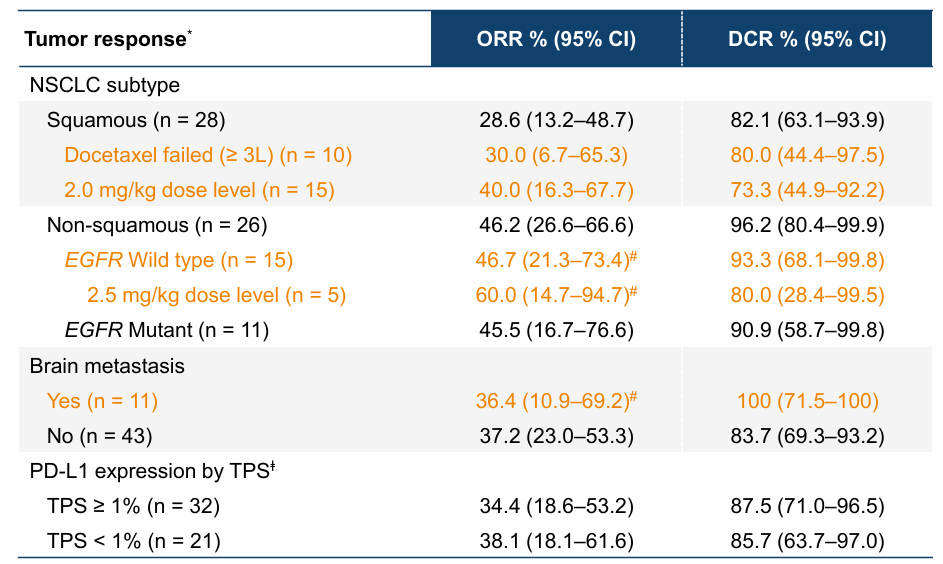
Current NSCLC data look equally dynamic. BL-B01D1, an EGFR x HER3 bispecific ADC, in combination with osimertinib produced 100% ORR and 100% target-lesion shrinkage in a first-line EGFR-mutant setting, with a 12-month PFS rate of 92.1%. As monotherapy after third-generation TKI progression, it still generated median PFS of 12.5 months. HLX43, a PD-L1 ADC using a tumor-microenvironment-cleavable linker, delivered ORR superior to historical chemotherapy benchmarks and maintained ORR of 38.1% even in PD-L1-negative patients, with ORR of 30% and DCR of 90% in patients with brain metastases. TQB2102, a HER2 dual-epitope bispecific ADC, achieved ORR of 61.1% in HER2-mutant NSCLC and 100% ORR in the rare HER2/EGFR double-mutant subgroup.
Risk-benefit and positioning
The central issue is whether these response advantages can be translated into durable benefit without prohibitive toxicity. Manageable safety has been reported for several programs, which is critical because lung cancer patients often arrive heavily pretreated and vulnerable to cumulative toxicity. If ADCs maintain favorable payload delivery and activity in brain metastases, they could become especially valuable where small molecules and immunotherapy lose traction.
Outlook
The field is now broad enough that the question is no longer whether ADCs belong in lung cancer, but how they will be sequenced. SCLC may become one of the most important proving grounds because unmet need is extreme and target biology is becoming clearer. In NSCLC, ADCs may increasingly serve as resistance bridges, combination partners and even first-line intensification tools. The future challenge will be rational sequencing, cross-resistance management and patient selection. But the direction is unmistakable: lung cancer is moving into an ADC-defined era, and the modality is beginning to function as a platform rather than an exception.

