


Background and Unmet Clinical Need
Glucagon-like peptide-1 receptor agonists (GLP-1RAs) are now established as a core component of type 2 diabetes (T2D) management. They lower glucose through glucose-dependent insulin secretion, suppression of glucagon release, delayed gastric emptying, and central appetite modulation, with additional benefits on body weight, blood pressure, and lipid profiles [1].
The cardiovascular protective effect of the class was first established with liraglutide in the LEADER trial, which showed a 13% reduction in three-point major adverse cardiovascular events (3P-MACE) versus placebo (HR 0.87; 95% CI 0.78-0.97) [2]. Current U.S. and European guidelines endorse GLP-1RAs in T2D patients with established cardiovascular disease or at high cardiovascular risk.
Within-class head-to-head data have, however, remained limited, particularly for agents developed outside North America and Europe. Loxenatide, a PEGylated, once-weekly GLP-1RA first approved in China by the National Medical Products Administration (NMPA) in 2018, has accumulated a body of real-world evidence addressing this gap. The series of analyses summarized here focuses on adults with T2D in routine Chinese practice.
Expert Profile

Li Shufa
MD, Chief Physician, Professor, Doctoral Supervisor
Director, Institute of Metabolic Diseases, Qingdao University
Department Director, Department of Endocrinology and Metabolic Diseases, the Affiliated Hospital of Qingdao University
Academic Leader of Qingdao Municipal Key Clinical Discipline
National Committee Member, Chinese Medical Association Society of Osteoporosis and Bone Mineral Research
Chairman, Qingdao Society for Osteoporosis and Bone Mineral Diseases
Vice Chairman, Shandong Medical Association Society of Osteoporosis and Bone Mineral Diseases
What This Research Addresses
Three recent analyses, anchored by the FIGHTING-3 multicenter cohort, examined whether once-weekly loxenatide differs from once-daily liraglutide on glycemic, cardiovascular, renal, and adherence endpoints in routine Chinese clinical practice. The underlying scientific question is straightforward: do pharmacokinetic differences between weekly and daily GLP-1RA dosing translate into measurable differences in real-world effectiveness across the most relevant cardiometabolic and behavioral endpoints?
Each analysis used propensity score matching (PSM) to balance treatment arms on a defined set of demographic and clinical covariates. None were randomized, and all are positioned as hypothesis-generating rather than confirmatory.
Key Findings From Three Real-World Analyses
Study 1: Time in Range on Continuous Glucose Monitoring
A multicenter retrospective study published in Frontiers in Pharmacology in 2024 by Chen and colleagues used 1:1 PSM to compare 101 GLP-1RA-treated patients with 101 patients receiving oral antidiabetic drugs (OADs) [3]. Continuous glucose monitoring (CGM) data were collected across five hospitals in Guangdong Province. Within the GLP-1RA arm, time in range (TIR; 3.9-10.0 mmol/L) differed between weekly and daily dosing:
At month 1, TIR was 65.9% with loxenatide vs. 52.0% with liraglutide (P=0.046).
At months 3-6, TIR reached 79.1% with loxenatide vs. 66.7% with liraglutide (P=0.010).
The authors suggested that once-weekly dosing may sustain more stable plasma drug concentrations than daily dosing, providing a plausible mechanistic rationale for the observed TIR differences. This dataset did not directly test a mechanism.
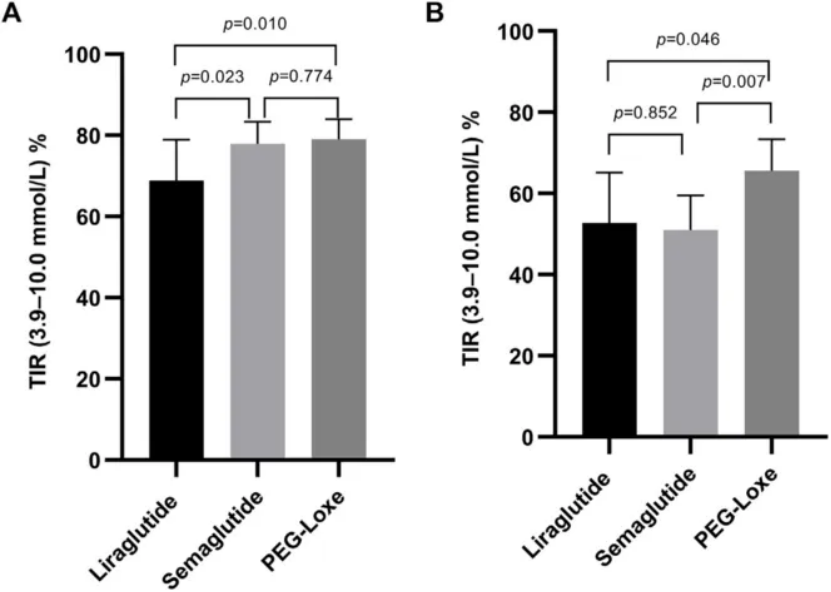 Fig.1. Effects of GLP1RA on TIR. (A) TIR Values After 36 Month Treatment; (B) TIR Values in the First Month of Treatment.
Study 2: Cardiovascular Outcomes in the FIGHTING-3 Cohort
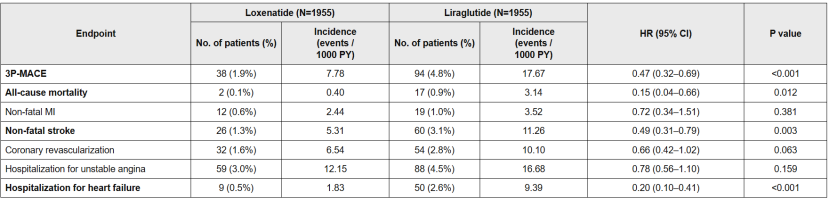
The FIGHTING-3 cardiovascular analysis drew on the Tianjin Health Medical Data Platform, covering 82 hospitals, and applied 1:1 PSM to assemble 1,955 loxenatide-treated and 1,955 liraglutide-treated T2D patients with established cardiovascular disease or cardiovascular risk factors [4]. Median follow-up was 29.5 months in the loxenatide arm and 30.4 months in the liraglutide arm. Matching variables included age, sex, diabetes duration, cardiovascular disease history, dyslipidemia, hypertension, kidney disease, and baseline use of SGLT2 inhibitors, antihypertensives, and lipid-lowering agents.
For the primary 3P-MACE endpoint, loxenatide was associated with a 53% lower risk compared with liraglutide (HR 0.47; 95% CI 0.32-0.69; P<0.001). Component endpoints showed:
All-cause mortality: HR 0.15; 95% CI 0.04-0.66; P=0.012.
Non-fatal stroke: HR 0.49; 95% CI 0.31-0.79; P=0.003.
Heart failure hospitalization: HR 0.20; 95% CI 0.10-0.41; P<0.001.
Secondary endpoints, including coronary revascularization (HR 0.66; P=0.063) and hospitalization for unstable angina (HR 0.78; P=0.159), trended in favor of loxenatide but did not reach statistical significance.
Table 1: Comparison of Cardiovascular Outcomes Between Loxenatide And Liraglutide
Study 3: Renal Outcomes and Adherence
A renal-focused subgroup analysis of FIGHTING-3, drawing on 798 patients per arm after 1:1 PSM, evaluated a composite renal endpoint defined as a sustained estimated glomerular filtration rate (eGFR) decline of 50% or more, kidney failure, or all-cause death [5]. The composite did not differ significantly between loxenatide and liraglutide (HR 0.15; 95% CI 0.02-1.34; P=0.090), consistent with comparable renal protection across the two agents.
Adherence, however, differed markedly. Proportion of days covered (PDC) reached 69.5% in the loxenatide arm versus 46.7% with liraglutide. Among loxenatide-treated patients, 100% remained on the 0.2 mg dose, while only 32.1% of liraglutide-treated patients remained on the 1.8 mg dose.
Table 2. Comparison of Renal Composite Endpoints Between Loxenatide And Liraglutide.

Mechanistic and Translational Implications
Three considerations may help frame the findings, although none has been directly tested in the analyses reviewed. First, weekly PEGylated dosing produces more stable GLP-1 receptor occupancy, which could in principle translate into more consistent postprandial and fasting glucose control. Second, sustained GLP-1 receptor activation has been linked in preclinical and translational work to broader cardiometabolic effects beyond glycemia, including effects on endothelial function, natriuresis, and lipid handling. Third, dosing frequency is a well-documented driver of adherence in chronic disease therapy, and adherence itself is a strong modifier of long-term cardiovascular outcomes.
Together these observations may help explain why a within-class pharmacokinetic difference could emerge as a within-class clinical difference in this dataset, and they support the rationale for prospective head-to-head comparisons that pre-specify adherence and dose-titration strategies.
Limitations and Next Steps
All three analyses share limitations common to retrospective, real-world studies: residual confounding despite PSM, indication bias, and limited generalizability beyond the studied populations. The cardiovascular analysis was not randomized and relied on claims- and electronic-health-record-derived endpoints. Adherence comparisons are confounded by differences in dose-titration practices between weekly and daily formulations. The renal endpoint was underpowered, with a wide confidence interval that crosses unity. None of the analyses have been replicated in independent populations, and the FIGHTING-3 reports have not, at the time of writing, been published in a peer-reviewed journal.
Prospective head-to-head trials, biomarker-based mechanistic studies, and validation in non-Chinese cohorts are needed before these findings can be incorporated into broader clinical practice guidelines. Until then, these data warrant caution in interpretation and should not be read as proof of clinical superiority.
References
[1] Chinese Diabetes Society. Guideline for the prevention and treatment of type 2 diabetes mellitus in China (2024 edition). Chin J Diabetes Mellitus. 2025;17(1):16-139.
[2] Marso SP, Daniels GH, Brown-Frandsen K, et al. Liraglutide and Cardiovascular Outcomes in Type 2 Diabetes. N Engl J Med. 2016;375(4):311-322.
[3] Chen Y, Chen J, Zhang S, et al. Real-world effectiveness of GLP-1 receptor agonist-based treatment strategies on time in range in patients with type 2 diabetes. Front Pharmacol. 2024;15:1370594.
[4] Wu H, Liu L, Duan Y, et al. Real-world comparison of loxenatide versus other GLP-1RAs on major adverse cardiovascular events in patients with type 2 diabetes: a multicenter cohort study (FIGHTING-3). 2025.
[5] Wu H, Liu L, Duan Y, et al. Real-world comparison of the effects of loxenatide with other GLP-1RAs on renal outcomes in patients with type 2 diabetes: a subgroup analysis of the FIGHTING-1 cohort study (FIGHTING-3). 2025.

