


Oral itraconazole is the standard treatment for cutaneous sporotrichosis, but clinical decision-making has long been complicated by the long treatment course, effects on liver function, and drug–drug interactions. For patients who cannot or do not wish to take long-term medication, is there a reliable non-pharmacologic option?
A team led by Profs. Xinghua Gao and Zhengxiu Li of the First Hospital of China Medical University recently published a randomized controlled trial in the Journal of the American Academy of Dermatology (JAAD) that uses data to answer this question: local hyperthermia delivers efficacy comparable to itraconazole, with virtually no systemic side effects.
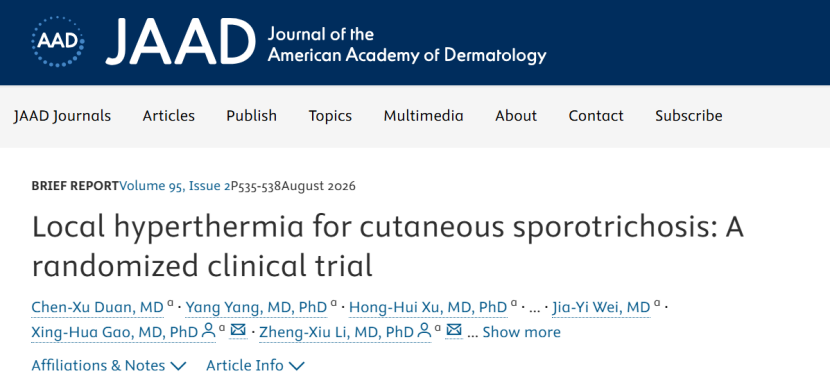
Fig. 1. Article Screenshot
How Was the Study Conducted?
The study enrolled 26 patients with cutaneous sporotrichosis confirmed by histopathology and fungal culture, randomized 1:1 to a local-hyperthermia group and an itraconazole group, with 13 in each. Baseline characteristics — age, sex, disease duration, lesion type and site — were balanced between the two groups. Of the 26, 25 had fixed-type disease and 1 had lymphatic-type; lesions were mainly distributed on the upper limbs (62%) and the face/neck (38%).
The hyperthermia group received infrared-heat treatment with real-time skin-temperature monitoring. Target temperatures were set by site and age: 42 °C for minors and for adult face/neck lesions; 44 °C for adult limb lesions. Each session lasted 30 minutes — given on days 1–3 and 9–10, then once weekly for six weeks. Treatment targeted only the index lesion; distal lesions were not directly heated.
The itraconazole group received oral itraconazole 200 mg/day for 3–6 months.
Efficacy was assessed by blinded investigators, with cure defined as complete lesion resolution and re-epithelialization, no exudate, crusting or infiltration (residual scarring or pigmentation acceptable). Patients were followed for three months after treatment to confirm recurrence status.
Key Results
At 24 weeks, complete clearance was 85% (11/13) in the hyperthermia group versus 77% (10/13) in the itraconazole group — a difference that was not statistically significant (95% CI: -46% to 30%). Mean time to clearance was also comparable between groups, at 3.6 months and 3.5 months respectively.
In subgroup analyses, no difference in efficacy was found between groups regardless of whether lesions were located on the upper limbs or the face/neck, or whether they were infiltrated plaques or nodules. Patient satisfaction scored 4.2 in the hyperthermia group versus 4.0 in the itraconazole group. No recurrences occurred in either group during the three-month follow-up.
On safety, the hyperthermia group experienced only mild-to-moderate local blisters, which resolved with symptomatic treatment, with no systemic adverse events. The itraconazole group reported no serious adverse events, but given itraconazole’s known potential for hepatic effects and other risks, the absence of systemic side effects makes hyperthermia an option worth considering for patients with related concerns.
A Worth-Noting Phenomenon
In the only lymphatic-type patient in the hyperthermia group, the investigators heated only one lesion directly; the result showed that distal, untreated lesions also resolved completely. This “remote effect” has previously been reported when local hyperthermia is used to treat multiple plantar warts — heating one site produces clearance at multiple sites. The phenomenon suggests that local hyperthermia may act partly by inducing systemic immune modulation, though the precise mechanism awaits further study.
Which Patients Are Suitable for Hyperthermia
Based on this study, local hyperthermia can be considered first for the following situations:
patients with abnormal liver function or at risk of drug–drug interactions;
patients unwilling to undergo 3–6 months of systemic therapy;
fixed-type or some lymphatic-type cutaneous sporotrichosis.
In addition, the infrared-heat device used in the study is the same as that used to treat common warts, with high clinical accessibility, a standardized operating workflow, and suitability for primary-care settings.
Two practical points deserve emphasis:
First, skin temperature must be monitored in real time using infrared thermometry — never estimated by experience — to avoid under-treatment that would compromise efficacy or over-heating that risks burns.
Second, target temperatures differ between the face and the limbs, and between children and adults; the parameters set out in the study protocol must be strictly followed.
Study Limitations
This was a single-center study with a sample size of only 26; any extrapolation of the conclusions should be made with caution. Enrolled patients were drawn from northeastern China, where Sporothrix globosa is the predominant pathogen; whether different species differ in their sensitivity to hyperthermia remains unclear. The three-month follow-up is relatively short for assessing long-term recurrence, and larger studies with longer follow-up are needed to consolidate the evidence.
Summary
This JAAD randomized controlled study provides evidence-based support for local hyperthermia in the treatment of cutaneous sporotrichosis. For patients who are not suitable for or unwilling to use itraconazole, local hyperthermia is a non-pharmacologic option backed by data, with established efficacy and a favorable safety profile. Future multi-center studies will further address long-term efficacy and interspecies differences.
Reference
[1] Duan CX, Yang Y, Xu HH, et al. Local hyperthermia for Cutaneous Sporotrichosis: A Randomized Clinical Trial. J Am Acad Dermatol. 2026. doi:10.1016/j.jaad.2026.04.031

