


19 years ago, a 4-year-old American girl was diagnosed with neuroblastoma. After undergoing standard treatment, her tumor continued to progress. With no other options, her parents enrolled her in an early clinical trial for CAR-T therapy.
Today, this girl has created a medical miracle. Surviving for 18.2 years, she holds the world record for the longest survival achieved through CAR-T therapy. She has since married, had children, and has not required any further cancer treatment for many years. Doctors have detected no signs of tumor recurrence.
On February 17, 2025, researchers from Baylor College of Medicine and other institutions published this groundbreaking achievement in Nature Medicine. Among the 19 patients who participated in the trial, 7 survived for more than 8 years, with 3 achieving complete remission.
Professor Wang Jinhu, Vice President of the Moganshan Campus of the Children's Hospital affiliated with Zhejiang University School of Medicine and Director of the Cancer Research Center at the National Clinical Research Center for Child Health and Diseases, analyzed for MedJ that although the paper has some "missing details," it "sends a positive signal. In the future, the combination of surgery and cell therapy, among other advanced methods, will have a transformative impact on the treatment of neuroblastoma."
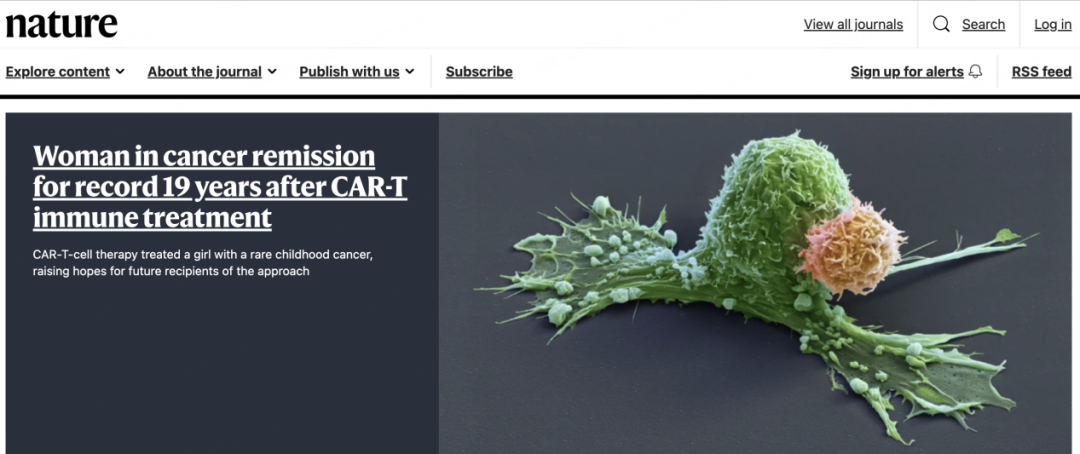
After the study was published, Nature featured a follow-up commentary on its front page
Disease-Free Survival for 18.2 Years
This study began in 2004 as a Phase I clinical trial for CAR-T therapy.
At the time, it was 13 years before the world's first CAR-T cell product would be approved. As pioneers, the research team aimed to explore the long-term potential of CAR-T therapy in treating solid tumors.
To this end, they recruited 19 patients with relapsed/refractory neuroblastoma, a highly malignant solid tumor that primarily affects children, is difficult to treat, and often metastasizes to the bones. Statistics show that its incidence in children is approximately 1 in 7,000, with 90% of cases occurring in children under 5 years old. Neuroblastoma accounts for 15% of cancer-related deaths in children.
"In the past, the overall 5-year survival rate for children with high-risk or relapsed neuroblastoma with bone marrow metastasis was only around 30% with surgery, radiation, and chemotherapy. Now, with the addition of stem cell transplantation, immunotherapy, and other methods, it has only improved to about 50%," Wang Jinhu explained to MedJ.
At enrollment, all 19 children were in Stage IV, meaning their tumors had metastasized to distant sites. According to the latest data, 7 patients were still alive at the last follow-up, with 2 lost to follow-up after surviving more than 8 and 10 years, respectively, and showing complete remission (CR) and no evidence of disease (NED) before being lost.
The other 5 patients, who continued to be followed, survived for over 13 years and are currently in CR/NED. Researchers noted, "They may have been completely cured."
Among them, one patient has achieved disease-free survival for 18.2 years. She was only 4 years old at the time, with refractory bone lesions, but now her tumor is in complete remission, and she has become the mother of two children. Unfortunately, she developed neurogenic deafness, which researchers believe is a side effect of prior chemotherapy.
However, 12 children passed away between 2 months and 7 years after treatment, most of whom were in a severe disease state with extensive tumor recurrence, bone marrow relapse, or bone damage. Researchers noted that patients in better initial conditions were more likely to benefit from CAR-T therapy.
It is worth mentioning that, according to the clinical trial registration information from 2004, the research team initially planned to follow all patients for at least 15 years. This was not only to verify efficacy but also to deepen the understanding of CAR-T biology and assess long-term safety risks.
Since CAR-T therapy uses genetically modified T cells, whether it could lead to secondary T-cell malignancies has always been a concern in the field.
Through follow-ups lasting up to 18 years, the research team stated, "There is no evidence that CAR-T cell therapy causes tumors or other long-term consequences."
Professor Gao Quanli, Director of the Department of Immunotherapy at Henan Cancer Hospital, told MedJ, "This is a very surprising result, especially considering it was a study from 20 years ago using first-generation CAR-T cells."
A "Crazy Idea"
"When we started this study in 2004, CAR-T was a 'crazy idea.' It was based on a 'strange' synthetic biology—could it really work?" recalled Dr. Helen Heslop, an immunotherapy researcher at Baylor College of Medicine and a member of the research team, in an interview with Nature.
Since first-generation CAR-T cells were used at the time, which have long been abandoned due to technological advancements, the study stopped recruiting patients after the Phase I trial ended in 2009. "It was also the 'dark age' of tumor cell immunotherapy, as the field was not optimistic about immunotherapy, making it difficult to secure funding to continue development," Gao Quanli explained to MedJ.
However, over the past decade, the team has continued to follow up with the trial patients. They have also published dozens of research papers on CAR-T cell structure design, biological understanding, and treatment of malignancies such as lymphoma, pancreatic cancer, and breast cancer.
During this time, CAR-T therapy has also seen rapid development. Since the first CAR-T therapy was approved in 2017, CAR-T cells have evolved to the fifth generation, with 12 CAR-T cell products now approved globally for various hematologic malignancies.
While CAR-T therapy has changed the fate of patients with hematologic malignancies, doctors have struggled to replicate its success in treating solid tumors.
Gao Quanli told MedJ that, compared to the high specificity of targets in hematologic malignancies, early targets for solid tumors were often tumor-associated antigens (TAAs), which are also expressed in normal tissues, leading to a higher risk of "off-target" effects in CAR-T therapy.
The CAR-T cells used in this study targeted GD2, which has strong specificity in neuroblastoma. "This achievement provides confidence and inspiration for the development of CAR-T therapies for solid tumors," Gao Quanli said.
"This should be one of the key directions for future neuroblastoma treatment," Wang Jinhu said. Since the Baylor College of Medicine team conducted the first trial, the field has developed new CAR-T cells targeting neuroblastoma and continuously adjusted treatment protocols to achieve better and more comprehensive therapeutic outcomes.
On January 25 of this year, Italian researchers published a paper in Nature Medicine stating that, using a next-generation CAR-T therapy targeting GD2, 2 out of 5 children with relapsed/refractory high-risk neuroblastoma achieved complete remission, and 1 showed sustained partial remission.
Wang Jinhu noted that with the development of modern surgical techniques, many tumors once considered unresectable can now be completely removed (CME). Combined with radiation and chemotherapy, the local recurrence rate of neuroblastoma can be controlled at a very low level. "However, the 5-year survival rate for high-risk patients is still only around 50%, mainly due to bone marrow and bone metastases."
The unique immunosuppressive microenvironment of solid tumors and the complex heterogeneity within the tumor are key factors limiting the efficacy of CAR-T cells. "But bone marrow and bone metastases are in a blood-rich environment, giving CAR-T therapy a better chance to exert its effects."
"Additionally, GD2 is not only highly expressed in neuroblastoma but also shows potential in other cancers, such as some gliomas," Wang Jinhu said.
Can CAR-T Cure Cancer?
After the study was published, Nature quickly followed up with a comment: There is reason to be optimistic, but there is still a long way to go.
Wang Jinhu analyzed for MedJ, "Although the results are impressive, the paper lacks some details, likely because it was a trial from 20 years ago. For example, while all enrolled patients were in Stage IV, the specific pathological types and risk groups were not provided."
In fact, some children in the trial were in cancer remission after prior treatment when they received CAR-T cells. "For these patients, it is difficult to assess how much CAR-T therapy contributed to their long-term survival. The paper also shows that patients in critical condition at the time of treatment did not fare well," Wang Jinhu said.
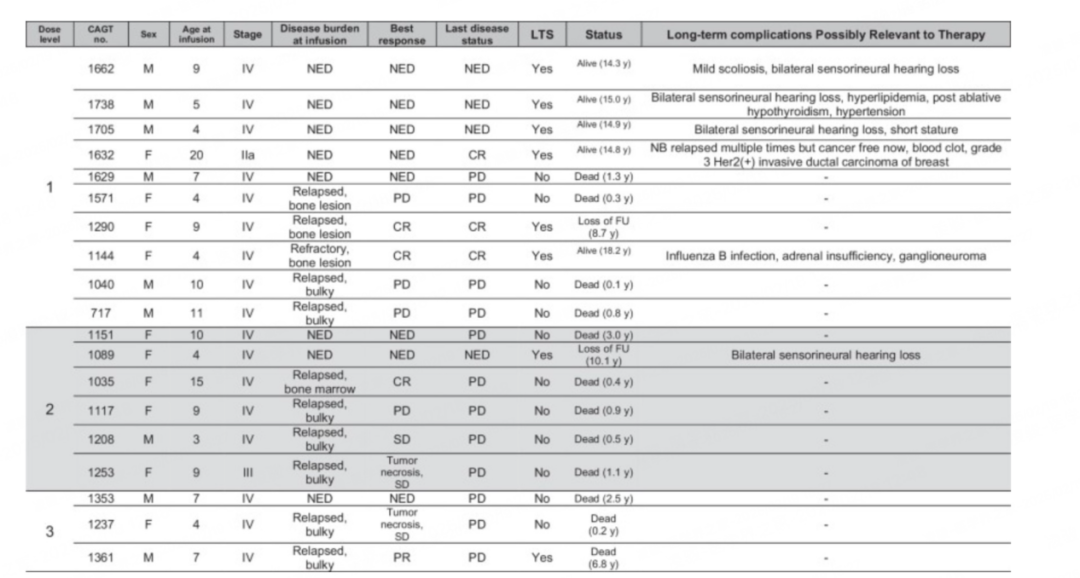
the baseline status and follow-up progress of the patients, some of whom were already in NED/CR status at the time of treatment. Source: Nature Medicine
"CAR-T therapy has some inherent limitations, such as complex preparation, a cumbersome treatment process, and the need for lymphodepletion pretreatment. Additionally, neuroblastoma is very complex, with many necrotic areas in an ischemic and hypoxic environment, making it difficult for CAR-T cells to enter the tumor and exert their killing effect."
Therefore, Wang Jinhu believes that future efforts should focus on precision medicine, grouping different types of patients for different cancers, and combining multiple treatment methods to identify the best candidates and timing for CAR-T therapy.
"In the treatment of neuroblastoma, using surgery and chemoradiotherapy to remove soft tissue lesions, followed by highly effective CAR-T therapy to clear bone marrow and bone metastases, is a promising direction for achieving long-term survival in high-risk patients."
"Based on different technological platforms and design methods, there are many types of CAR-T cells, offering infinite possibilities for curing cancer. Although progress in solid tumors has been slow, all revolutionary therapies in human medicine have developed step by step," Wang Jinhu said.
According to Wang Jinhu, his team and collaborators have also initiated the development of universal CAR-T therapy for relapsed/refractory neuroblastoma. "In early cases of 'compassionate use,' we have seen encouraging results, and we will further advance research and clinical applications in the near future."
Globally, many research institutions are exploring multi-dimensional approaches in optimizing CAR constructs and identifying innovative combination strategies. For example, "bispecific" designs target cancer cells expressing two tumor antigens simultaneously, enhancing anti-tumor activity while avoiding damage to healthy cells expressing only one antigen.
U.S. researchers have also modified CAR-T cells to both target tumor antigens and express interleukin-15 (IL-15), which promotes T-cell activation in the tumor microenvironment. In a Phase I trial, 8 out of 12 patients with solid tumors achieved disease control. The results were published in Nature in October 2024.
Gao Quanli stated that, in terms of the prospects of cancer treatment technologies, many cutting-edge therapies have shown short-term efficacy comparable to or even better than CAR-T therapy. "But the 'cancer-curing' potential demonstrated by CAR-T therapy is the fundamental driving force behind its continued development in the field."

