


On February 6, the NMPA website showed that Kelun-Biotech’s TROP2 ADC sacituzumab tirumotecan (sac-TMT) had been approved for a new indication for the treatment of adult patients with unresectable locally advanced or metastatic hormone receptor-positive (HR+) and human epidermal growth factor receptor 2-negative (HER2-) breast cancer who had previously received endocrine therapy and other systemic treatment in the advanced or metastatic setting. This indication had previously been included in the CDE priority review pathway.
Sacituzumab tirumotecan is a TROP2-targeting ADC developed by Kelun-Biotech. It consists of the humanized monoclonal antibody sacituzumab, an enzymatically cleavable linker, and the novel topoisomerase I inhibitor T030, with an average drug-to-antibody ratio (DAR) as high as 7.4.
In May 2022, Kelun-Biotech signed a collaboration agreement with Merck granting Merck exclusive rights outside Greater China to develop, use, manufacture, and commercialize sacituzumab tirumotecan. In November 2025, Merck announced that Blackstone would pay USD 700 million, non-refundable subject to termination provisions, to cover part of sacituzumab tirumotecan’s R&D costs in 2026.
To date, Merck has launched 16 global Phase III trials of sacituzumab tirumotecan across lung cancer, breast cancer, gastric cancer, and gynecologic tumors.
From a regulatory perspective, sacituzumab tirumotecan had previously been approved for three indications in China, and this is the fourth.
In November 2024, it was approved for patients with locally advanced or metastatic triple-negative breast cancer (TNBC) who had previously received at least two systemic therapies, including at least one for advanced or metastatic disease.
In March 2025, it was approved for adult patients with locally advanced or metastatic nonsquamous NSCLC harboring EGFR mutations after progression following EGFR-TKI and platinum-based chemotherapy.
In October 2025, it was further approved for adult patients with EGFR-mutant locally advanced or metastatic NSCLC after progression following EGFR-TKI treatment.
The new indication approval was based on positive results from the registrational Phase III OptiTROP-Breast02 study, a randomized, open-label, multicenter trial evaluating sacituzumab tirumotecan monotherapy (5 mg/kg, Q2W) versus investigator’s choice chemotherapy in patients with locally advanced or metastatic HR+/HER2- breast cancer (IHC 0, IHC 1+, or IHC 2+/ISH-).
At the 2025 ESMO Congress, OptiTROP-Breast02 results were formally presented. A total of 399 HR+/HER2- breast cancer patients who had previously received CDK4/6 inhibitor therapy and at least one chemotherapy regimen in the advanced or metastatic setting were randomized 1:1 to sacituzumab tirumotecan or investigator’s choice chemotherapy (ICC).
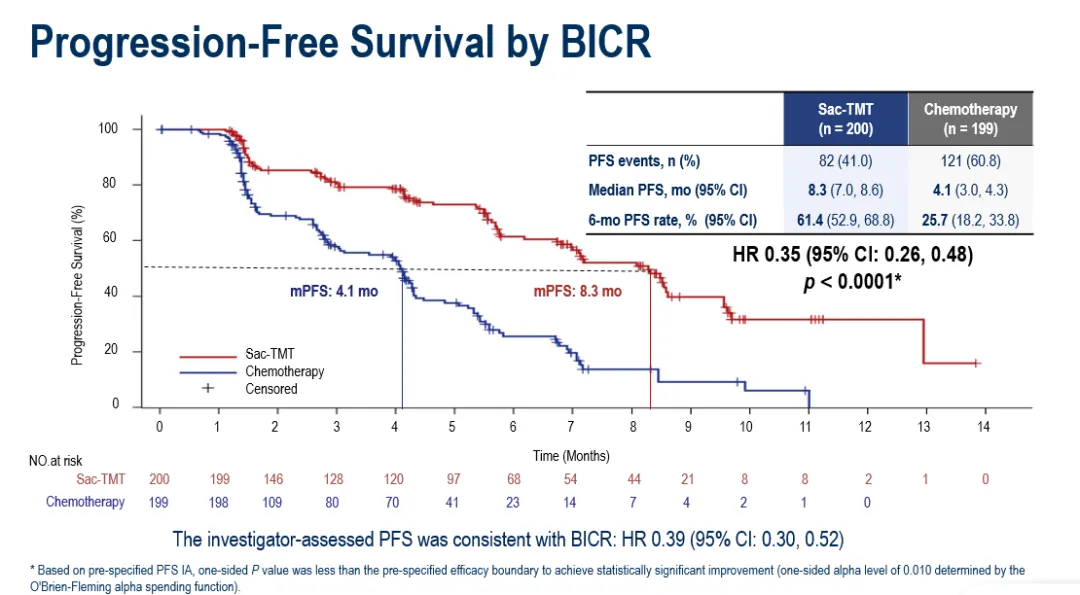
As of January 22, 2025, results showed that median progression-free survival was significantly longer with sacituzumab tirumotecan than with ICC (8.3 months vs 4.1 months), and clinical benefit was observed regardless of HER2 expression level (HR=0.39 in HER2-nonexpressing patients and HR=0.31 in HER2-low patients).
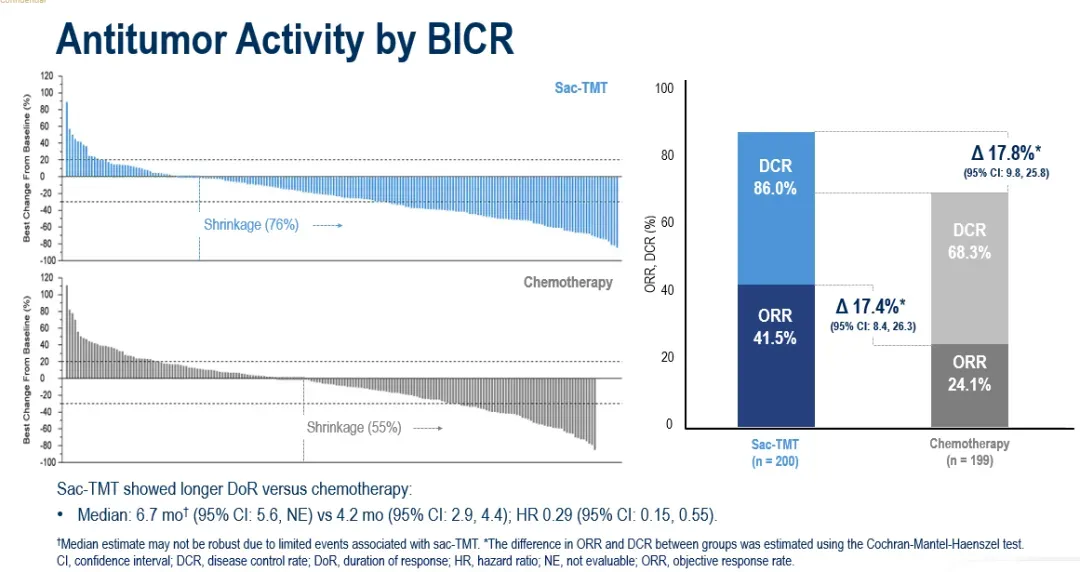
Compared with chemotherapy, sacituzumab tirumotecan also showed longer duration of response and a better objective response rate than ICC (41.5% vs 24.1%). Overall survival also showed a favorable trend for sacituzumab tirumotecan versus ICC (HR=0.33).
In terms of safety, grade 3 or higher treatment-related adverse events occurred in 62.0% of patients in the sacituzumab tirumotecan group and 64.8% of patients in the ICC group. No patients in the sacituzumab tirumotecan group and 0.5% in the ICC group discontinued treatment because of TRAEs. Pneumonitis occurred in 1.5% and 1.0% of patients, respectively, and all cases were grade 1-2.
Insight database shows that three TROP2 ADCs have so far been approved globally: sacituzumab tirumotecan (Kelun-Biotech), sacituzumab govitecan (Gilead), and datopotamab deruxtecan (Daiichi Sankyo/AstraZeneca). In China, besides the already approved sacituzumab tirumotecan, three additional TROP2 ADCs have entered Phase III development, from Fudan-Zhangjiang, Hengrui Medicine, and Shijian/Lianing Biologics.

