


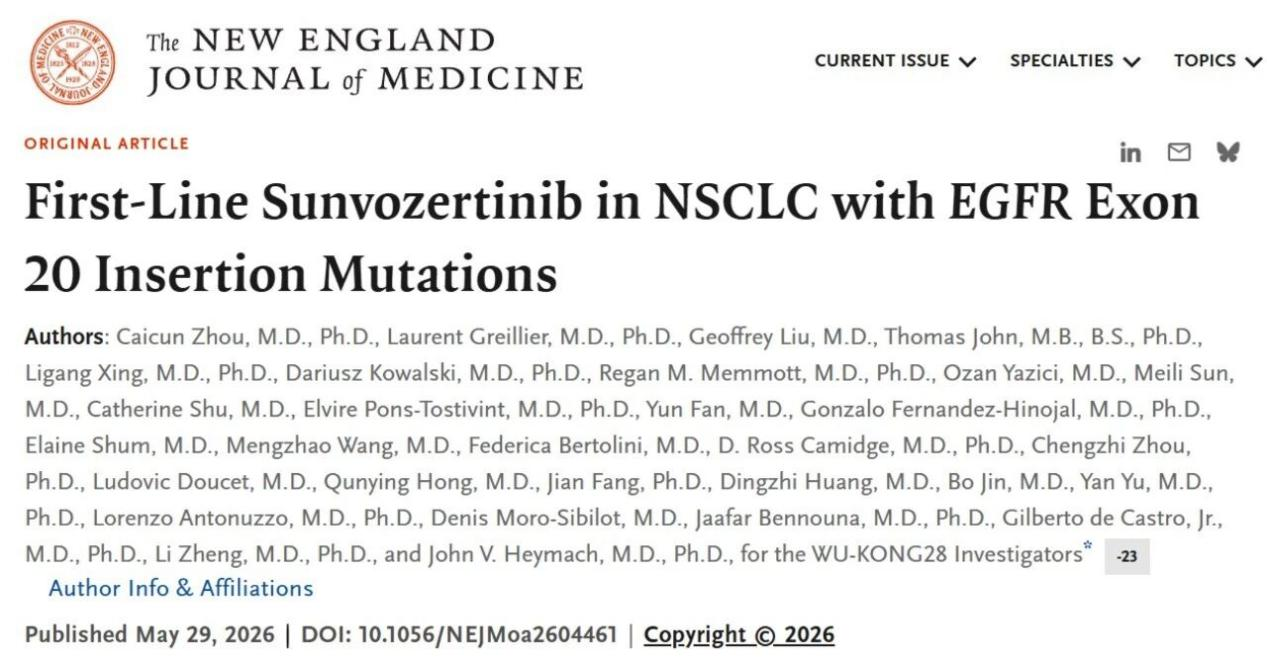
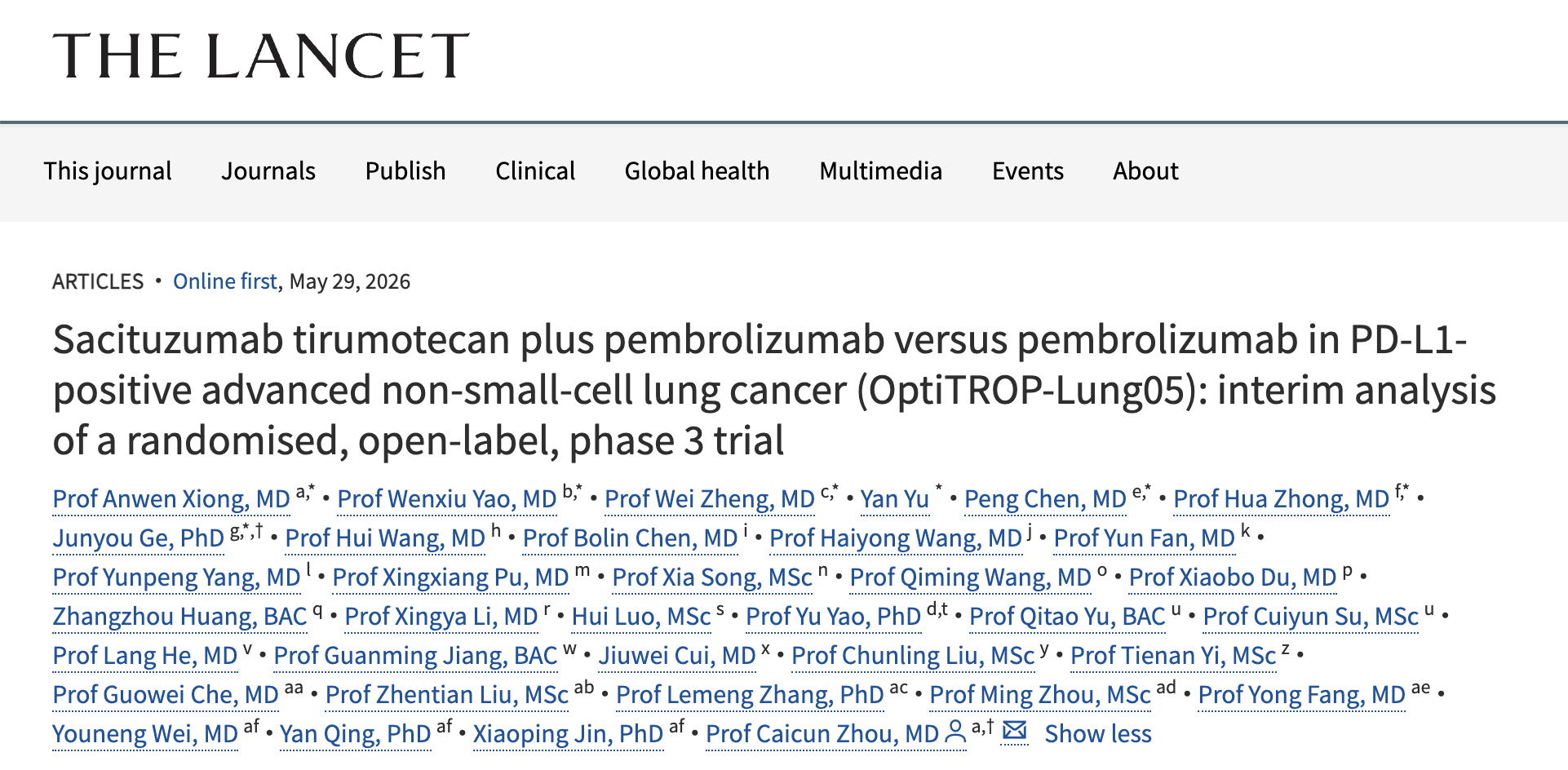
At 3:00 AM Beijing time today (May 30), two multi-center phase 3 clinical studies led by Prof. Caicun Zhou, Director of the Department of Oncology at Tongji University Affiliated Shanghai East Hospital and Director of the Cancer Institute at Tongji University School of Medicine, were orally presented at the ASCO Annual Meeting and simultaneously published in the world‘s top medical journals, The New England Journal of Medicine and The Lancet.
The two studies respectively confirmed that first-line monotherapy with sunvozertinib in EGFR exon20 insertion-mutated non-small cell lung cancer (NSCLC), and first-line sacituzumab trimetocan plus pembrolizumab in PD-L1-positive NSCLC, each significantly prolonged progression-free survival and substantially reduced the risk of disease progression compared to standard of care.
Lung cancer is the most common malignancy worldwide and the leading cause of cancer death. NSCLC accounts for approximately 85% of all lung cancer cases. Among these, EGFR exon20 insertion mutations (exon20ins) have a unique spatial conformation that renders traditional targeted therapies largely ineffective. Patients with this mutation have a significantly worse prognosis than those carrying common EGFR sensitive mutations, and first-line treatment has long relied on platinum-based chemotherapy. On the other hand, for patients with no driver mutations such as EGFR/ALK and with positive PD-L1 expression, although immunotherapy has become the standard of care, a large proportion of patients do not achieve durable remission, and better combination treatment strategies are urgently needed. The two studies led by Prof. Zhou’s team precisely address these two major clinical challenges and provide highly compelling solutions.
In the field of EGFR exon20ins, the oral, irreversible, and highly selective EGFR-TKI sunvozertinib, with its unique molecular design, has overcome this refractory target from the very beginning. The WU-KONG28 study, conducted across 15 countries and regions worldwide, directly compared sunvozertinib monotherapy versus platinum-doublet chemotherapy as first-line treatment for advanced EGFR exon20ins NSCLC. The results showed that sunvozertinib significantly improved objective response rate (58.9% vs 31.1%) and achieved both statistically and clinically significant improvement in progression-free survival (10.3 vs 7.5 months), reducing the risk of disease progression or death by 35%.
In the field of PD-L1-positive NSCLC, the novel TROP2-targeting antibody-drug conjugate (ADC) sacituzumab trimetocan, in combination with the PD-1 inhibitor pembrolizumab, showed synergistic efficacy. The OptiTROP-Lung05 study demonstrated that the combination arm significantly improved objective response rate (70.2% vs 42.0%) compared to pembrolizumab monotherapy. The median progression-free survival in the combination arm has not yet been reached (compared to 5.7 months in the control arm), with a 65% reduction in the risk of disease progression or death.
Prof. Caicun Zhou noted that the WU-KONG28 study marks that EGFR exon20ins, a mutation type long regarded as “refractory,” is finally poised to benefit from a highly effective and convenient oral targeted therapy, freeing treatment-naïve patients from reliance on traditional chemotherapy and opening a new treatment path for tens of thousands of patients worldwide. The OptiTROP-Lung05 study is the first phase 3 trial globally to demonstrate that an ADC combined with an immune checkpoint inhibitor is significantly superior to immune monotherapy in first-line treatment of PD-L1-positive NSCLC. It signifies that the treatment of driver gene-negative advanced NSCLC has formally moved from the immunotherapy era into a new epoch of precise synergy between ADC and immunotherapy.
Tongji University Affiliated Shanghai East Hospital is the primary institution responsible for these two studies, and Prof. Caicun Zhou is the principal investigator and the corresponding author of both papers. In September 2025, Prof. Zhou officially assumed the position of Chair of the Board of Directors of the International Association for the Study of Lung Cancer (IASLC), becoming the first Chair from China in the organization’s over-50-year history. These two studies brought together leading lung cancer research centers from multiple countries worldwide, including the United States, the European Union, Australia, Brazil, Argentina, and Türkiye, fully demonstrating the exceptional capability of Chinese clinical research teams in international multi-center collaboration. They also set a new benchmark for the global journey of innovative drugs originating from China.
The New England Journal of Medicine original article link:
https://www.nejm.org/doi/full/10.1056/NEJMoa2604461?query=featured_home
The Lancet original article link:
https://www.thelancet.com/journals/lancet/article/PIIS0140-6736(26)00968-2/abstrac

