


The global oncology market is expected to exceed US$370 billion by 2030, reinforcing its status as the most valuable therapeutic field worldwide. Even with obesity and metabolic disease drawing intense attention, oncology remains the arena in which large pharmaceutical companies continue to fight for long-term strategic dominance. According to Evaluate forecasts cited in the original article, the top-five ranking in oncology could be reshaped by 2030, with Johnson & Johnson emerging as the company most likely to climb toward the top tier.
From Late Line to Front Line: J&J Built Its Foundation in Hematologic Malignancies
More than two decades ago, J&J entered hematologic malignancies through acquisitions and external partnerships. In 2003, it reached a commercialization and clinical-development agreement with Millennium to obtain rights outside the United States for bortezomib, a proteasome inhibitor that had just been approved by the U.S. FDA for heavily pretreated multiple myeloma. Bortezomib became a landmark therapy in multiple myeloma and, as its indications expanded from later lines to frontline use and into mantle cell lymphoma, it quickly grew into a blockbuster.
A second major pillar arrived in 2011 when J&J partnered with Pharmacyclics on ibrutinib, a first-in-class BTK inhibitor. After accelerated FDA approval in mantle cell lymphoma in 2013 and approval in previously treated chronic lymphocytic leukemia in 2014, ibrutinib continued moving forward. In 2016, it became the first chemotherapy-free frontline option approved for CLL, a genuinely milestone-setting event. Although the BTK inhibitor space is now crowded, ibrutinib’s first-mover advantage generated substantial returns and helped J&J establish a powerful presence in hematology.
The true watershed came in 2015 with daratumumab, the first approved CD38 monoclonal antibody. Originally discovered by Genmab and licensed by J&J in 2012, daratumumab won accelerated approval in relapsed or refractory multiple myeloma and then quickly moved from later-line use to second line and then frontline therapy. As indications expanded and treatment lines moved forward, the drug evolved into a backbone therapy in multiple myeloma. J&J also developed a subcutaneous formulation, and in Europe, the United States, and Japan it has been approved for high-risk smoldering multiple myeloma, marking an important advance in earlier intervention.
After nearly a decade of expansion, daratumumab has become a cornerstone of multiple-myeloma treatment. The article notes that revenue reached US$14.351 billion in 2025, up 23.0% year on year. That pace of growth, a full decade after launch, shows just how durable the franchise has become.
J&J did not stop there. In 2017, it partnered with Legend Biotech on ciltacabtagene autoleucel, a BCMA-directed CAR-T therapy. The product was approved in 2022 for heavily pretreated multiple-myeloma patients and later moved into earlier relapse settings. Revenue reached US$1.887 billion in 2025, up 95.9% year on year, and U.S. pricing has climbed from US$465,000 to US$549,700, underscoring the therapy’s commercial potential.
The company also brought in two more first-in-class CD3 bispecific antibodies from Genmab: teclistamab, targeting BCMA/CD3, and talquetamab, targeting GPRC5D/CD3. Teclistamab became the first approved BCMA/CD3 bispecific in 2022 and generated US$670 million in 2025 revenue. In March 2026 it received another FDA approval in combination with daratumumab for patients who had received at least one prior therapy including a proteasome inhibitor and an immunomodulator. Talquetamab, approved in 2023, became the first GPRC5D/CD3 bispecific and posted US$463 million in 2025 revenue, up 61.3% year on year.
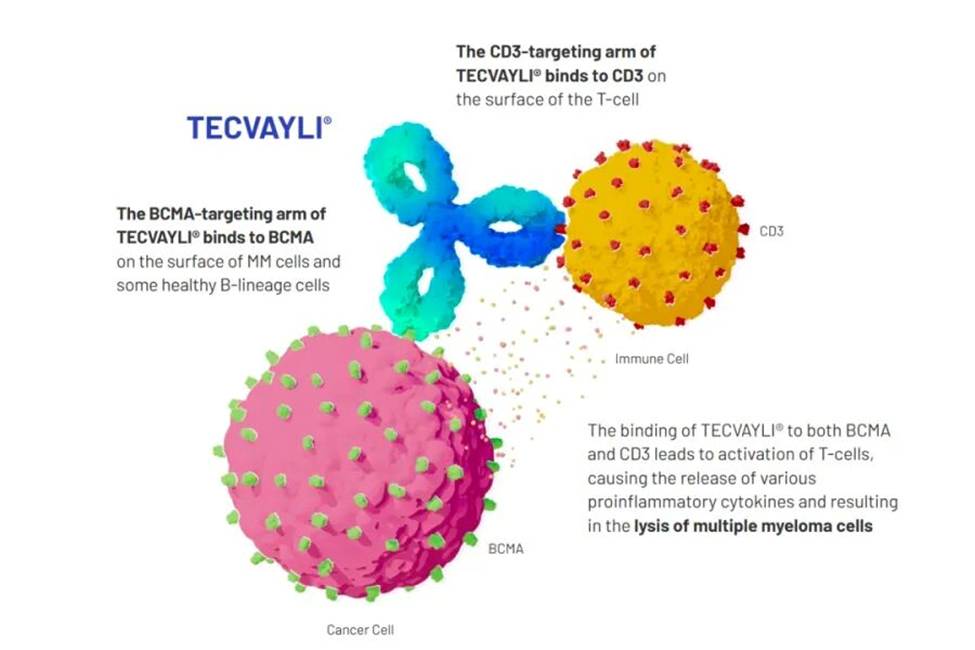
Mechanism illustration for teclistamab from Janssen Research & Development.
Taken together, J&J has built a remarkably broad moat in blood cancers, especially in multiple myeloma. Its portfolio now spans from frontline to late-line treatment, with overlapping mechanisms and modalities that strengthen physician familiarity and reinforce market position.
In Solid Tumors, J&J Looked for Blue Water Inside a Red Ocean
Solid tumors are both too important to ignore and too competitive to enter casually. J&J’s answer was not to chase the busiest lanes without differentiation but to identify disease areas where clinical needs remained significant and strategic positioning was still possible. Prostate cancer became one of those chosen battlegrounds.
Before 2010, overall survival for advanced prostate cancer had not improved in a meaningful way. In 2011, J&J’s abiraterone, obtained through the acquisition of Cougar Biotechnology, was approved for metastatic castration-resistant prostate cancer after docetaxel and was later expanded into earlier lines. It rapidly became a central product in mCRPC, reaching peak annual sales of nearly US$3.5 billion in 2018 and dominating endocrine treatment in prostate cancer for years.
When abiraterone approached the patent cliff, J&J’s second-generation androgen receptor inhibitor apalutamide, obtained through the acquisition of Aragon Pharmaceuticals, entered the picture. Approved in 2018 for non-metastatic castration-resistant prostate cancer, it became the first global approval in that setting. Sales reached US$2.999 billion in 2024 and US$3.574 billion in 2025, showing that J&J had successfully created a second growth engine in prostate cancer.
The company has continued to push precision approaches, including the niraparib plus abiraterone fixed-dose combination Akeega, approved in 2023 for BRCA-mutated mCRPC and later expanded in Europe to BRCA1/2-mutated metastatic hormone-sensitive disease. At the same time, J&J deliberately stepped away from the crowded PSMA path and instead selected KLK2 as a differentiated target because it remains stably expressed even in patients with downregulated PSMA.
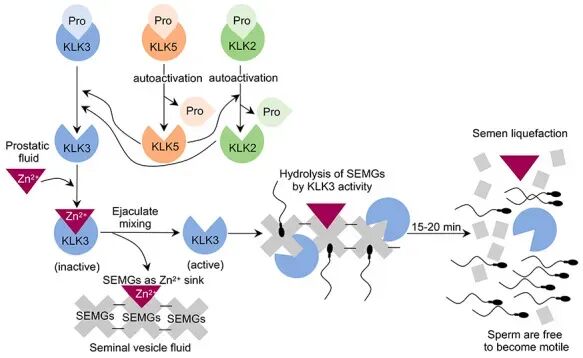
A KLK2 pathway figure highlights the rationale for J&J’s differentiated targeting strategy in prostate cancer.
In the KLK2 space, J&J is advancing pasritamig, a potentially first-in-class KLK2/CD3 bispecific antibody now in a global multicenter phase III trial across countries including China, the United States, Japan, and France. The company is also developing KLK2-focused CAR-T and radioligand or RDC programs in phase I. Another notable program is HLD-0915, acquired through Halda Therapeutics. This oral first-in-class RIPTAC agent simultaneously binds androgen receptor and BRD4, creating a trimeric complex that functionally knocks down BRD4 and produces antitumor activity. In early clinical results summarized in the article, 42% of treated patients achieved a PSA50 response and 23% achieved a PSA90 response; among patients completing at least two treatment cycles, the response rates were even higher.
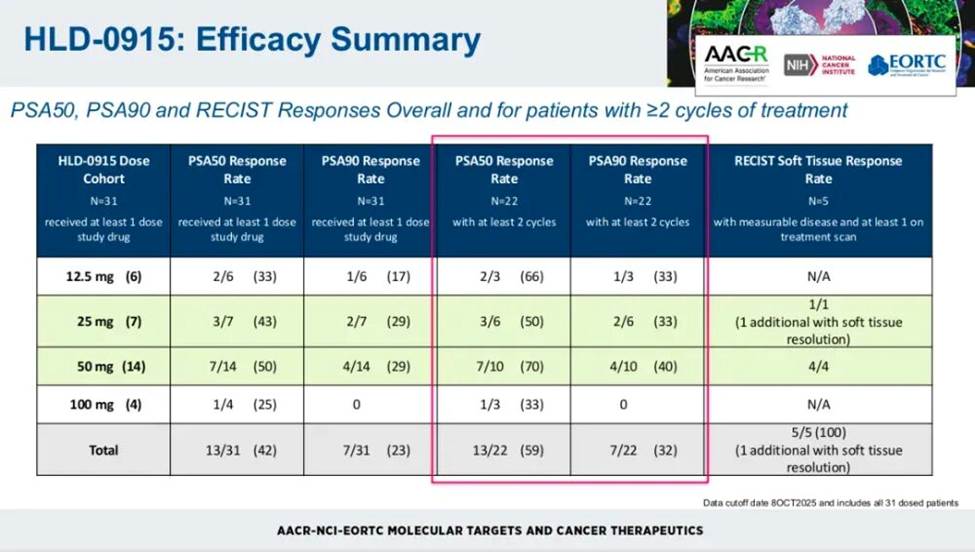
Early clinical efficacy summary for HLD-0915 from Halda Therapeutics.
Outside prostate cancer, J&J has also pursued differentiated strategies in lung cancer. Rather than trying to build a simple me-too challenger to osimertinib, it focused on amivantamab, a c-MET/EGFR bispecific antibody intended to address MET-amplification resistance in EGFR-mutant disease. The drug was first approved in 2021, and in late 2025 the FDA approved a subcutaneous formulation combined with lazertinib for frontline EGFR-mutant non-small cell lung cancer. The company says amivantamab has now won four NSCLC-related approvals globally and generated US$734 million in 2025.
J&J also launched TAR-200, later branded INLEXZO, for high-risk non-muscle-invasive bladder cancer in 2025. The product is a drug-device combination placed in the bladder to release gemcitabine over a three-week period. In the SunRISe-1 phase II trial cited in the source article, 82% of evaluable patients achieved complete disappearance of tumor lesions, with tolerable adverse effects. The design is noteworthy not only as a bladder-cancer asset but also as a milestone in long-duration local drug delivery.
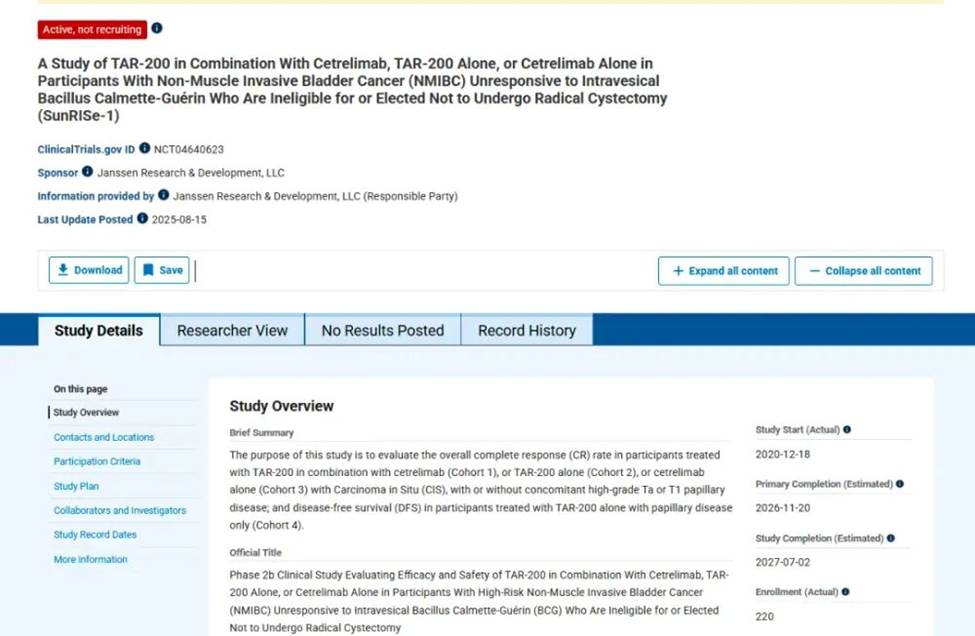
SunRISe-1 trial results supported the breakthrough positioning of TAR-200 in bladder cancer.
What J&J’s Path Means for Chinese Innovators
The article closes by drawing lessons for Chinese biopharma. First, everything starts with a major unmet clinical need. J&J repeatedly chose disease settings where real therapeutic gaps existed and then invested in genuine treatment advances. The lesson is not simply to chase first-in-class labels, but to pair differentiated science with strong clinical development that can move a drug forward into earlier lines and optimal combinations.
Second, J&J repeatedly upgraded its technological stack. When PD-1 became crowded, it pushed into bispecifics. When ADCs became intensely competitive, it had already begun exploring radiopharmaceuticals and other next-generation modalities. In crowded spaces, the company’s answer has often been not just to move faster, but to move to a different technological layer.
Third, it thinks in combinations and disease franchises rather than single assets. Multiple myeloma is the clearest example: instead of relying on one star product, J&J has assembled a therapeutic matrix spanning many lines and mechanisms, making it harder for competitors to dislodge the franchise.
Fourth, its business-development strategy combines decisiveness with patience. Partnerships with Genmab, the bet on Pharmacyclics, and acquisitions such as Ambrx all reflect a willingness to assume early risk and then spend many years realizing the full potential of those assets. For Chinese companies with sufficient resources, identifying undervalued global platforms in areas such as radiopharmaceuticals or multispecific antibodies may offer a path through future cycles.
In the end, oncology remains a perpetual contest of succession. J&J’s decades-long expansion shows what strategic precision, sustained clinical execution, and technological boldness can achieve. CEO Joaquin Duato has stated publicly that the company aims to reach US$50 billion in oncology revenue by 2030. Based on the breadth of its current strategy, that ambition no longer sounds remote.

