


On 16 July 2026, the National Medical Products Administration (NMPA) website showed that iza-bren (brand name: Yizekang; Chinese generic name: Lunkangyilongtuo monoclonal antibody; international nonproprietary name: izalontamab brengitecan) — a first-in-class EGFR×HER3 bispecific antibody-drug conjugate (ADC) independently developed by Sichuan Baili Tianheng Pharmaceutical — has been approved by the NMPA for the treatment of adult patients with recurrent or metastatic esophageal squamous cell carcinoma (ESCC) who have previously failed treatment with a PD-1/PD-L1 monoclonal antibody combined with platinum-containing chemotherapy.
Approval is based on the PANKU-Esophagus01 (BL-B01D1-305) study, the world’s first Phase 3 registrational trial of an ADC to achieve dual primary-endpoint positivity in ESCC. Compared with chemotherapy (irinotecan/paclitaxel/docetaxel), iza-bren delivered significantly improved efficacy:
l Progression-free survival (PFS) more than doubled (4.17 vs 1.97 months, HR=0.50, P<0.0001), with a 6-month PFS rate of 32.7% — more than twice that of chemotherapy (14.7%);
l Overall survival (OS) extended by 2.6 months (9.79 vs 7.20 months, HR=0.64, P=0.0004), with a 12-month OS rate of 34.8% versus 22.5% with chemotherapy;
l Objective response rate (ORR) increased nearly threefold (35.3% vs 13.1%) (1).
As the world’s first approved bispecific ADC, iza-bren fills a gap in second-line treatment for patients with ESCC who have progressed on immunotherapy, and is expected to reshape the treatment landscape. It marks the formal entry of ESCC therapy into the era of bispecific ADCs, with Chinese patients among the first in the world to benefit from this novel therapy.
Iza-bren Reshapes the ESCC Treatment Landscape and Opens the Bispecific ADC Era
ESCC is a high-incidence cancer with a distinctly Chinese disease profile, carrying a heavy disease burden and a long-standing treatment challenge. Although immune checkpoint inhibitor plus chemotherapy has become the standard first-line regimen for advanced disease, second-line treatment after progression has long been stuck in a clinical impasse of “no standard of care, no highly effective option, no durable benefit.” The approval of iza-bren has fundamentally rewritten the existing landscape of second-line ESCC treatment across three dimensions: clinical, evidence-based, and industrial.
The incidence of esophageal cancer in China accounts for approximately half of the global total (2), and 85%-90% of cases are squamous cell carcinoma, with most patients diagnosed at an advanced stage (3). After first-line immune checkpoint inhibitor plus chemotherapy, traditional single-agent chemotherapy yields an ORR below 10%, median PFS of only 1.6-3.1 months, and median OS of only 6.2-7.1 months (4-6). No high-level evidence currently supports a highly effective and safe standard second-line regimen for clinical use. The approval of iza-bren provides, for the first time, an indication-specific standard second-line option for advanced ESCC after first-line immunotherapy progression, and brings an end to the passive situation of “no drug available, treatment by experience.”
An Evidence Base Rebuilt: Filling a Long-Standing Gap in “Domestic High-Level Phase 3 Dual-Endpoint Positivity” for ESCC Second-Line Therapy.PANKU-Esophagus01 is the world’s first Phase 3 trial of an ADC in second-line ESCC to achieve dual primary-endpoint positivity (PFS and OS). It is the first study to demonstrate that a bispecific ADC outperforms traditional chemotherapy across both efficacy endpoints, providing high-level evidence for China and establishing a new efficacy benchmark for ESCC second-line therapy globally.
An Industry Landscape Reshaped: Chinese Innovation Leads the Global Bispecific ADC Field.In November 2025, the PANKU-Esophagus01 interim analysis announced dual primary-endpoint success; in January 2026, the ESCC marketing application was accepted by the Center for Drug Evaluation (CDE) and granted priority review; in June 2026, the study was presented in an oral session at the American Society of Clinical Oncology (ASCO) Annual Meeting; in July 2026, the NMPA formally approved iza-bren for the new ESCC indication. From CDE acceptance to formal approval, the process took less than six months. Behind this efficient review is the urgency of unmet clinical need and a strong regulatory recognition of the clinical value of domestic innovation.
As the world’s first approved bispecific ADC, iza-bren was developed in China with the pivotal trial led by a Chinese team and has produced globally leading evidence — marking Chinese innovative drugs in the ADC field for solid tumors as having joined the global first tier.
Iza-bren Sets a New Benchmark for ESCC Second-Line Therapy and Opens the Bispecific ADC Era
With robust dual-endpoint positive results, the PANKU-Esophagus01 study comprehensively validates the clinical value of iza-bren across three dimensions — tumor shrinkage, disease control, and survival benefit — and redefines the efficacy ceiling of second-line ESCC treatment.
PFS Doubled, With a 50% Reduction in the Risk of Progression or Death
The study showed that iza-bren achieved a median PFS of 4.17 months, more than double the chemotherapy group’s 1.97 months, with a 50% reduction in the risk of disease progression or death (HR=0.50, P<0.0001). The 6-month PFS rate reached 32.7% — more than twice that of the chemotherapy group (14.7%) — meaning that nearly one-third of patients in the iza-bren group had not progressed at six months, compared with less than one-seventh in the chemotherapy group.
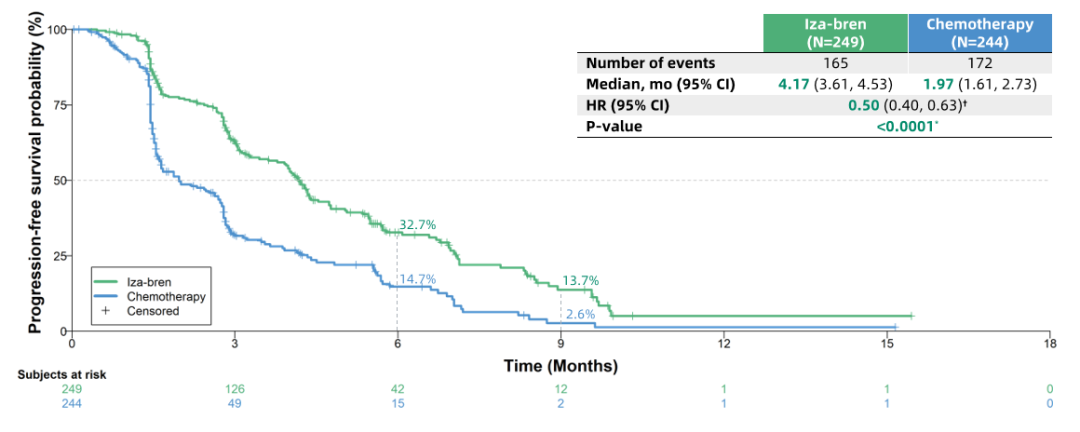
Fig. 1. PFS in the Iza-bren Group Versus the Chemotherapy Group in PANKU-Esophagus01
Median OS Approaching 10 Months: Breaking the Second-Line Survival Ceiling
OS is the gold standard for evaluating the clinical value of an oncology drug. At a median follow-up of 7.8 months (information maturity 71.7%), iza-bren achieved a median OS of 9.79 months, a significant 2.6-month extension over the chemotherapy group’s 7.20 months, with a 36% reduction in the risk of death (HR=0.64, P=0.0004). The 12-month OS rate with iza-bren was 34.8% — more than one-third of patients surviving beyond the one-year mark. For a long time, the median OS in second-line treatment after immunotherapy resistance in advanced ESCC has hovered at 6-7 months, with few breakthrough advances. By raising median OS to nearly 10 months, iza-bren delivers a milestone survival breakthrough in the field over the past decade. This result not only establishes iza-bren as the standard of care in ESCC second-line therapy but also brings hope and a brighter outlook for long-term survival.
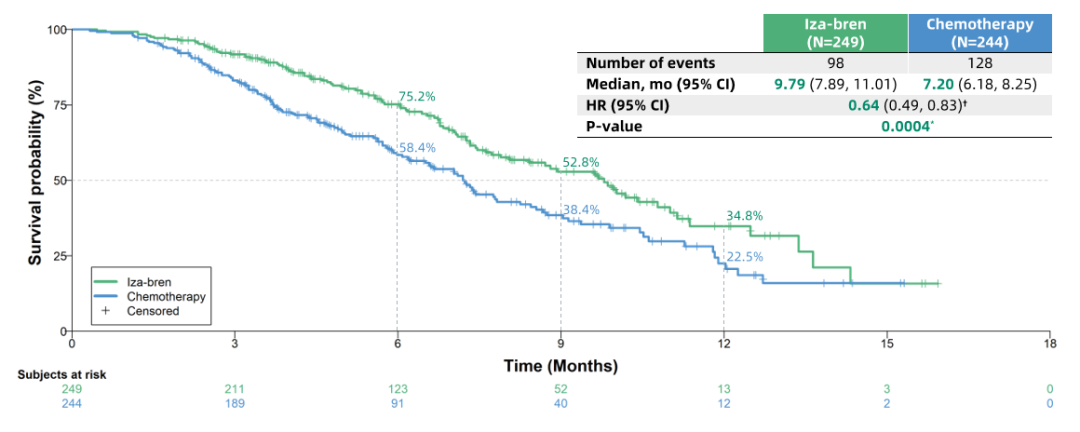
Fig. 2. OS in the Iza-bren Group Versus the Chemotherapy Group in PANKU-Esophagus01
ORR Nearly Tripled, With Rapid Improvement in Quality of Life
The BICR-assessed ORR in the iza-bren group reached 35.3%, nearly three times that of the chemotherapy group (13.1%). 65.9% of patients experienced reduction in target lesions, with a median tumor shrinkage of -31.5%, compared with 38.5% and -20.5% in the chemotherapy group. For ESCC patients, rapid tumor shrinkage carries direct clinical meaning — alleviation of cancer-related symptoms and improvement in nutritional status and quality of life.
Consistent Subgroup Benefit and Manageable Safety
Subgroup analysis showed that, regardless of baseline ECOG score, age, or prior receipt of curative-intent treatment, PFS and OS benefit trends were consistent across subgroups, confirming the broad clinical applicability of the drug.
In terms of safety, adverse events with iza-bren were predominantly hematologic in nature, with grade ≥3 neutropenia and thrombocytopenia typically recovering within 4 days. Non-hematologic adverse events were mostly low-grade. With dose delay, dose reduction, and standard supportive care, the vast majority of patients were able to continue iza-bren treatment. In addition, the incidence of interstitial lung disease (ILD) was very low, and the overall safety risk was manageable (1).
A Differentiated Dual-Target Design: A New Path for Immune-Resistant Disease
The breakthrough nature of iza-bren lies in the unique design of its EGFR×HER3 bispecific ADC. Iza-bren simultaneously binds EGFR with high affinity and HER3 with low affinity, blocking the formation of heterodimers upstream. It is conjugated via a cathepsin B-cleavable linker to a novel topoisomerase I inhibitor, Ed-04, with a drug-to-antibody ratio (DAR) of approximately 8. The agent combines direct cytotoxic killing, bystander effect, and antibody-dependent cellular cytotoxicity (ADCC), thereby maintaining potent antitumor activity even in immune- and chemotherapy-resistant microenvironments.
Clinical use does not require pre-screening for EGFR or HER3 expression, which substantially lowers the barrier to clinical adoption and facilitates rapid implementation across medical institutions of all levels, benefiting all patients meeting the indication.
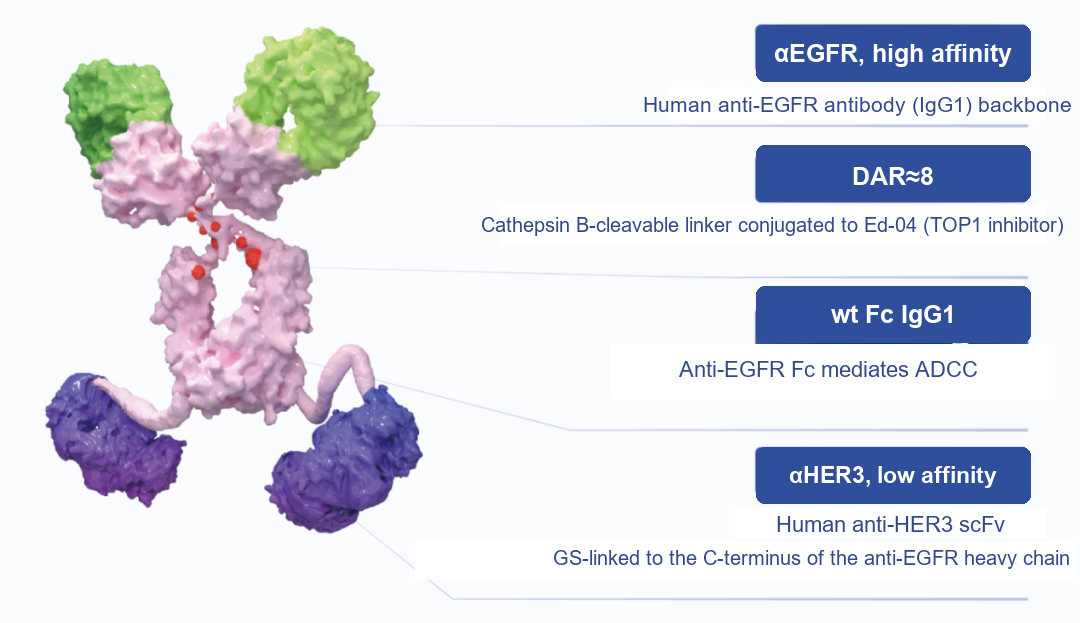
Fig. 3. Structural Diagram of Iza-bren
Conclusion
The approval of iza-bren fills a long-standing gap in second-line treatment for ESCC and brings an end to the absence of a standard regimen in this setting. With high-level, dual-endpoint evidence, it is positioned to become the preferred option for ESCC second-line therapy, driving standardization of clinical practice and meaningfully extending survival and improving quality of life for patients.
Iza-bren is currently being explored in first-line ESCC, and parallel development is under way in triple-negative breast cancer, non-small cell lung cancer, and other tumor types. As real-world application accumulates and additional data emerge, this bispecific ADC is expected to cover a broader range of treatment scenarios, benefit more patients with solid tumors, and contribute Chinese insight and innovation to global oncology care.
References
1. Zhihao Lu, et al. Izalontamab brengitecan (iza-bren) versus chemotherapy in patients with recurrent or metastatic esophageal squamous cell carcinoma (ESCC): A multicenter, randomized, open-label, phase III study. 2026 ASCO. 4008.
2. Xu Y, et al. Divergent trends in the burden of esophageal, gastric, and liver cancers in China. Journal of the National Cancer Center, 2025.
3. Chen R, et al. Patterns and trends in esophageal cancer incidence and mortality in China: an analysis based on cancer registry data. Journal of the National Cancer Center, 2023, 3(1): 21-27.
4. Huang J, et al. Camrelizumab versus investigator’s choice of chemotherapy as second-line therapy for advanced or metastatic oesophageal squamous cell carcinoma (ESCORT): a multicentre, randomised, open-label, phase 3 study. Lancet Oncol. 2020;21(6):832-842.
5. Kojima T, et al. Randomized Phase III KEYNOTE-181 Study of Pembrolizumab Versus Chemotherapy in Advanced Esophageal Cancer. J Clin Oncol. 2020;38(35):4138-4148.
6. Shen L, et al. Tislelizumab Versus Chemotherapy as Second-Line Treatment for Advanced or Metastatic Esophageal Squamous Cell Carcinoma (RATIONALE-302): A Randomized Phase III Study. J Clin Oncol. 2022;40(26):3065-3076.

