


Insulin was discovered in 1921 by Canadian physician Frederick Banting and his assistant Charles Best at the University of Toronto, who successfully extracted a glucose-lowering substance from dog pancreases and named it “insulin.” The following year, this purified substance was injected into a 14-year-old patient with diabetes, and insulin was shown to be an effective treatment for the disease. In 1923, Banting was awarded the Nobel Prize in Physiology or Medicine.
For more than a century, insulin has continued to evolve and remains an irreplaceable cornerstone of diabetes therapy. The global insulin market has long been dominated by three major players — Novo Nordisk, Sanofi, and Eli Lilly — which together account for more than 80% of global insulin sales. That landscape, however, now appears to be shifting. After decades of near-monopoly control of the global insulin supply, the “big three” have collectively announced the suspension of several insulin products in Europe, opening a multi-billion-dollar gap in a long-established market. As this gap emerges, can Chinese pharmaceutical companies seize the moment and step in?
A Brief History of Insulin Preparation Evolution
The discovery of insulin not only saved countless lives but also profoundly advanced our understanding of disease biology. In the early clinical use of insulin, physicians observed striking differences in insulin sensitivity between young, lean patients and middle-aged, overweight patients. In the 1950s, American physicist Rosalyn Yalow developed radioimmunoassay, a technique sensitive enough to detect that so-called “non-sensitive” diabetic patients did, in fact, have insulin in their blood. This overturned the prevailing view that adult-onset diabetes was caused by insulin deficiency and directly led to the classification of diabetes into type 1 (insulin-dependent) and type 2 (non-insulin-dependent). With subsequent advances in immunology and genetics, type 1 diabetes was confirmed as a chronic autoimmune disease, and a three-stage pathogenic model was proposed — autoantibody appearance, dysglycemia, and clinical diagnosis. For type 2 diabetes, the underlying pathology came to be understood as insulin resistance combined with progressive β-cell failure. These mechanistic breakthroughs paved the way for the iterative improvements in clinical insulin formulations.
At the clinical level, insulin has gone through three generations of development — from animal-derived extracts to genetic engineering, and on to precisely engineered analogs. Early animal-derived insulin was limited in supply (23,000 animal pancreases yielded only about one pound of insulin) and, because its structure differed from human endogenous insulin, was highly immunogenic, frequently causing allergic reactions and lipoatrophy at injection sites.
Recombinant DNA technology, introduced in 1978, broke this impasse. Genentech developed recombinant human insulin, which substantially reduced the risk of immune reactions. In 1982, recombinant human insulin developed by Genentech and licensed to Eli Lilly received FDA approval, ushering insulin into the era of humanized therapy. This licensing arrangement propelled Eli Lilly to the forefront of the industry, and recombinant human insulin has long held around 60% of the U.S. insulin market.
Although recombinant human insulin addressed many of the shortcomings of animal-derived insulin, it still imperfectly mimicked physiological insulin secretion: when used as a prandial insulin, it acted too slowly, and when used as a basal insulin, its duration of action was too short. To address this, scientists developed third-generation insulin analogs by modifying amino acid sequences. By altering amino acid structures or applying related modifications, the pharmacokinetic profile of insulin — including onset, peak, and duration of action — was changed while preserving its biological activity and stability.
In 1996, Eli Lilly’s rapid-acting insulin lispro (Humalog) received FDA approval. By switching the order of two amino acids on the B-chain, lispro dissociated rapidly into monomers, becoming the world’s first rapid-acting insulin analog.
In 1999, Novo Nordisk’s rapid-acting insulin analog NovoRapid (insulin aspart) was approved in Europe and, the following year, in the United States, breaking Eli Lilly’s grip on the American insulin market. Before this, Novo Nordisk had also introduced the world’s first prefilled insulin pen, a major innovation in insulin delivery that simplified the injection process.
While Eli Lilly and Novo Nordisk were competing fiercely in the insulin market, Sanofi introduced insulin glargine (Lantus), which was approved by the FDA in 2000. By shifting the isoelectric point to slow absorption, glargine enabled once-daily basal glycemic control, becoming the world’s first once-daily long-acting insulin analog. For many years, Lantus held the position of the world’s top-selling diabetes medicine.
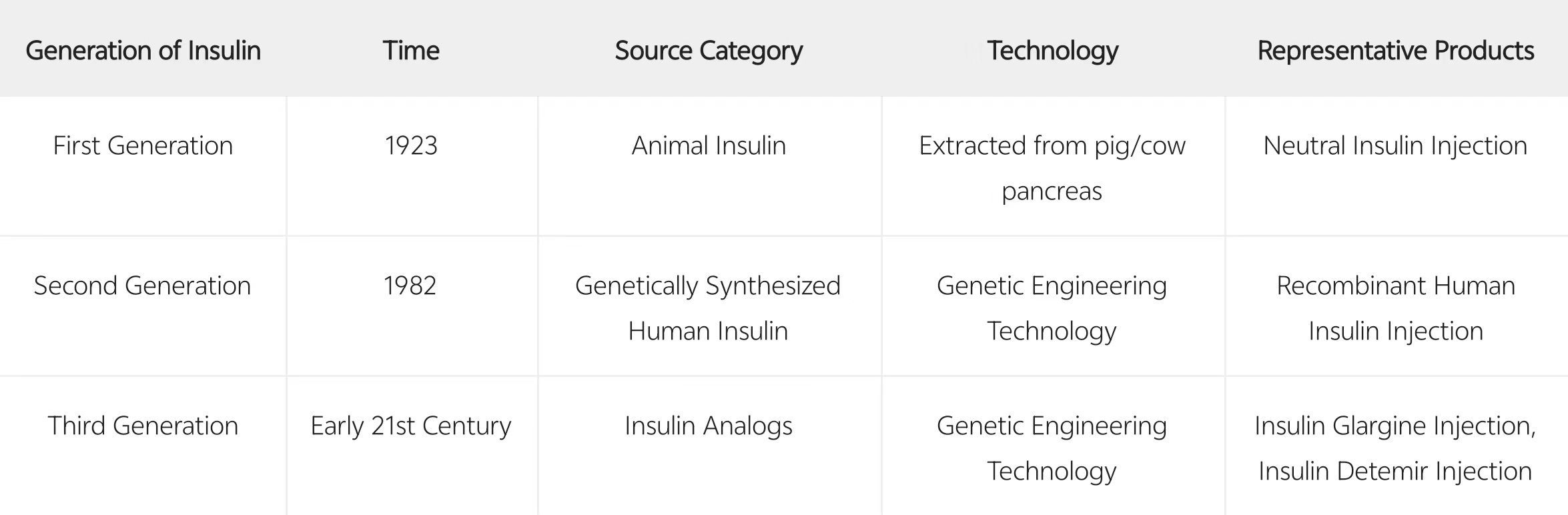
Fig. 1. Three Generations of Insulin Products. Source: Public Information
Subsequently, Novo Nordisk introduced Levemir (insulin detemir), the world’s first soluble long-acting basal insulin analog, with a duration of action of up to 24 hours. To balance patient adherence and stable glycemic control, the company also developed the world’s first soluble dual insulin — Ryzodeg (insulin degludec/insulin aspart, 70% degludec + 30% aspart) — reducing injection frequency while lowering the risk of hypoglycemia. More recently, Novo Nordisk launched insulin icodec, the world’s first once-weekly insulin formulation, which significantly reduces injection frequency and may improve quality of life for patients.
Through these waves of innovation, Novo Nordisk, Eli Lilly, and Sanofi — through continuous research and clinical trials — have driven the development of insulin therapy and met the diverse treatment needs of patients with diabetes. With decades of accumulated channel advantages and brand inertia, the three companies have long held decisive influence over the global insulin market. According to public information, in 2015 the global insulin market was largely divided among Novo Nordisk (40.1%), Sanofi (38.9%), and Eli Lilly (18.0%), with all other companies holding just 3% combined. Of the 43 insulin products approved by the European Medicines Agency between 1996 and 2022, more than 95% came from these three companies.
Giants Retreat; A Gap Emerges
For more than two decades, the global insulin market — and the Chinese market in particular — has been dominated by the three incumbents. Before 1998, Chinese patients depended entirely on imported insulin. In 1923, Franklin McLean, then president of the Peking Union Medical College, remarked that producing insulin in China “would be extremely expensive.” It was not until Tonghua Dongbao and Gan & Lee Pharmaceutical successively overcame the technical challenges of recombinant human insulin and analogs, launching rapid-acting, long-acting, and premixed products, that China finally broke through the foreign stronghold. Having products on the market, however, did not translate into market share, as the multinational incumbents retained their dominance through established brands and distribution networks.
The turning point came in 2021, when China included insulin in the national centralized drug procurement program for the first time. This dealt a heavy blow to the high-margin models of the foreign players but opened a path for domestic companies to leapfrog. By the second round of insulin-specific volume-based procurement, which was implemented in 2024, the domestic share had risen from approximately 31% before the program to 45%. In this round, domestic companies such as Gan & Lee, Tonghua Dongbao, and Sunshine Lake Pharma demonstrated strong ambition, with several products placed in Group A1 to secure 100% of the procurement volume. The multinational incumbents, by contrast, appeared disengaged: Novo Nordisk’s insulin detemir was even disqualified for bidding above the valid declared price, and several products from Eli Lilly and Sanofi were relegated to Groups B and C. While volume-based procurement has expanded domestic share, it has also nearly halved the size of the Chinese insulin market, which fell from more than 30 billion yuan in 2019 to approximately 19.2 billion yuan in 2023. The strategy of trading price for volume has made the ceiling in the domestic market clearly visible.
At the same time, the global market is undergoing significant turbulence. In Europe, the concentration of biosimilars and strict national price controls have driven down the median price of originator glargine, leaving the multinational incumbents with only marginal profits at best. A more critical challenge comes from the explosive growth of GLP-1 receptor agonists. Blockbuster products such as semaglutide and tirzepatide offer both glycemic control and weight loss, with annual sales frequently reaching tens of billions of U.S. dollars, making them genuine “cash machines.” Under the lure of these high profits, traditional insulin has been strategically deprioritized.
In March of this year, Eli Lilly announced that it would stop selling insulin lispro, insulin glargine, and several other insulin products in Europe by the second quarter of 2027. Around the same time, Novo Nordisk also announced that, for commercial reasons, it would discontinue sales of several specific insulin formulations. Sanofi has also indicated that, due to insufficient manufacturing capacity, shortages of insulin lispro were seen across Europe in the first quarter of the year.
In the United States, the 2022 Inflation Reduction Act capped patient out-of-pocket insulin costs at $35 per month, upending the foreign players’ high-margin business model and forcing the big three to cut prices significantly and reduce their footprint. In 2023, Novo Nordisk announced that its long-acting insulin Levemir would be discontinued by the end of 2024, a development that has come to symbolize broader industry change.
The collective withdrawal of the multinational incumbents has opened a multi-billion-dollar gap in the global insulin market, and it is at precisely this moment that mature Chinese pharmaceutical companies are presented with a significant overseas opportunity.
The Breakout Path of Chinese Insulin
For Chinese pharmaceutical companies, this is not a simple matter of filling a gap but a breakout based on solid manufacturing capabilities. As protein-based biologics, insulins face a much higher threshold for overseas launch than chemical generics. Both the European regulator and the U.S. FDA impose stringent reviews of process stability and quality consistency. Companies must demonstrate that their products are highly similar to the reference product in quality, safety, and efficacy, and that their manufacturing processes and batch-to-batch consistency can withstand long-term scrutiny.
After years of accumulation, Chinese pharmaceutical companies have reached globally leading levels in the large-scale manufacturing of biologics. In addition, China’s insulin volume-based procurement over the past few years has forced companies to adapt to a low-price, high-volume, and stable-supply environment, which shares common ground with the payment logic of mature European pharmaceutical markets and has given Chinese companies greater confidence in cost negotiations.
On May 14 of this year, Gan & Lee Pharmaceutical’s insulin lispro (EU brand name: Bysumlog; China brand name: Suxilin) received marketing authorization from the European Commission. This follows the approval of Gan & Lee’s insulin glargine (EU brand: Ondibta; China brand: Changxiulin) and insulin aspart (EU brand: Dazparda; China brand: Ruixiulin), making Bysumlog the third Gan & Lee insulin product to be approved in Europe within half a year.
Sunshine Lake Pharma’s insulin glargine (Langlara) has gone further, becoming the first Chinese insulin product to reach the U.S. market and obtaining “interchangeable” status, the highest regulatory designation. This means that pharmacists may substitute Langlara for the originator product without the intervention of the prescribing physician, laying a critical foundation for rapid uptake. This approval not only marks entry into the U.S. market but is also expected to unlock mutual recognition across Europe, the United Kingdom, and World Health Organization procurement channels, providing a “passport” for Chinese insulin to reach core global markets for the first time.
The European and U.S. insulin markets, long monopolized by originator products, are now being reshaped by Chinese insulins, product by product. For some domestic companies, a new era of opportunity may be beginning. To capture this incremental volume in the future, Chinese players will need to ensure long-term, stable supply, maintain reasonable margins within a low-price system, and leverage partners to enter local procurement and prescribing networks.
A Narrow Window: Beware of the Incumbents’ Return
It is worth noting that the current retreat of the incumbents is strategic. Once the GLP-1 boom subsides or capacity issues are resolved, these companies may return. Novo Nordisk, which has been deeply rooted in the diabetes market for many years, continues to pursue new advances in insulin R&D.
During glycemic control with insulin, hypoglycemia is a common side effect and a challenge that has troubled the industry for decades. To address this, Novo Nordisk is developing a “smart” insulin that can automatically adjust its activity in response to fluctuating blood glucose levels. NNC2215 is the company’s investigational glucose-sensitive insulin (GSI), in which a macrocyclic compound (a glucose-binding pocket) and a glucoside-based “switch” are attached to the human insulin molecule. When glucose concentrations are low, the glucoside binds to the macrocycle, the molecule is in a “closed” state, and it cannot engage the insulin receptor, exerting no glucose-lowering effect. When glucose concentrations are high, glucose displaces the glucoside, the molecule “opens,” binds the receptor normally, and initiates glucose lowering. Experimental results show that, as glucose levels rise from 3 mM to 20 mM, the affinity of NNC2215 for the insulin receptor increases 3.2-fold.
NNC2215 is still at an early stage of development, but if successfully launched, it may address the long-standing challenge of insulin-induced hypoglycemia — a development whose significance should not be underestimated.
In addition, Novo Nordisk is exploring biweekly insulin formulations, with a once-monthly formulation also in preclinical development, aiming to deliver “one injection per month” through nanocarrier or long-acting modification technologies. In oral insulin, the most technically challenging area, the company’s oral icodec has entered Phase I clinical trials.
In short, the multinational incumbents are still working to lower the cognitive and behavioral barriers of glycemic management through more physiological delivery methods and more precisely designed molecules. Their withdrawal from the insulin market is only temporary. Chinese companies will need to use this window to build brand recognition, distribution networks, and customer loyalty.
From the spark of inspiration in Banting’s laboratory in 1921 to Sunshine Lake Pharma’s “interchangeable” FDA designation for insulin glargine in 2026, insulin has traveled a remarkable century-long journey. It is not only a victory of humankind over a once-fatal disease, but also a microcosm of advances in protein science, drug delivery technology, and shifts in the global pharmaceutical industry. As multinational incumbents strategically retreat under the glare of GLP-1, Chinese pharmaceutical companies, with their long-term commitment and systematic upgrading of the industrial chain, have taken over the relay baton of history. A century ago, Franklin McLean asserted that producing insulin in China “would be extremely expensive”; a century later, Chinese-made insulin is beginning to enter mainstream global markets. At its core, this transformation reflects a redistribution of the global mature-biologics supply chain. For Chinese pharmaceutical companies, obtaining a ticket to enter mainstream markets is only the beginning; capturing the dividends of this industrial redistribution will be the next test.

