


In 2025, Insilico Medicine completed a pivotal leap in the capital markets. On December 30, the company listed on the Main Board of the Hong Kong Stock Exchange under Rule 8.05, becoming the first AI-driven biopharma company to do so through that route. It raised HK$2.619 billion, making it the largest biotech IPO financing in Hong Kong that year.
On March 29, 2026, the company released its first full-year results since listing. Total revenue for 2025 reached US$56.24 million. Drug discovery contributed US$24.95 million, pipeline development US$23.89 million, software solutions US$4.91 million, and other discovery-related revenue US$2.49 million. The revenue mix matters: it shows that Insilico is not reliant on a single story or a single business line, but is already operating a hybrid model spanning platform licensing, internal pipeline advancement, and asset monetization.
Almost simultaneously, Insilico announced a new AI-enabled collaboration with Eli Lilly worth up to about US$2.75 billion, including an upfront payment of US$115 million. Lilly obtained global exclusive rights to a potentially first-in-class oral preclinical candidate in a specified indication, while the two companies will also collaborate on multiple discovery programs against additional Lilly-selected targets. For the market, the signal was unmistakable: the company is no longer only selling computational promise; it is selling drug assets that counterparties are willing to price aggressively.
Pharma.AI Is Being Repriced
One of the deepest reasons the market has begun to reprice Insilico lies in the maturation of Pharma.AI itself. In 2022, the company introduced the integrated generative AI platform to cover small-molecule and biologics R&D, extending from target discovery and molecular generation to clinical-trial optimization. According to the prospectus, the platform is built around Biology42, Chemistry42, Medicine42, and Science42.
Biology42 serves as the target-discovery gateway and includes applications such as PandaOmics and Generative Biologics. PandaOmics has long been one of Insilico’s best-known products in the sector, integrating more than 20 models for target and biomarker discovery while combining generative AI with expert validation. The platform has now been expanded with four new scoring categories, a major Panda-Claw upgrade, and the release of TargetBench 1.0, described as the field’s first benchmark for drug-target discovery. That move is strategically important because it externalizes and standardizes capabilities that were once largely internal.
Chemistry42 remains the company’s core engine for molecular design and optimization. It combines generative chemistry, Golden Cubes, ADMET profiling, and related modules. Insilico says it has opened more than 300 AI models and then narrowed them to more than 40 validated models for use in generative chemistry. The platform has also improved generative design, physics-based property prediction, ADMET assessment, and off-target risk prediction, while launching the multimodal chemical foundation model Nach01, trained on billions of molecular and text data points.
Medicine42, meanwhile, centers on the inClinico application, a multi-engine generative AI tool for clinical-trial analysis that predicts the likelihood of phase II-to-phase III transition. Its accuracy has been validated prospectively. Science42 is a newer addition that includes the DORA research-writing assistant, which is intended to support literature review, hypothesis generation, and data interpretation. Together, these modules indicate that Insilico is trying to build not just a discovery tool, but an end-to-end R&D operating system.
Software adoption offers a basic but meaningful validation layer. In 2025, the company reported 181 software users, up 18.3% year on year. In a sector where many AI-drug-discovery platforms struggle to turn pilots into repeat purchases, continued procurement is itself evidence that customers see practical utility.
A Clinical Pipeline Is Becoming the True Differentiator
What most clearly separates Insilico from a large portion of the AI-drug-discovery field is its clinical pipeline. The company currently has 10 key programs in clinical research, with eight cumulative clinical milestones including two phase II programs, four phase I programs, and two investigational new drug approvals.
The best-known example is Rentosertib, also known as ISM001-055, a small-molecule TNIK inhibitor for idiopathic pulmonary fibrosis. It is described as the first candidate to combine both AI-enabled target discovery and AI-enabled molecule design all the way into phase II. Insilico used PandaOmics to identify TNIK as a potential anti-fibrotic target from complex omics data and then used Chemistry42 to design a novel molecular structure. The company says the program moved from AI-proposed target to phase I in roughly 18 months, versus at least six years for conventional approaches.
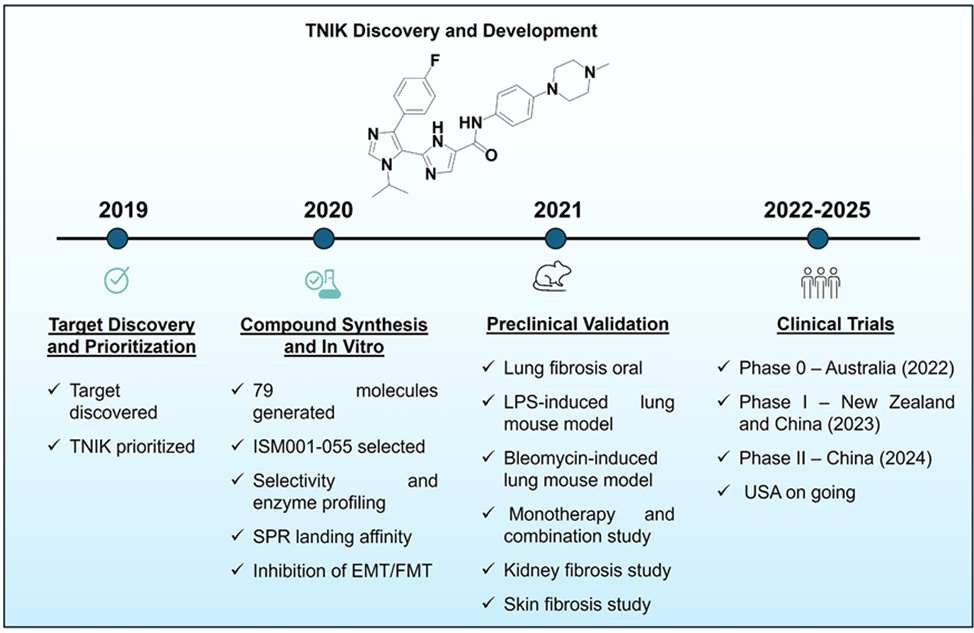
A development timeline for ISM001-055 illustrates the accelerated path from TNIK target discovery to clinical testing.
In a phase IIa study conducted in China in 2024, Rentosertib showed favorable safety and tolerability along with dose-dependent signals of improved lung function. The data were published in Nature Medicine and later selected for presentation at multiple top-tier international meetings in 2025. Still, the risks are substantial. IPF is a graveyard for late-stage hopes, with previous setbacks involving Gilead, FibroGen, and Roche programs. Moreover, TNIK is a first-in-class target, which means biological uncertainty and translational risk remain high. Yet if the mechanism ultimately succeeds, the upside would be equally outsized.
Other programs are also moving. Garutadustat has entered phase IIa and dosed its first patient. ISM6331 and ISM3412, targeting TEAD and MAT2A respectively, have launched global multicenter phase I studies. An inhaled formulation of ISM001-055 has been submitted for clinical evaluation in mainland China. MEN2501, a highly selective KIF18A inhibitor licensed to Menarini from Insilico’s ISM9862 program, dosed its first patient in phase I and triggered an HK$39 million milestone payment. ISM8969 obtained U.S. FDA clearance for clinical testing, while ISM4808, being advanced by Tasly, dosed the first participant in phase II for adult insomnia.
Importantly, Insilico is also testing whether AI can stretch beyond standard small-molecule workflows into more complex modalities. In November 2025, the company published work in Nature Communications on D16-M1P2, a PKMYT1-targeting PROTAC with potential best-in-class properties designed through Chemistry42. The molecule is intended to both induce PKMYT1 degradation and directly inhibit kinase activity, potentially addressing selectivity and resistance issues seen with existing inhibitors. It has already advanced to pre-candidate validation.
Big-Ticket BD Shows the Market Is Willing to Pay
If platform upgrades and pipeline progress validate Insilico’s R&D capability, repeated business-development transactions show that the market is increasingly willing to pay for that capability. Collaborations with Fosun Pharma, EQRx, and Sanofi in 2022 provided an early proof of concept. The Sanofi agreement around Pharma.AI carried a potential value of up to US$1.2 billion, while the Fosun partnership covered four designated targets plus co-development of the QPCTL project ISM8207.
Between 2023 and 2025, Insilico began converting platform capability into tradable assets, signing three deals with Exelixis and Stemline with a combined potential value approaching US$2 billion. After listing, the cadence accelerated further. In December 2025, the company licensed Greater China rights to ISM4808 to TWi Biotechnology. In January 2026, it signed a multi-year oncology discovery agreement with Servier worth up to US$888 million, followed by a co-development deal on the brain-penetrant NLRP3 inhibitor ISM8969 with Fosun unit Henlius or Hengtai? (as described in the original Chinese article, with US$66 million in upfront and milestone payments), then another collaboration worth nearly US$120 million with Qilu Pharmaceutical in cardiovascular and metabolic disease. In March, it added a foundation-model collaboration with Liquid AI, and then the new Lilly deal.
The pattern is what matters. In a short period, Insilico has placed consecutive bets across oncology, neurodegeneration, metabolism, and AI foundation models. That breadth suggests Pharma.AI may already be productive across multiple disease areas. Investors and partners are effectively underwriting not just present programs but the expected future output of the platform.
Conclusion
AI in drug discovery is not only about making R&D more efficient. At its most ambitious, it is about generating new therapeutic assets that can survive clinical development, attract partners, and justify substantial deal value. Insilico Medicine has started to sketch out one of the clearest templates for how that model might work in practice. Rather than relying purely on concept-driven enthusiasm, the company is assembling an operating framework in which platform iteration, pipeline advancement, and global BD reinforce one another. That is likely why the market has begun to define it differently.

