


Among the disruptive technologies reshaping innovative drug R&D in recent years, in vivo CAR-T is an undeniable force.
As a milestone breakthrough in tumor immunotherapy, CAR-T cell therapy has demonstrated remarkable efficacy in hematologic malignancies and even solid tumors—Carvykti (cilta-cel) from CARsgen just received NMPA approval for advanced gastric/gastroesophageal junction adenocarcinoma after at least second-line treatment failure. However, the "ex vivo manufacturing" model of conventional CAR-T is complex, costly, and associated with severe toxicities, creating enormous accessibility and safety bottlenecks.
In vivo CAR-T, by moving the "cell factory" into the patient’s body, transforms "bespoke customization" into "industrial pharma" and promises to be a game-changing disruptor.
Over the past year or more, in vivo CAR-T has become a favorite target for global pharma giants—Astellas, AbbVie, BMS, AstraZeneca, Gilead, J&J, and Eli Lilly have all placed heavy bets. With first-tier assets like Kelonia, Capstan, Orbital, and EsoBiotec acquired one after another, investable independent in vivo CAR-T companies are dwindling, and asset scarcity is rising sharply. Chinese in vivo CAR-T players, now entering their data-validation phase, are poised to become the next BD focus.
Why Is "In Vivo" So Coveted?
Since the first CAR-T therapy was approved, cell therapy has shown transformative efficacy in hematologic tumors and even autoimmune diseases. Yet conventional ex vivo CAR-T has always been trapped in an "impossible trinity": it cannot simultaneously satisfy efficacy, cost control, and patient accessibility. Its "bespoke" model requires harvesting a patient’s T cells, genetically modifying and expanding them ex vivo, and then reinfusing them—a process taking 2–4 weeks, with a single treatment costing hundreds of thousands to over a million dollars. Pre-infusion lymphodepletion chemotherapy also carries serious infection risks.
In vivo CAR-T fundamentally reconfigures this paradigm. Instead of relying on ex vivo manufacturing, it delivers vectors via a single intravenous injection, directly reprogramming T cells in situ into CAR-T cells.
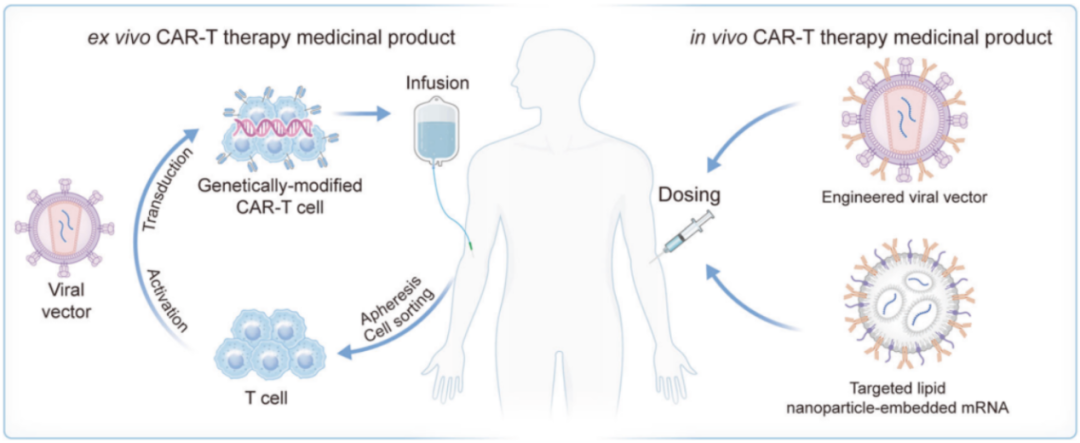
Fig.1.Schematic illustration of ex vivo versus in vivo CAR-T manufacturing processes (Source: Nature)
This not only drastically shortens manufacturing time and reduces costs, but more importantly, in vivo CAR-T can be administered without lymphodepletion, preserving immune integrity and lowering infection risk. The gradual generation and expansion of in vivo CAR-T also avoid the severe immune reactions triggered by massive bolus cell infusions. Study data show extremely low incidences of cytokine release syndrome (CRS) and immune effector cell-associated neurotoxicity syndrome (ICANS).
At its core, the in vivo CAR-T explosion is an arms race in delivery technology. The current mainstream delivery routes are lentiviral vectors and lipid nanoparticles (LNPs), each with distinct advantages guiding different clinical strategies.
Lentiviral vectors integrate CAR genes into the T-cell genome for long-term expression, suitable for "one-shot cure" oncology applications, but targeting and insertional mutagenesis risks must be addressed. LNP-mRNA offers transient expression with no genomic integration risk, higher safety, and a controllable time window—particularly suitable for autoimmune diseases. However, LNP-antibody conjugate manufacturing consistency, targeting efficiency, and degradation resistance remain engineering challenges.
Broadly, the lentiviral approach follows the "long-term persistence" logic of conventional CAR-T and has delivered more impressive data in hematologic tumors to date; the LNP-mRNA route, with its "transient and controllable" profile, is opening a new "immune reset" battlefield in autoimmune diseases.
MNCs’ Billion-Dollar Shopping Spree: Overseas Quality Assets Nearly Exhausted
As delivery technologies advance, in vivo CAR-T has progressed by leaps and bounds, demonstrating disruptive potential and triggering an MNC land-grab. Between 2025 and 2026, cumulative transaction value in this space exceeded $15 billion, with overseas quality assets swiftly "carved up".
Eli Lilly is an aggressive player in this field, and its “dual-track high-stakes strategy” reflects strong confidence in in vivo CAR-T technology. In February 2026, Eli Lilly acquired Orna for up to $2.4 billion. Orna is a company focused on developing circular RNA therapeutics; leveraging its circular RNA technology platform combined with a novel lipid nanoparticle (LNP) delivery system, it delivers CAR constructs directly to patients’ immune cells in vivo. Currently, ORN-252—a CD19-targeting in vivo CAR-T therapy developed by the company—is in clinical development for autoimmune disease treatment.
Kelonia’s core technology is the iGPS (in vivo Gene Positioning System) platform, based on engineered lentiviral vectors that generate CAR-T cells directly in patients via a single infusion. Its lead asset KLN-1010, a BCMA-targeting in vivo CAR-T, presented updated data at ASCO 2026 showing a 100% ORR in 18 R/R multiple myeloma patients, with all patients achieving MRD negativity at 1 month and a favorable safety profile.
In just two months, Lilly has invested nearly $10 billion in in vivo CAR-T, securing both major technology pathways to ensure it stays in the race.
For Eli Lilly, the substantial cash flow generated by its GLP-1 product, tirzepatide, provides ample ammunition for aggressive investments in next-generation technology platforms. Beyond GLP-1, Lilly is building its growth engine for the next decade. Now is the ideal time to intensify efforts in in vivo CAR-T therapy: it is neither venturing into uncharted territory alone nor missing the opportunity to secure a favorable position through forward-looking investments.
Beyond Lilly, AbbVie has also pursued a dual-pathway strategy. In January 2024, AbbVie partnered with in vivo CAR-T startup Umoja in a $1.44 billion deal, firing the first shot among big pharmas. Umoja’s VivoVec platform is one of the most clinically advanced in vivo CAR-T platforms—a surface-engineered third-generation lentiviral vector designed with multiple innovations to optimize in vivo T-cell transduction efficiency and functional activity.
Over a year later, in June 2025, AbbVie acquired Capstan for $2.1 billion in cash, gaining its targeted lipid nanoparticle (tLNP) platform technology. Its core pipeline CPTX2309 is an in vivo anti-CD19 CAR-T candidate using tLNPs for RNA delivery, with first-in-class potential, primarily developed for B-cell-mediated autoimmune diseases.
For AbbVie, with Humira biosimilars launching across U.S. and European markets, the company urgently needs innovative therapies to fill the revenue gap. As a "super player" in global immunology, its acquisition decisions consistently revolve around pipeline sustainability and technological forward-lookingness. Acquiring Capstan and betting on Umoja are essentially dual reinforcements of its immunology pipeline.
Also noteworthy is Gilead, which became a cell and gene therapy leader in 2017 through a >$10 billion acquisition but has recently faced the risk of being overtaken by latecomers. To maintain its leadership, Gilead is continuously reinventing itself and making strategic acquisitions in CAR-T.
In addition to its continued focus on ex vivo CAR-T therapies, Gilead’s subsidiary Kite Pharma has made two strategic moves into the in vivo CAR-T space. In August this year, Kite acquired Interius BioTherapeutics for $350 million, strengthening its lentiviral delivery technology capabilities; in October of the same year, Kite entered into a collaboration with Shenzhen Puregene Biotech to further integrate lentiviral delivery systems. The total value of this collaboration may reach up to $1.64 billion, underscoring Gilead’s firm commitment to securing a strategic position in the in vivo CAR-T field.
Additionally, in March 2025, AstraZeneca acquired EsoBiotec for $1 billion, making its first entry into in vivo CAR-T and gaining a lentiviral-based in vivo T-cell engineering platform. Prior to this, AstraZeneca had already made multiple bets in cell therapy—acquiring Gracell in 2023 and TeneoTwo in 2022—aiming to build a full-chain CAR-T pipeline for hematologic tumors and autoimmune diseases.
In August of the same year, BMS acquired Orbital (circRNA/LNP) for $1.5 billion, positioning in vivo CAR-T as a key strategic direction for autoimmune disease treatment.
Within the blink of an eye, major pharmaceutical companies have crowded into the in vivo CAR-T therapy race. Multinational corporations (MNCs) are willing to invest vast sums—not on a single product, but on a technological platform capable of unlocking a market worth tens of billions of dollars. As Lilly’s oncology head stated, developing ex vivo cell therapies into scalable, commercially viable medicines remains challenging, whereas in vivo therapies hold promise for leapfrogging competitors. With real money, MNCs have voted decisively—identifying the future evolutionary trajectory of CAR-T technology.
China’s Rising Power: The Next BD Hotspot
With overseas front-runner assets now in MNC portfolios, the heat is spreading outward. At the recently concluded ASCO and EHA 2026 annual meetings, Chinese biopharma companies delivered clinically compelling data, proving they can compete with—and even locally lead—the global first tier, naturally making them the next BD focus.
Lentiviral Route: Legend Biotech’s "Perfect Score" Validation
Legend Biotech’s LB2501 (CD19/CD20 dual-targeting) data presented at EHA 2026 stunned the industry. In the high-dose cohort (DL2) of R/R B-NHL patients, 6 patients achieved a 100% ORR and 83.3% CR, with no lymphodepletion preconditioning required. On safety, there were no dose-limiting toxicities (DLT), serious adverse events (SAE), or ICANS; all CRS events were Grade 1–2.
LB2501 is based on Legend’s proprietary TaVec lentiviral platform, which packages CD19/CD20 genetic information into a third-generation replication-defective lentiviral vector, engineered with modified fusogenic glycoproteins and CD3-binding agents to achieve specific T-cell transduction. These data not only validate the power of its TaVec platform but also demonstrate the potential of dual-targeting design in evading antigen escape. As a pioneer in cell therapy, Legend Biotech is once again establishing its voice in the next-generation cell therapy arena.
Yimufeng Biosciences, a domestic leader in the lentiviral route, has leveraged its proprietary iMAGIC platform to successively disclose preclinical data on multiple core pipelines, leading the domestic race. Its in vivo CAR-T candidates include IMV101 (CD19-targeting) for B-cell hematologic malignancies, demonstrating high-specificity transduction and potent antitumor activity; IMV103 (CLDN18.2-targeting) for solid tumors including gastric cancer, one of China’s first solid-tumor in vivo CAR-T pipelines; and IMV102 (BCMA-targeting) for multiple myeloma, achieving dose-dependent tumor inhibition and long-term efficacy with a single administration.
Moreover, the iMAGIC platform uses AI to optimize envelope proteins and T-cell targeting modules, substantially reducing off-target delivery risk from the source and building a unique technological moat.
Additionally, domestic players including IASO Biotherapeutics and Fengxun Bio are also pursuing lentiviral-route in vivo CAR-T development. IASO has three in vivo CAR-T products in IIT stages, covering hematologic tumors and autoimmune diseases. Fengxun’s in vivo CAR-T pipeline GI-001, targeting the classic CD19 antigen for R/R B-ALL and other hematologic malignancies, has initiated IIT clinical trials.
LNP Route: Multi-Pronged Progress in Autoimmunity and Oncology
Chinese biopharma companies are advancing just as rapidly on the LNP-mRNA route, even achieving global leadership in autoimmune diseases:
Weitao Bio: GT801 (CD19-targeting) data presented at ASCO 2026 showed a 100% ORR in 4 R/R B-NHL patients, with 3 complete responses (CR). CAR-T cells were detected within 4 hours post-administration, peaking at >90%, with monocyte CAR expression below 3%, demonstrating excellent targeting specificity. All CRS events were Grade 0–1.
GT801 is a CD19-targeting in vivo CAR-T candidate that delivers CD19 CAR mRNA via LNP directly to T cells in patients for in vivo transfection. The disclosed results show that with rational delivery design and multi-dose strategies, the LNP route can not only achieve efficient CAR-T generation in humans but also sustain peripheral B-cell depletion and deep B-cell clearance in tissues including bone marrow and lymph nodes.
WestGene Biopharma: WGb-0301 (CD8-targeting LNP) achieved up to 100% CAR positivity in 4 lymphoma patients, with successful repeated dosing up to 10 times; one MCL patient achieved CR, with all safety events Grade 1–2.
Wisjin Bio, leveraging its proprietary tLNP platform, enables direct in vivo generation of CAR-T cells in patients through intravenous mRNA injection alone. Currently, Wisjin’s in vivo CAR-T pipeline targeting CD19, CD20, CD8, and BCMA has all entered clinical trials, and its dual-target in vivo CAR-T program targeting both CD19 and BCMA is also poised to enter clinical development.
WGb-0301, highlighted at ASCO 2026, represents another validation of WestGene’s foundational technology.
Hongxin Bio: HN2301 (SLE-targeting), published in the New England Journal of Medicine (NEJM), showed that in 3 refractory SLE patients receiving a 4 mg dose, circulating B cells were completely cleared within 6 hours and sustained for 7–10 days.
HN2301 is developed on Hongxin’s engineered cell-targeting delivery platform (EnC-LNP), with core components comprising the proprietary ionizable amino lipid ILB-3132, a humanized CD8-targeting antibody fragment, and proprietary Anti-CD19 CAR mRNA. This innovative therapy offers new hope for numerous refractory SLE patients seeking immune system reset for long-term remission.
Beyond clinical data disclosures, Chinese biopharma companies are also keeping pace with global rhythm in platform expansion and pipeline advancement: Fosun Kairos has initiated R&D on dual-targeting in vivo CAR-T (targets undisclosed) for refractory autoimmune diseases including SLE and myasthenia gravis, based on antibody-conjugated LNP and ionizable lipid technologies.
Everest Medicines’ EVM18, an in vivo CAR-T candidate developed on its proprietary mRNA and tLNP platforms, has completed validation in humanized mice and non-human primates and initiated clinical trials, with key data non-inferior to industry benchmark Capstan.
From Concept Validation to Industrial Race
In 2026, the in vivo CAR-T field has entered a phase of concentrated validation. Early data from both major technological approaches have demonstrated efficacy and safety exceeding expectations, validating the logical soundness of in situ programming within the body.
Previously, EsoBiotec’s ESO-T01, whose data were disclosed in Nature Medicine, achieved a 100% overall response rate (ORR) but also resulted in grade 3 cytokine release syndrome (CRS) and one fatality (although attributed to disease progression), sounding a safety alarm amid the field’s enthusiasm.
Although challenges remain ahead, MNCs’ billion-dollar acquisitions have reshaped the valuation logic of this sector. While overseas companies such as Capstan, Kelonia, and Orna have already been acquired by industry giants, Chinese in-vivo CAR-T biotech firms—backed by robust clinical data and foundational platform technologies—are standing at the threshold of value re-rating. From Legend Biotech’s lentiviral dual-target platform to MicroTherapeutics’, Hongxin’s, and Everest Medicines’ LNP-based pipelines for autoimmune diseases and oncology, Chinese assets are poised to become the hottest targets in the next wave of global business development (BD) deals.

