


Background and Unmet Need
Pancreatic ductal adenocarcinoma (PDAC) remains one of the deadliest common solid tumors. More than 90% of patients present with locally advanced or metastatic disease at diagnosis, and first-line standard-of-care regimens have historically yielded median progression-free survival (PFS) in the range of approximately 5-6 months. KRAS mutations are detected in roughly 90% of PDAC cases, with KRAS G12D accounting for approximately 40% of these events. Despite decades of effort, KRAS was long considered an “undruggable” target, and selective inhibitors directed against the G12D variant have only recently entered clinical evaluation.
What the Study Found
Liwei Wang, Jiujie Cui, and colleagues at Renji Hospital, Shanghai Jiao Tong University School of Medicine, report the results of an open-label phase 1b/2 trial (NCT06520488) evaluating HRS-4642, a next-generation non-covalent KRAS G12D inhibitor, in combination with nab-paclitaxel and gemcitabine (the AG regimen) as first-line therapy in advanced KRAS G12D-mutant PDAC.
Among treated patients, including approximately 90% with an Eastern Cooperative Oncology Group (ECOG) performance status of 1, the combination produced a confirmed objective response rate (ORR) of 63.3%, compared with historical ORRs of approximately 23-27% reported for AG chemotherapy alone in this setting. The disease control rate (DCR) reached 93.3%, and median PFS was 13.1 months, more than double the historical benchmark of roughly 5.5 months for AG alone. The 1-year overall survival (OS) rate was 83.3%, versus an estimated 35% for chemotherapy alone.
ctDNA dynamics provided an additional signal of activity: complete clearance of KRAS G12D-mutant circulating tumor DNA was observed in 88.9% of patients with paired samples, suggesting deep molecular responses in a subset of treated tumors. These findings are consistent with KRAS G12D inhibition achieving more than transient target suppression in responding lesions.
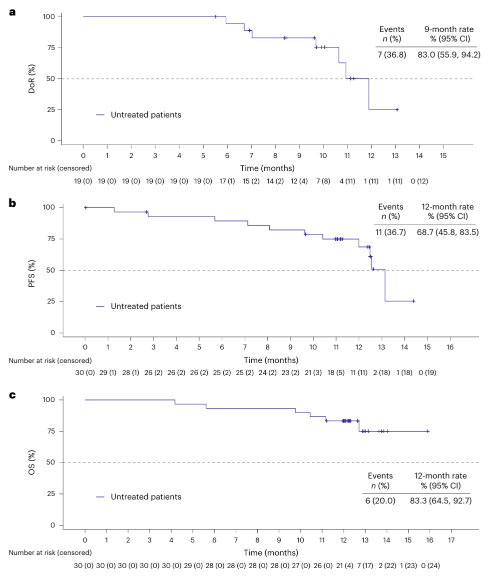
Fig.1.Kaplan–Meier Curves for a: DoR, b: PFS and c: OS in Treatment Naive Patients
Mechanistic Findings
HRS-4642 is described as a high-affinity, highly selective, long-acting non-covalent inhibitor of KRAS G12D, designed to overcome the resistance mechanisms that have limited earlier covalent G12C inhibitors and first-generation G12D-directed agents. Preclinical work supporting the clinical program indicated that KRAS G12D inhibition can reshape the tumor immune microenvironment.
In translational analyses from the trial, on-treatment tumor biopsies showed increased transcriptomic signatures of antigen presentation and elevated lymphocyte infiltration, including T-cell-enriched immune phenotypes. Pathway-level analyses were also associated with delayed rebound of MAPK signaling during treatment, consistent with a slower emergence of adaptive resistance relative to KRAS G12C inhibition in other tumor types.
Translational Implications
Together, the preclinical and translational data suggest that HRS-4642 plus chemotherapy may help convert KRAS G12D-mutant PDAC, traditionally considered an immunologically “cold” tumor, into a more permissive microenvironment. Whether this finding translates into durable immune-mediated disease control will require longer follow-up and randomized comparison. The current data could provide a rationale for evaluating HRS-4642-based combinations with immune checkpoint inhibitors in future studies, although no such combination has been tested in this trial.
Safety Profile
The combination appeared tolerable in a population with substantial baseline symptom burden. The most common adverse events were manageable myelosuppression consistent with the chemotherapy backbone. Notably, the rates of rash, nausea, vomiting, and diarrhea were lower than those reported for several marketed oral KRAS inhibitors in other settings. No treatment-related discontinuations or treatment-related deaths were reported in the published cohort.
Clinical Evidence and Next Steps
The phase 1b/2 data support the launch of the first registrational randomized trial of a selective KRAS G12D inhibitor in PDAC. A multicenter phase 3 study (NCT07232875) is now comparing HRS-4642 plus AG chemotherapy with AG chemotherapy alone in the same first-line setting. The trial, which has begun enrollment in China, has PFS and OS as primary endpoints and is expected to provide the first randomized evidence on whether the early-phase signals can be confirmed at scale.
Limitations and Open Questions
Several caveats should temper interpretation of these results. The phase 1b/2 design, relatively small sample size, and absence of a randomized control arm within the reported cohort mean that cross-trial comparison with historical AG data is descriptive rather than definitive. Median follow-up remains immature for overall survival, and the durability of response beyond the first year of treatment has not yet been established. The translational insights on antigen presentation and tumor-infiltrating lymphocytes are based on a limited number of paired biopsies and require external validation.
Whether HRS-4642 plus chemotherapy will ultimately improve long-term outcomes for the broader KRAS G12D-mutant PDAC population, including patients with poorer performance status, specific co-mutations, or prior therapies, will depend on the ongoing phase 3 program and longer follow-up of the original cohort. Until then, the data warrant validation in larger randomized trials rather than supporting routine clinical adoption.
Source
Original coverage adapted from the article reporting Wang et al., “KRAS-G12D inhibitor HRS-4642 plus chemotherapy in advanced KRAS G12D-mutant pancreatic cancer: a phase 1b/2 trial,” published in Nature Medicine. Trial registration: NCT06520488 (phase 1b/2) and NCT07232875 (phase 3). This document is a research-focused English rewrite prepared for international medical and scientific readers and is not an official translation.

