


On November 23, 2026, the House Select Committee on the Strategic Competition Between the United States and the Chinese Communist Party released Prescription America: How to Protect Americans from a Dangerous Dependence on China for Their Medicines, a 57-page investigation into drug development in China and its consequences for US pharmaceutical policy. The committee’s chairman, John Moolenaar (R-MI), framed the report around a single proposition: that China has built a faster and cheaper clinical trial system, that US capital is funding it, and that Washington should respond on several fronts at once. The report draws in part on interviews with dozens of industry executives, investors, investigators, trial staff and government officials, and it offers 12 policy recommendations. None of them is law, and most are not close to it. What the report does change is the stated compliance expectations of companies that generate clinical data in China and file with US regulators.
Article Key Points
• A House select committee report recommends restricting FDA acceptance of Chinese clinical trial data.
• It also recommends banning data from PLA hospitals and Xinjiang trial sites for IND and marketing applications.
• The report carries no legal force; most of its 12 recommendations remain proposals.
• Five multinational drug companies have said they will not start new trials at the identified locations.
• Existing trials are to continue under their protocols, and the report found no evidence of illegality.
What The Report Covers
The report places drug discovery, first-in-human trials, cross-border licensing, co-development, venture capital, NewCo formation, FDA regulation and commercialization in a single analytical framework, and also addresses patent disclosure and the fast follower model. Its main subject is innovative drug development; it gives comparatively little space to traditional active pharmaceutical ingredients, generics or finished-product supply chains.
The committee offered six headline findings. It states that China is running a coordinated, state-sponsored industrial policy to dominate global biotechnology; that China’s fast and low-cost clinical trial system is accelerated by weak ethical safeguards; that US companies are fueling that strategy; that FDA incentives push development toward China; that representatives of the Chinese government impeded FDA inspections at sites in Xinjiang and at People’s Liberation Army (PLA) hospitals, where major US companies including Bristol Myers Squibb and Merck have run trials; and that Chinese innovation feeds off fast followers and, the report alleges, theft.
Industry Data Cited In The Report
The report tabulates industry data drawn from several commercial sources, and the figures depend on which dataset is used.
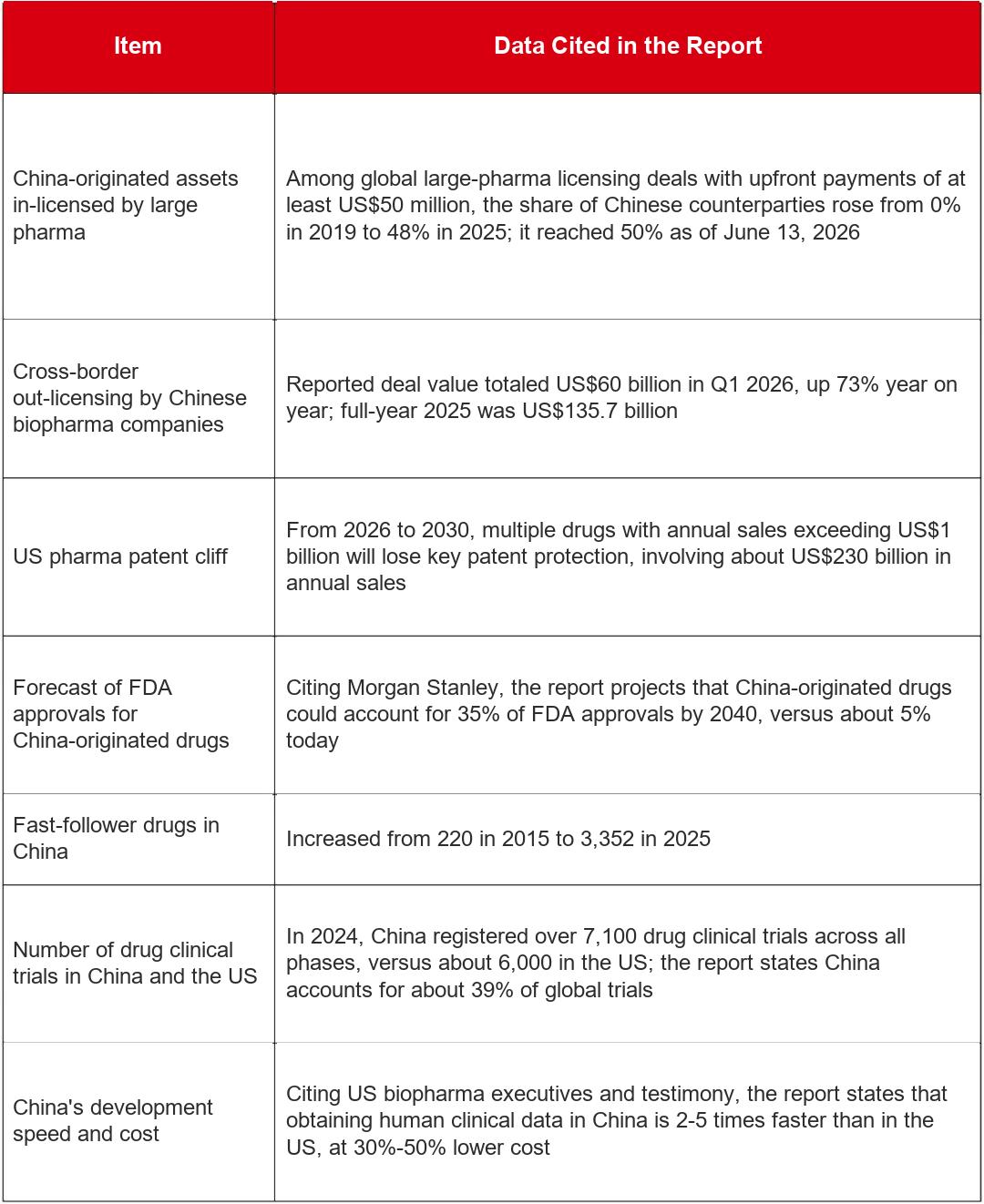
In global large-pharma licensing deals with an upfront payment of at least $50 million, the share of transactions with a Chinese counterparty rose from 0% in 2019 to 48% in 2025, and stood at 50% as of June 13, 2026. Cross-border out-licensing by Chinese biopharmaceutical companies was reported at $60 billion in the first quarter of 2026, up 73% year on year, against $135.7 billion for the full year 2025. Between 2026 and 2030, several drugs with sales above $1 billion are projected to lose key patent protection, affecting roughly $230 billion in annual sales. The report cites a Morgan Stanley projection that China-origin drugs could account for 35% of FDA approvals by 2040, against about 5% currently. Chinese fast follower drugs increased from 220 in 2015 to 3,352 in 2025. In 2024, China registered more than 7,100 drug clinical trials against about 6,000 in the United States, which the report puts at roughly 39% of global trials.
Two caveats apply to these numbers. First, the licensing totals include potential development, registration and commercialization milestone payments rather than money already received. The 2040 approval share is an institutional projection, and the speed and cost figures come from executive statements and written testimony quoted in the report. Second, the report body separately cites J.P. Morgan data placing China-origin assets at 42% of comparable large-pharma transactions in the first half of 2026, a figure drawn from a different data product and counting basis than the 50% shown in its Figure 1. The 42% and 50% figures therefore describe different things.
How The Report Describes China Clinical Development
The report discusses two distinct routes for clinical research in China: the formal investigational new drug (IND) pathway, administered by the National Medical Products Administration (NMPA) and its Center for Drug Evaluation (CDE), and investigator-initiated trials (IITs).
On the formal pathway, the report states that China began reforming its early-phase human trial system in 2015, introduced implied permission for IND applications in 2018 and updated it in 2025, and that qualifying trials may begin if no objection is raised within 30 days. It notes that China joined the International Council for Harmonisation (ICH) as a regulatory member in 2017.
IITs are initiated by physicians or researchers within hospitals and approved by hospital ethics committees. The report lists their uses as generating early safety and proof-of-concept data, selecting doses and deciding whether to continue investing, supporting subsequent IND dossiers, and testing and modifying candidate drugs before formal registration trials. It also states that, by design, Chinese IIT is not a substitute channel for a China-US IND and that its function is principally to obtain human data earlier.
In cell and gene therapy, the report cites 1,033 IITs conducted in China between 2015 and 2023, with annual numbers growing elevenfold over that period. A separate cell therapy study is cited as counting 2,519 Chinese trials between 2005 and 2024 as IIT, representing 90% of trials in that field, most of them in cancer. The report also draws on prior literature to discuss informed consent, study oversight, adverse event disclosure and patient protection, and cites individual research risk events.
The New Chinese Regulation On Clinical Research
The report discusses the Regulation on the Administration of Clinical Research and Clinical Transformation Applications of New Biomedical Technologies, issued as State Council Order No. 818. It was signed on September 28, 2025 and takes effect on May 1, 2026, and covers gene therapy, cell and derivative therapies, tissue and organ therapies, microbial therapies and brain-computer interfaces, among others. The requirements the report enumerates include completing nonclinical research before starting human clinical research, conducting research at tertiary grade A hospitals, obtaining informed consent and prohibiting charges to research participants, securing separate approval from academic and ethics committees, and filing the research protocol with the National Health Commission.
Cross-Border Transactions And NewCos
Table 1 of the report lists 15 US company in-licensing transactions of Chinese assets, spanning single-asset licenses, multi-asset collaborations, joint discovery and joint development.
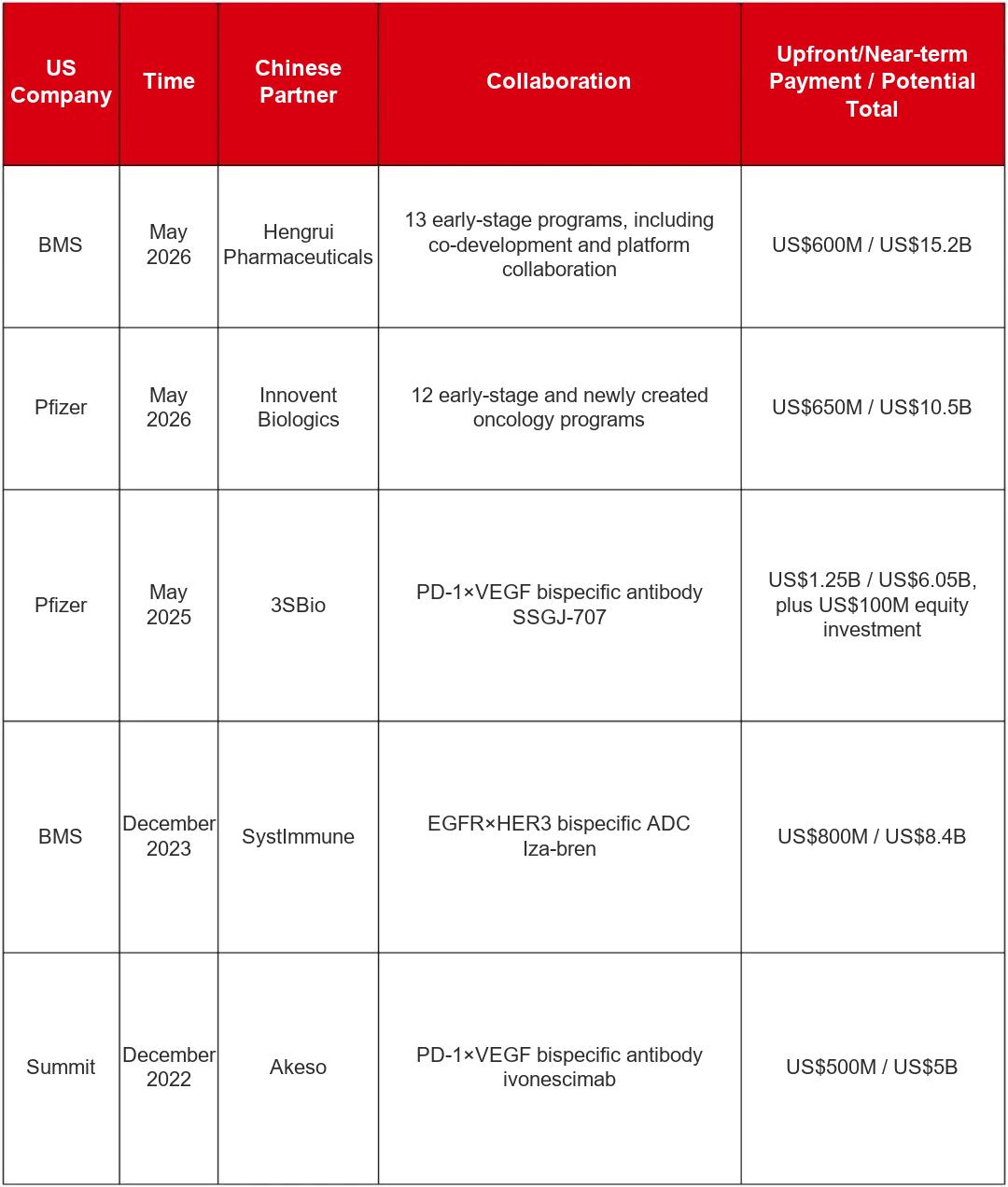
Five of the 15 are reproduced in the source article. In May 2026, Bristol Myers Squibb agreed terms with Jiangsu Hengrui covering 13 early-stage projects, including joint development and platform collaboration, with an upfront payment of $600 million and a potential total of $15.2 billion. Also in May 2026, Pfizer signed with Innovent Biologics on 12 early-stage and newly created oncology programs, with a $650 million upfront payment and a $10.5 billion total. In May 2025, Pfizer licensed the PD-1 x VEGF bispecific SSGJ-707 from 3SBio for a $1.25 billion upfront payment and a $6.05 billion total, plus a $100 million equity investment. In December 2023, Bristol Myers Squibb licensed the EGFR x HER3 bispecific ADC iza-bren (BL-B01D1) from SystImmune for $800 million upfront and a potential $8.4 billion. In December 2022, Summit Therapeutics licensed the PD-1 x VEGF bispecific ivonescimab from Akeso for $500 million upfront and a potential $5 billion.
The report notes that some recent collaborations have extended beyond single-asset licensing into joint development. The Bristol Myers Squibb and Jiangsu Hengrui collaboration, for example, comprises four oncology or hematology assets from Hengrui, four immunology assets from Bristol Myers Squibb, and five novel assets to be discovered and developed jointly. Hengrui is to lead early clinical development of all 13 programs, and Bristol Myers Squibb is to lead subsequent development.
The report also lists 10 companies backed by Chinese assets, including Kailera, Verdiva, Solstice Oncology, Aiolos and Ouro. The NewCo model it describes has investment funds partnering with Chinese companies to form a new entity, with the Chinese company licensing assets into it, the new entity taking on subsequent development and management, and some of these companies later acquired by large drug companies.
Two acquisitions are cited: GSK’s purchase of Aiolos for a $1 billion upfront payment with up to $400 million in regulatory milestones, and Gilead’s purchase of Ouro for a $1.67 billion upfront payment with up to $500 million in milestones. Both figures check out against the underlying transactions, with two qualifications the report does not spell out. The GSK transaction with Aiolos Bio, whose sole clinical asset was the anti-TSLP antibody AIO-001, was announced in January 2024 and completed in February 2024, roughly two and a half years before the report was published. The Gilead transaction with Ouro Medicines, whose sole asset is the BCMAxCD3 bispecific antibody gamgertamig (OM336), in-licensed from Keymed Biosciences, was announced in March 2026 and completed in June 2026, for a $1,675 million upfront payment split equally between Gilead and Lakefront Biotherapeutics, the company formed from the former Galapagos.
How The Report Describes FDA Data Acceptance And Inspection
The report states that the FDA currently has no dedicated review mechanism targeting Chinese clinical data or China-origin molecules. Chinese data are in principle subject to the same rules as other foreign data, including compliance with good clinical practice (GCP) and informed consent requirements, and their conclusions must be applicable to the US population and medical practice. Chinese companies may use early data from China to support IND applications for phase II or III trials conducted in the United States, and Chinese companies and China-origin molecules may enter accelerated programs such as Fast Track and Breakthrough Therapy once they meet statutory and regulatory standards.
For IIT, FDA officials told the committee that if a sponsor relies on such data to support a program, the FDA can inspect IIT sites, while also stating that early Chinese IIT sites receive FDA inspection at a low rate.
The report cites FDA inspection data for fiscal years 2017 through 2026, when the agency conducted 6,752 clinical investigator and sponsor-investigator inspections worldwide, 5,208 of them in the United States and 226 in China. Chinese inspections therefore represent about 4.3% of the US total, and the report notes this counts inspections rather than the proportion of trial sites covered. Year by year, Chinese inspections rose to 147 in fiscal year 2026, from 26 in fiscal year 2025 and 18 in fiscal year 2024.
Inspections In Specific Regions And At A Specific Institution
The report states that the FDA conducted no inspections of clinical trial sites in the region it describes from 2009 through 2025. A trial registry shows 572 trials with sites in that region since 2009, and the report notes the true number may be higher because some trials were not registered.
It also describes the inspection history of one specific institution, a PLA hospital in Beijing. FDA attempted inspections in 2021 and in 2024 and both were obstructed; according to the committee, coordination by the sponsor eventually allowed the inspection to be completed in January 2025, which the report describes as the first such inspection completed at a PLA hospital since 2018. As of October 2026, the FDA said it was developing institution-level policy on the acceptability of data from that region and that institution.
The report lists the arrangements of five multinational drug companies for new trials. Bristol Myers Squibb, Eli Lilly, Merck and Pfizer each indicated that they will no longer, or do not expect to, start new trials at the identified locations. AbbVie made a comparable arrangement for the specific institution while retaining the option to run new trials in the region. Most existing trials are to continue under their protocols. The company commitments are limited to new trials, and reporting indicates that most are framed as no new starts with existing trials unaffected, with four of the five also agreeing to stop trials in Xinjiang, AbbVie excepted. The committee states that it found no evidence of illegality in its roughly six-month investigation.
Fast Followers And Intellectual Property Disputes
The report defines a fast follower as a company that did not originate the target or mechanism but, after another company validated it, rapidly developed its own version. Such follow-on drugs may hold improvement patents covering fewer side effects, lower dosing frequency or oral formulations replacing injections. The report discusses the relationship between early clinical speed and patent disclosure: once an originator publishes its research and molecule, other companies design new molecules around the validated target and use early trials to obtain human data.
The report also records dissenting views from within the industry, noting that fast following is common across the global drug industry, that modified molecules retain their own innovation, that some may outperform the original, and that such competition may increase treatment options for patients.
Two intellectual property disputes are mentioned. One is Beam Therapeutics’ September 2026 suit in the US District Court for the District of Massachusetts against YolTech Therapeutics, its US collaborator Serapha Bio and two individuals, alleging misappropriation of trade secrets in base editing intellectual property. The other is Revolution Medicines’ April 2026 lawyer letter to Erasca, which asserts that the pan-RAS molecular glue ERAS-0015 is substantially equivalent to compounds claimed in Revolution’s US Patent No. 12,409,225 and that a third party misappropriated trade secrets in a patent application relating to the compound. Both are allegations made in the course of litigation; the report provides no court findings.
The 12 Policy Recommendations
All 12 items are proposals or intended measures put forward by the report’s authors. Unless otherwise noted, they are not laws already in effect or FDA rules already issued.
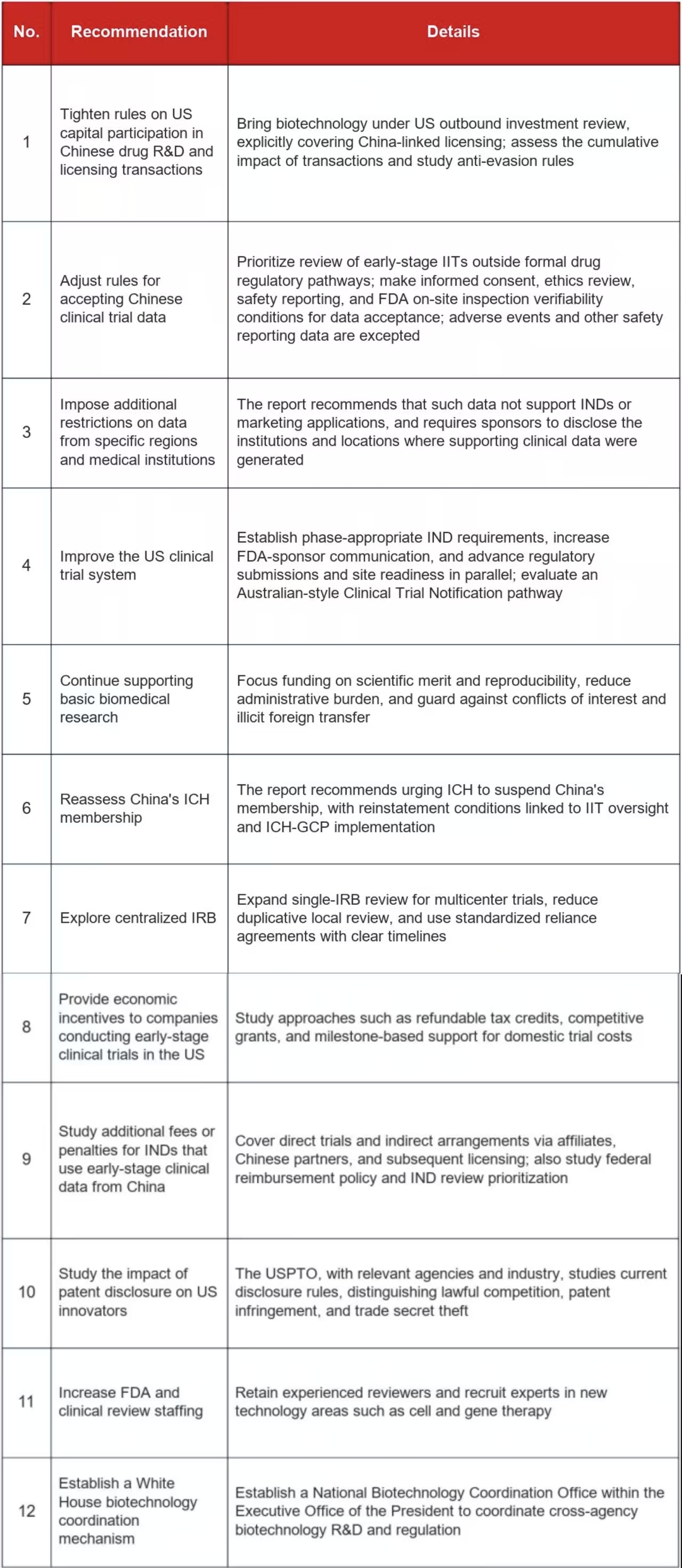
In outline, the recommendations are to bring biotechnology into US outbound investment screening with explicit coverage of Chinese molecular licensing and to study evasion; to adjust the rules for accepting Chinese clinical trial data, with the main focus on early IIT outside the formal drug registration pathway, making verifiable informed consent, ethics review, safety reporting and FDA on-site inspection the conditions for acceptance and excluding adverse event and other safety reporting data from any restriction; to set additional limits on data from specified regions and medical institutions, with related data barred from supporting IND or marketing applications and sponsors required to disclose the institutions and locations that generated supporting data; to modernize the US clinical trial system through IND requirements matched to development stage, greater FDA and sponsor communication, and station-based supervision with parallel evaluation of an Australian-style Clinical Trial Notification pathway; to sustain basic biomedical research with scientific value and reproducibility as funding priorities, reduced administrative burden and safeguards against interest conflicts and illegal technology transfer; to reassess China’s ICH membership, with a push for ICH to suspend China and to set recovery conditions tied to ICH monitoring and GCP enforcement; to explore centralized institutional review boards to expand single-IRB review for multisite trials, reduce duplicative local review and use standardization, reliance agreements and clear deadlines; to provide economic incentives for companies running early clinical trials in the United States, studying refundable tax credits, competitive grants and milestone funding to offset US trial costs; to study surcharges or penalties for IND applications for therapies developed from early-stage clinical trials in China, covering direct trials, affiliated companies, Chinese partners and the indirect arrangements that may follow from subsequent licensing, alongside consideration of federal reporting policy and IND review priority; to study the impact of patent disclosure on US innovators, with the USPTO and relevant agencies and the industry examining current disclosure rules and distinguishing lawful competition from patent infringement and trade secret theft; to increase FDA and clinical review staffing, retaining experienced reviewers and recruiting specialists in cell and gene therapy and other emerging areas; and to establish a White House biotechnology coordination mechanism through a National Biotechnology Coordination Office to coordinate biotechnology research and regulatory work across departments.
The report also refers to H.R. 9102, the proposed COINS rule, and report language accompanying the H.R. 8646 and H.R. 9260 appropriations bills. These sit at different stages of the policy and legislative process and differ from current FDA regulations.
Information The Report Also Records
Alongside its recommendations, the report records several points that qualify the picture it paints. IIT can produce high-quality research and valuable data, with the report’s discussion focused on oversight, transparency and patient protection. China’s formal IND pathway has accelerated and converged with international standards. Some US drug companies and investors active in China do not accept the framing that cross-border licensing is hollowing out the US research system, and cite US biopharmaceutical merger volumes as their basis. In July 2026, FDA officials told the committee’s staff that the number of products whose early research was done mainly in China and that then entered US marketing applications remains small.

