


In recent years, Prof. Weiping Cai, chief expert at the Infectious Disease Center of Guangzhou Eighth People’s Hospital, Guangzhou Medical University, has clearly felt that the number of older adults among the HIV patients he manages is rising.
The trend seems to have begun around 2017. “Among newly identified patients in our outpatient clinic, middle-aged and older adults now account for more than 50%,” Prof. Cai told MedJ. Commercial sex is the main route of infection, and condom use is very low.
Prof. Cai’s observation is not an isolated one.
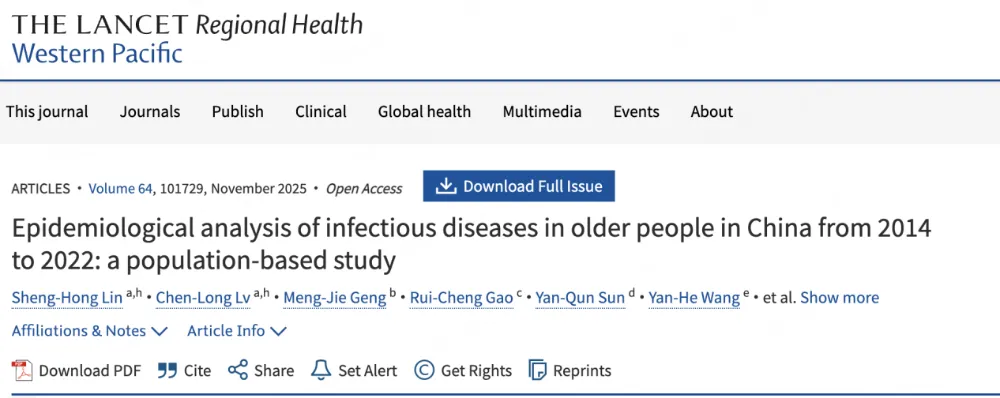
According to a recent Lancet investigation by scholars from the State Key Laboratory of Pathogen and Biosecurity and other institutions, from 2014 to 2022 most notifiable infectious diseases declined among older adults, but sexually transmitted diseases did not. Syphilis rose from the fourth to the third most common infection in this population, and HIV rose from eighth to seventh.
At the “Two Sessions” on March 7, Dr. Xiaoqing Liu, director of the Jiangxi Provincial Center for Disease Control and Prevention and a deputy to the National People’s Congress, said that older adults have become a distinct risk group. While the proportion of university students with HIV has been falling, the number among older adults is still rising rapidly, reshaping the traditional profile of the HIV epidemic.
Dr. Lijuan Wang, chief physician at the STD/AIDS Prevention and Control Department of the Beijing Chaoyang District Center for Disease Control and Prevention, told MedJ: “Medical progress has lengthened healthy life expectancy, and the sexually active period has lengthened as well. But social recognition of older adults’ sexual needs has not kept pace. Without appropriate education, intervention, and policy support, their risk of infection increases.”
Case numbers keep rising
Prof. Cai has worked in HIV prevention and control for 30 years. He said that in earlier years, HIV infection was seen mainly in younger people infected through blood exposure or drug use. Later, heterosexual transmission increased, but it was still concentrated in younger groups. Only in the past decade have older adults begun to rise as a major patient group.
Most older patients are men. Some are widowed, while others have gone many years without marital sex.
“I have seen more than one case like this. Many of them were infected through sex workers in their forties or fifties. Unlike younger people, who may go through a latent period of nearly 10 years, older adults usually progress from infection to disease in about three years, which suggests the infections occurred in recent years,” Prof. Cai said.
The Lancet paper reported that among older adults, men had 1.56 times as many sexually transmitted infections as women, with the highest incidence in the 60 to 64 age group. For HIV, incidence in men did not begin to decline until age 74, while in women the turning point came at 65. The highest proportions were seen in southwest China.
A 2023 study by scholars from the National Center for AIDS/STD Control and Prevention, Chinese Center for Disease Control and Prevention, published in the Chinese Journal of Epidemiology, likewise reported that the number of people aged over 60 living with HIV increased from more than 17,400 in 2015 to more than 27,000 in 2022, concentrated mainly in parts of southwest and south China where the epidemic is relatively severe.
Dr. Wang told MedJ that because of factors such as tighter urban management, heterosexual transmission through commercial sex accounts for a relatively small share of cumulative HIV cases in Beijing, whereas transmission through sex between men accounts for more than 75%, and close to 90% among newly reported cases.
Dr. Wang said: “Most people in the current older generation grew up in an era when sex was taboo and never received formal sex education. Some believe condoms are only for contraception, and some even think that only young people can become infected with HIV.”
“In addition, after older adults become infected, many know little about the disease or feel too ashamed to face it, so they seldom seek testing on their own. As a result, many are not diagnosed until a late stage, and that delay further increases the risk of onward spread,” Dr. Wang said.
In Prof. Cai’s view, the rising rates of syphilis, gonorrhea, and other sexually transmitted infections among older adults reflect social, physiological, and cognitive mechanisms very similar to those driving HIV.
Prof. Cai said that whether the need is psychological or physiological, older adults have no formal channel for release because of embarrassment. “Their sexual behavior is hidden, sex education is absent, and condom use is very low. Taken together, these factors make STI control in older adults especially difficult.”
“Among all sexually transmitted infections, HIV is the most difficult because detection is lower and later, infection remains transmissible for years despite a lack of symptoms, and there is still no complete cure,” Prof. Cai said.
Where does HIV in older adults come from?
In 2011, Bai Hua, now in his fifties, founded the HIV mutual-aid charity organization Baihualin in Beijing. He is also living with HIV himself. Bai Hua noticed the rise of HIV among older adults as early as then, though it drew little public attention.
Unlike some experts, Bai Hua does not think the main cause is simply that older adults have become more sexually open.
“In fact, older people’s sexual needs have always existed. They were just repressed for a long time, and only in recent years have the social modes of making connections changed dramatically,” Bai Hua said. “Earlier, many older patients were infected through sex trade in hidden corners. Now more and more older people meet online and then connect offline.”
Dr. Wang has seen many similar cases. A typical scenario is an older person who has been widowed for years, with adult children at work and grandchildren at school. “They have little to do during the day and feel lonely, so they start taking part in different online and offline social activities,” she said.
In that process, do older adults recognize the risks of sexually transmitted infections? The people MedJ interviewed described different observations.
Prof. Cai said some older adults feel they do not have many years left, know that HIV infection can have a long latent period and that treatment has improved, and find condoms uncomfortable, so they take chances and engage in high-risk sex.
Bai Hua has more often seen older patients who knew very little about HIV before infection and felt the disease was far away from them. “I have even met patients who had been told by different sources that HIV is a disease only gay people get.”
“Once they discover they are infected, they often do not know what to do and are even less willing to seek help from relatives or friends. They feel intense fear and shame, and many miss the window for standardized medical intervention,” Bai Hua said.
In 2018, Bai Hua therefore created an online support group specifically for older patients, where members provide emotional support and share reliable treatment information. Nearly 1,000 people have joined.
With the rapid development of highly active antiretroviral therapy, viral loads can now be effectively suppressed, even to the point of non-transmissibility, and life expectancy can approach normal. But for older patients, the picture is less optimistic.
Dr. Wang told MedJ that the challenge in treating older adults with HIV lies in comorbidity. Many have underlying diseases and poorer baseline health. There can also be drug interactions between chronic-disease treatments and antiretroviral therapy, and older adults tolerate adverse effects less well.
Prof. Cai noted that younger people have a more intact immune system and often maintain lower viral loads during the latent period. In older adults, by contrast, acute infection can drive viral load rapidly to high levels. If this is not detected in time and sexual activity continues, infectiousness can be even higher.
“Even after standard treatment controls the viral load, damaged immune function in older adults is difficult to restore, and they remain at higher risk of a range of health problems,” Prof. Cai said.
Prevention and control dilemmas
Since 2025, Guangdong, Hunan, Jiangxi, Chongqing, and other provinces and municipalities have successively released HIV prevention and control plans for 2025 to 2030, explicitly making HIV prevention among older adults a priority.
Guangdong has specifically called for exploring HIV testing among people older than 50 and for setting up extended treatment sites in cities where older adults account for more than 20% of infections. Chongqing has emphasized building at least one volunteer team for HIV education in each district or county and carrying out at least monthly awareness activities in rural left-behind populations and community leisure sites frequented by middle-aged and older adults.
Prof. Cai told MedJ that public education on HIV prevention for older adults is difficult to carry out. “Many times, volunteers have to use other topics as an entry point, for example slipping HIV information into sessions about cardiovascular or cerebrovascular disease.”
“If you advertise a talk directly as STI prevention, most older adults probably will not come,” he said.
Liang Xiaofeng, former deputy director of the Chinese Center for Disease Control and Prevention, made a similar point in an interview with China Newsweek, saying that health education for older adults is very hard to deliver effectively.
Dr. Zaicun Li, chief physician at the infectious disease center outpatient clinic of Beijing YouAn Hospital, recalled participating in many HIV education events where almost no one came forward to ask questions.
In Bai Hua’s view, education efforts led by government agencies and hospitals are strong and wide-reaching, but often not sufficiently targeted. “The advantage of nongovernmental organizations is that they can approach at eye level the high-risk people hidden in corners that government departments cannot reach, creating an effective complement,” he said.
Family communication is also important. Dr. Wang told MedJ that because of sexual shame, adult children rarely discuss such topics with their parents.
“The old belief was that there is no infection without sex. But sexual need is instinctive and, to some extent, impossible to block completely. Children should therefore appropriately explain to their parents how to protect themselves if they do have sex, including consistent and correct condom use and, when condoms are not used, seeking post-exposure prophylaxis in time,” Dr. Wang said.
In the long run, more important still is the removal of stigma surrounding sexually transmitted infections.
Whether it is health education, pre- and post-exposure prevention, or case monitoring and reporting, these standard epidemiologic measures often work poorly against HIV because HIV has never been merely a disease. Behind it lies a web of social discrimination, ethical dilemmas, and the survival conditions of marginalized groups.
Bai Hua has seen many infected people who would rather give up treatment and hide themselves by every means, even changing phone numbers and leaving home to live anonymously elsewhere. “For them, discrimination and moral judgment are harder to bear than the virus itself. That is extremely harmful to disease control.”
Bai Hua told MedJ: “People living with HIV do not want excessive attention, even so-called care. Only when HIV is truly treated as simply a disease can the public-health tools we have long relied on really work.”

