


At the ESMO Congress 2026, held in Madrid, Spain, from October 23 to 27, 2026, the phase III HIMALAYA study reported its longest follow-up to date, seven years, in first-line unresectable hepatocellular carcinoma (uHCC) (Abou-Alfa et al., ESMO 2026, poster 1683P). HIMALAYA was the first phase III study of dual immunotherapy to report a positive result in this setting. It randomised 1171 patients with no prior systemic therapy to the STRIDE regimen of a single 300 mg dose of tremelimumab followed by durvalumab 1500 mg every four weeks, to durvalumab alone, or to sorafenib, with a data cut-off of March 2, 2026.
In the STRIDE arm, median overall survival (OS) was 16.43 months, against 13.77 months with sorafenib (HR 0.76, 95% CI 0.65-0.89, P<0.001), and the 7-year OS rate was 14.0%, twice the 7.0% recorded with sorafenib. The OS curve showed a distinct long tail, with the rate of decline slowing markedly in later follow-up, and this pattern is consistent with the regimen’s single-start, sustained-maintenance design, in which an early dual immune activation is followed by repeated dosing.
Since the primary analysis was first presented at the ASCO GI meeting in 2022, showing a 3-year OS rate of 30.7% against 20.2%, HIMALAYA has reported five-year and six-year follow-up results and a series of subgroup analyses, and the STRIDE regimen has been approved in multiple countries, including China (Abou-Alfa et al., NEJM Evid 2022;1(8):EVIDoa2100070).
To interpret the clinical implications of the seven-year data, MedJ Oncology invited Prof. Jiabin Cai, Associate Chief Physician and Associate Professor in the Department of Hepatobiliary Surgery and Liver Transplantation at Zhongshan Hospital, Fudan University, to comment on survival benefit, safety and the implications for long-term management in uHCC.
Article Key Points
• HIMALAYA reported its longest follow-up to date, seven years, at the ESMO Congress 2026 (poster 1683P)
• Median OS was 16.43 months with STRIDE versus 13.77 months with sorafenib (HR 0.76, 95% CI 0.65-0.89)
• The 7-year OS rate was 14.0% with STRIDE, twice the 7.0% recorded with sorafenib
• In patients who achieved disease control, the 7-year OS rate reached 20.8% versus 9.4%
• No new SAEs were reported over seven years; subsequent immunotherapy was lower, 6.6% versus 24.4%
Expert Profile: Prof. Jiabin Cai

• Medical doctor, Associate Chief Physician, Associate Professor and doctoral supervisor, Department of Hepatobiliary Surgery and Liver Transplantation, Zhongshan Hospital, Fudan University
• Trained under Academician Jia Fan, leader of the same department at Zhongshan Hospital
• Research focuses on the mechanisms of resistance to targeted and immunotherapies in hepatocellular carcinoma
• Papers published in Gut, Hepatology, Journal of Hepatology, Nature Chemical Biology and others
• Member, Supportive Treatment Committee, Chinese Anti-Cancer Association
• Member, Industry-Academia-Research Translation Committee, Chinese Anti-Cancer Association
• Member, Translational Medicine Committee, Shanghai Anti-Cancer Association
• Recipient of national-level young talent recognition
• Recipient, National Youth Post Competency Award, 2022
• Selected, Fifth Youth Talent Support Programme, China Association for Science and Technology
• Awardee, Shanghai Oriental Talent Programme, youth track
• Awardee, Shanghai Science and Technology 35 Under 35 Programme, and Shanghai Young Doctor Training Programme
• Awardee, Chenguang Programme, Shanghai Municipal Education Commission
HIMALAYA 7-Year OS Data and Subgroup Results
Baseline Characteristics
As of the March 2, 2026 data cut-off, the full analysis set comprised 1171 patients. Among the extended long-term survivors (eLTS), defined as patients surviving at least 84 months, there were 71 patients: 32 in the STRIDE arm, 27 in the durvalumab alone arm and 12 in the sorafenib arm. Baseline characteristics of these eLTS were comparable with those of the full analysis set as a whole.
Overall Survival
Median OS in the STRIDE arm was 16.43 months, against 13.77 months with sorafenib (HR 0.76, 95% CI 0.65-0.89, P<0.001). The 7-year OS rate was 14.0% with STRIDE, twice the 7.0% with sorafenib, while durvalumab alone gave 10.2% (95% CI 7.2-13.7%), with an HR against sorafenib of 0.86 (95% CI 0.74-1.00). The survival advantage was maintained over long-term follow-up (Fig. 1). Median follow-up was 82.58 months in the STRIDE arm, 82.41 months in the durvalumab alone arm and 37.98 months in the sorafenib arm.
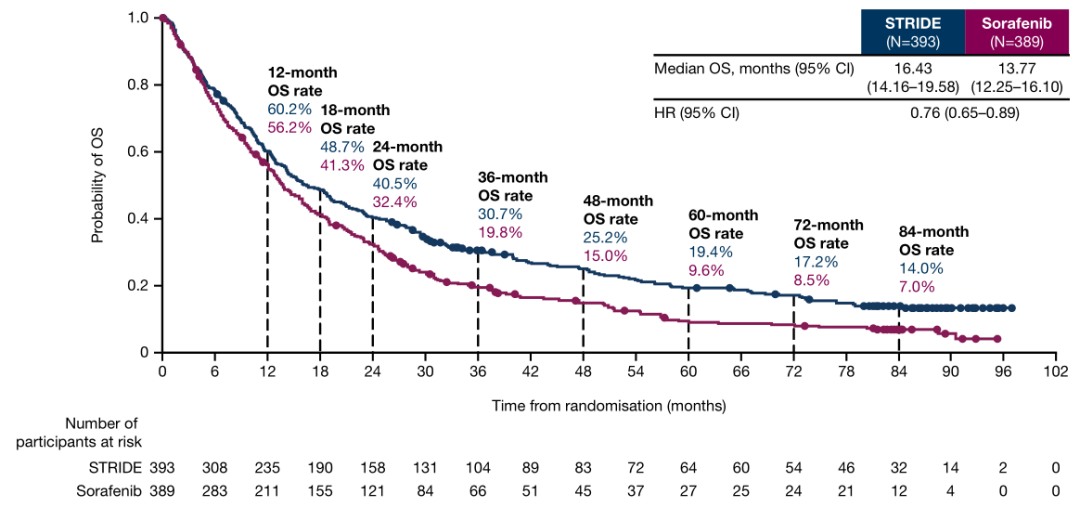 Fig. 1. Overall Survival in the Global Cohort, with 7-year OS Rates of 14.0% for STRIDE and 7.0% for Sorafenib
Subgroup Analysis
In patients who achieved disease control (DC), the 7-year OS rate was 20.8% with STRIDE, about 2.2 times the 9.4% with sorafenib. Consistent long-term benefit was also observed across subgroups defined by baseline liver function, using the Albumin-Bilirubin (ALBI) score, and by disease aetiology. The 7-year OS rate was 16.0% with STRIDE versus 11.0% with sorafenib in patients with ALBI grade 1, and 11.6% versus 2.4% in those with ALBI grade 2/3. In patients with hepatitis B virus (HBV) infection, the HR for STRIDE versus sorafenib was 0.66 (95% CI 0.50-0.87), a 34% reduction in the risk of death (Fig. 2).
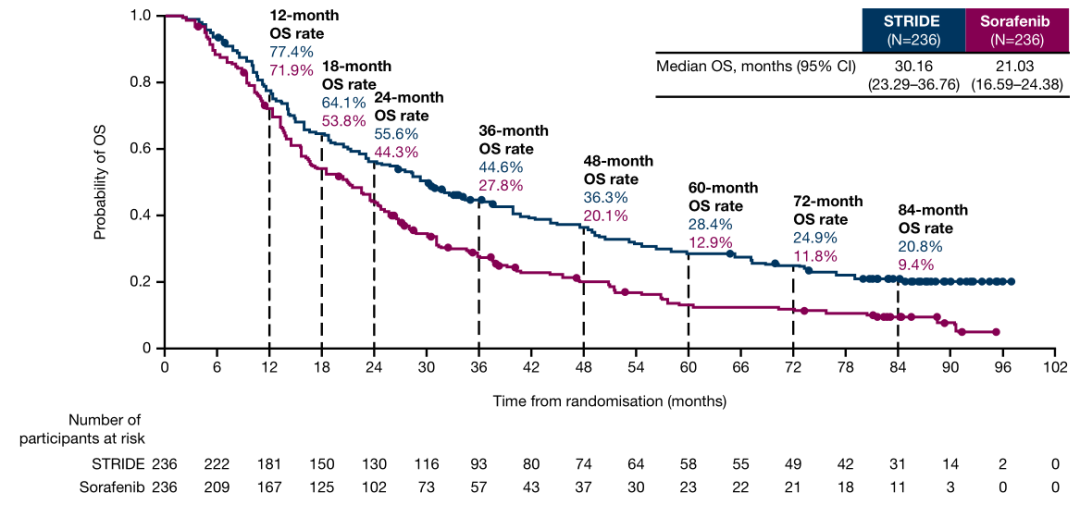 Fig. 2. Overall Survival in Patients who Achieved Disease Control, with 7-year OS Rates of 20.8% for STRIDE and 9.4% for Sorafenib
Tumour Response
By RECIST v1.1, the objective response rate (ORR) was 20.1% with STRIDE, about four times the 5.1% with sorafenib. Twelve patients in the STRIDE arm achieved complete response (CR), against none in the sorafenib arm. Median duration of response (DoR) was 22.34 months with STRIDE, compared with 18.43 months with sorafenib (Fig. 3).
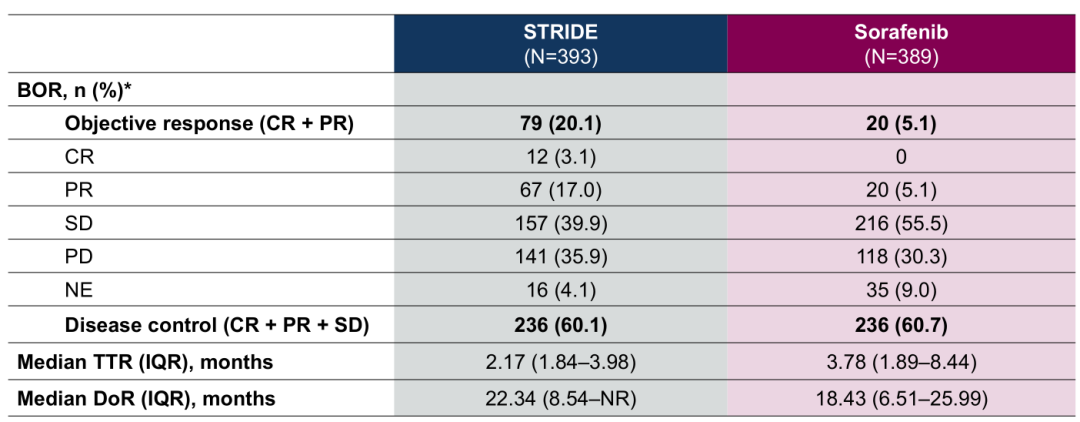 Fig. 3. Tumour Response Assessed by RECIST v1.1, with an Objective Response Rate of 20.1% for STRIDE and 5.1% for Sorafenib
Safety
Over seven years of follow-up, no new serious adverse events (SAEs) were reported in the STRIDE arm, and the safety profile was consistent with that reported in earlier analyses (Lau et al., Hepatology 2026;83(3):484-496). The proportion of patients receiving subsequent anticancer therapy was similar in the two arms (42.7% vs 46.0%), while the proportion receiving subsequent immunotherapy was significantly lower in the STRIDE arm (6.6% vs 24.4%). Grade 3 or 4 treatment-related adverse events were less frequent with STRIDE than with sorafenib, at 25.8% versus 37.2%.
Expert Commentary
Hepatocellular carcinoma (HCC) is a malignant tumour arising from hepatocytes. Because its onset is insidious and characteristic symptoms are few, most patients are diagnosed at an intermediate or advanced stage, when the opportunity for radical surgery has been lost. Developing effective treatment strategies and improving long-term survival therefore remain pressing questions in HCC management.
First-line treatment in uHCC has evolved from single-agent targeted therapy, through targeted-immune combinations, to dual immunotherapy, and the objective of treatment has widened from simply extending survival towards achieving long-term survival of good quality (Chan et al., J Gastroenterol Hepatol 2026;41(5):1436-1445). In this context, the STRIDE regimen, which combines CTLA-4 and PD-L1 blockade, offers a treatment option for addressing the long-term survival bottleneck in uHCC (Kelley et al., Clin Cancer Res 2026;32(4):694-704).
At the clinical level, HIMALAYA has confirmed the survival benefit of this dual-target strategy. The primary analysis was first reported at the ASCO GI meeting in 2022, with 3-year OS rates of 30.7% against 20.2%, and the series of longer follow-ups has continued to confirm the durability of the benefit, at 19.6% versus 9.4% at five years and 17.1% versus 8.9% at six years, roughly twice the comparator in each case (Abou-Alfa et al., NEJM Evid 2022;1(8):EVIDoa2100070). The seven-year follow-up presented at ESMO 2026 extends that observation. The 7-year OS rate of 14.0% against 7.0% means that about one in seven patients with uHCC survives beyond seven years, and the advantage was consistent across subgroups: in patients with a poorer baseline liver function reserve (ALBI grade 2/3), the 7-year OS rate was 11.6%, against 2.4% in the comparator arm, which suggests that a poorer liver function reserve did not erode the long-term benefit. Because HBV infection is the predominant cause of HCC in China, the HBV-positive subgroup is of particular interest, with an HR of 0.66 corresponding to a 34% reduction in the risk of death. Taken together, these data support the consistency of benefit across clinically distinct populations and the durability of the effect over seven years, which provides a basis for moving advanced liver cancer towards management as a chronic condition.
Two aspects of these results warrant caution. The first is the potential confounding of the OS endpoint by subsequent treatment. Although the proportion of patients receiving subsequent anticancer therapy was similar in the two arms, at 42.7% versus 46.0%, far fewer patients in the STRIDE arm received subsequent immunotherapy, at 6.6% versus 24.4%. This suggests that the long-term benefit derives to a substantial degree from the durable antitumour immune effect induced by the STRIDE regimen and is less influenced by later-line treatment. The second is the exploratory nature of the disease control analysis, which relates post-baseline disease status to survival and cannot on its own establish a causal relationship. The trial was open label and enrolled predominantly patients with Child-Pugh A liver function, so extrapolation to patients with more advanced liver dysfunction should be cautious, and the use of sorafenib as the comparator does not allow direct comparison with other first-line immunotherapy combinations.
The overall safety profile also remained stable over the extended follow-up, with no new SAEs reported in the STRIDE arm and the long-term characteristics consistent with earlier analyses. No additional toxicity was accumulated, so patients could complete their planned treatment course, which matters for a treatment given in first line and intended to be maintained over many years.
Reference
[1] Abou-Alfa GK, Chan SL, Sangro B, et al. Seven-year overall survival (OS) and OS by tumour response measures from the Phase 3 HIMALAYA study of tremelimumab plus durvalumab in first-line unresectable hepatocellular carcinoma (uHCC). ESMO 2026, 1683P.
[2] Abou-Alfa GK, Lau G, Kudo M, et al. Tremelimumab plus durvalumab in unresectable hepatocellular carcinoma. NEJM Evid. 2022;1(8):EVIDoa2100070.
[3] Chan LL, Chan KOK, Chan SL. Systemic therapy for advanced hepatocellular carcinoma in 2026: current standard-of-care and emerging therapeutic strategies. J Gastroenterol Hepatol. 2026;41(5):1436-1445.
[4] Kelley RK, Lee Y, Conway J, et al. T-Cell Receptor and Immune Gene Expression Pharmacodynamics for Durvalumab Alone and with Tremelimumab or Bevacizumab in Unresectable Hepatocellular Carcinoma. Clin Cancer Res. 2026;32(4):694-704.
[5] Lau G, Sangro B, Cheng AL, et al. Immune-mediated adverse events and overall survival with tremelimumab plus durvalumab and durvalumab monotherapy in unresectable HCC: HIMALAYA phase III randomized clinical trial. Hepatology. 2026;83(3):484-496.

