


Glucagon-like peptide-1 (GLP-1) receptor agonists have become an important option in the treatment of type 2 diabetes mellitus (T2DM) owing to their multiple benefits, including glycemic control, weight reduction, and cardiovascular protection. However, the psychiatric safety of this class has remained a focus of clinical attention. In 2023, the European Medicines Agency (EMA) initiated an investigation into the potential association between GLP-1 receptor agonists and suicidal risk; conclusions from real-world studies have since been inconsistent. Prior research has largely focused on psychiatric adverse events during active treatment, with heterogeneous results. The more insidious "risk window" — that is, after discontinuation — has received almost no attention in the literature.
Recently, a team led by Prof. Guang Ning of Shanghai Ruijin Hospital published a study in Nature Metabolism based on a large retrospective cohort from the Shanghai Hospital Linked Database (SHLD). For the first time, the study systematically distinguished psychiatric risk differences between the on-treatment period and the post-discontinuation period: GLP-1 receptor agonists did not increase the risk of depression or anxiety during treatment (neutral versus DPP-4 inhibitors, lower versus SGLT-2 inhibitors), but the risk of anxiety rose significantly after discontinuation.
Fig. 1. Literature Screenshot
Neutral or Lower Risk During Treatment, Elevated Anxiety Risk After Discontinuation
Using the Shanghai Hospital Linked Database, the study identified T2DM patients who initiated GLP-1 receptor agonists, dipeptidyl peptidase-4 (DPP-4) inhibitors, or sodium-glucose cotransporter 2 (SGLT-2) inhibitors for the first time between January 2018 and June 2024. The study only included treatment-naive T2DM patients with no prior history of depression or anxiety and no history of severe psychiatric illness. After propensity score matching, the final analysis included 22,976 matched pairs for the GLP-1RA vs DPP-4 inhibitor comparison and 23,524 matched pairs for the GLP-1RA vs SGLT-2 inhibitor comparison. Baseline characteristics were well balanced between groups.
The study endpoints were new-onset depressive or anxiety disorder, defined by diagnostic codes or relevant prescriptions.
On-treatment analyses showed that, compared with DPP-4 inhibitors, GLP-1RA users had no significant difference in the risk of depression or anxiety (HR 0.95; 95% CI: 0.89–1.02), whereas compared with SGLT-2 inhibitors, GLP-1RA users actually had a lower risk (HR 0.84; 95% CI: 0.79–0.89). When depression and anxiety were analyzed separately, the protective effect of GLP-1RA during treatment was more pronounced for anxiety — with risk reductions of 8% versus DPP-4 inhibitors (HR 0.92) and 19% versus SGLT-2 inhibitors (HR 0.81).
However, the post-discontinuation results were entirely reversed. The study continued to follow patients after drug discontinuation (~12,000 in the GLP-1RA group and ~13,000 in the comparator groups), with a median post-discontinuation follow-up of approximately 1.1 years. The data showed that the incidence of the composite endpoint of new-onset depression or anxiety after discontinuation was significantly higher than in the prior DPP-4 inhibitor group (9.42 vs 7.60 per 100 person-years; HR 1.19; 95% CI: 1.07–1.33) and also higher than in the prior SGLT-2 inhibitor group (9.29 vs 7.77 per 100 person-years; HR 1.16; 95% CI: 1.04–1.29). Cumulative incidence curves showed a progressively widening separation after discontinuation. This elevated risk was primarily driven by anxiety disorders — with the post-discontinuation anxiety risk increased by 23% versus the DPP-4 inhibitor group (HR 1.23) and by 18% versus the SGLT-2 inhibitor group (HR 1.18), whereas no significant difference was observed between groups for depressive disorders.
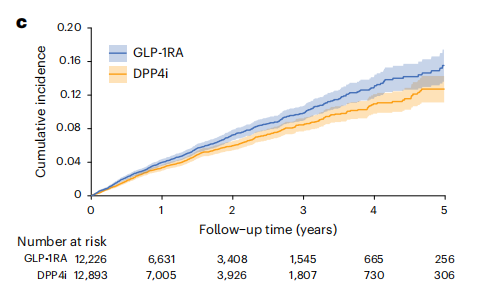
Fig. 2. Cumulative Incidence Curves for the Composite Endpoint of Depression and Anxiety After Discontinuation of GLP-1 Receptor Agonists Versus DPP-4 Inhibitors
The study verified the robustness of the results through multiple sensitivity analyses, including multivariable adjustment, competing-risk models, inverse probability weighting, and varying grace period settings. Assessment for unmeasured confounding showed no significant association for negative-control outcomes (hemorrhoids and otitis media), and the E-value (≥ 1.58) suggested that residual unmeasured confounding would be unlikely to fully explain the observed association between GLP-1RA discontinuation and elevated psychiatric risk.
Triglyceride Rebound Mediates Only a Small Portion of the Risk; Metabolic and Psychological Factors Both Contribute
It is well established that discontinuation of GLP-1 receptor agonists is often accompanied by weight rebound and worsening cardiometabolic parameters. In the present study, participants who had discontinued GLP-1 receptor agonists showed greater lipid rebound than those who had previously used DPP-4 or SGLT-2 inhibitors. To further validate the association between metabolic parameter changes and psychiatric risk, the investigators performed a causal mediation analysis. The results showed that post-discontinuation triglyceride elevation mediated only a small portion of the overall elevated anxiety risk — accounting for 6.8% of the total effect in the GLP-1RA vs DPP-4 inhibitor comparison and 5.5% in the GLP-1RA vs SGLT-2 inhibitor comparison.
The investigators noted that triglyceride rebound explains only a small fraction of the risk, and that concomitant weight rebound following discontinuation may be an important potential psychological stressor. Patients with diabetes already have a higher intrinsic susceptibility to psychiatric illness, and the combination of metabolic rebound and psychological stress further amplifies post-discontinuation psychiatric vulnerability.
Subgroup analysis showed that patients with shorter treatment duration (≤ 270 days) had a higher post-discontinuation risk. In this subgroup, the post-discontinuation HR was 1.22 (95% CI: 1.04–1.44) compared with DPP-4 inhibitors and 1.13 (95% CI: 1.00–1.28) compared with SGLT-2 inhibitors. This suggests that patients who discontinue after a short course of treatment may face a greater psychiatric risk. The trend was consistent across individual GLP-1 receptor agonist subgroups, with the loxenatide subgroup showing numerically higher values (post-discontinuation vs SGLT-2 inhibitors: HR 2.01; 95% CI: 1.25–3.24), though interpretation should be cautious given that no adjustment for multiple comparisons was performed.
Clinical Implications: Discontinue Cautiously and Monitor Closely
The core clinical implication of this study is that the psychiatric safety of GLP-1 receptor agonists changes dynamically across treatment phases — risk is neutral or lower during treatment and elevated for anxiety after discontinuation. The investigators explicitly proposed clinical management recommendations in the discussion.
Before initiating GLP-1 receptor agonist therapy, clinicians should evaluate the patient’s psychiatric history and current psychological status, including screening for depression, anxiety, substance abuse, and suicidal ideation, and should inform the patient about the possibility of weight rebound and reversal of cardiometabolic benefits after discontinuation. For patients currently on treatment — particularly those with a treatment duration of ≤ 270 days who are considering discontinuation — clinicians should counsel on the potential for weight rebound and increased psychiatric risk after stopping, monitor mood and psychological status closely, and refer to a mental health specialist when indicated.
Study Limitations
This study has several limitations. First, the data were derived exclusively from an urban T2DM population in Shanghai; the conclusions cannot be directly extrapolated to other ethnic groups, different healthcare systems, or populations using GLP-1 receptor agonists for obesity alone. Second, despite the use of active comparators, a new-user design, propensity score matching, and other methods to control for confounding, residual confounding cannot be fully excluded. Third, the study lacked direct post-discontinuation weight measurements, using triglyceride rebound only as an indirect proxy for weight change. Finally, the study included only treatment-naive T2DM patients without a prior history of depression or anxiety; the conclusions do not apply to patients with a psychiatric history.
Summary: In summary, GLP-1 receptor agonists do not increase the risk of depression or anxiety during treatment, but the risk of anxiety rises significantly after discontinuation. As the use of GLP-1 receptor agonists becomes increasingly widespread, clinical management should not only focus on the benefits and risks during active treatment, but should also pay greater attention to psychiatric assessment and monitoring during the post-discontinuation period.
References
1. Zhang T, He P, Ji Y, et al. Association of GLP-1RA discontinuation and risk of depressive and anxiety disorders in people with type 2 diabetes: a cohort study. Nat Metab. 2026. doi:10.1038/s42255-026-01567-z

