


Today (9th), at noon, Xijing Hospital of Air Force Medical University announced that under the leadership of Academician Dou Kefeng, a full liver from a multi-gene-edited pig was successfully transplanted into the body of a brain-dead patient on January 7th. This is the first time in human history that a full pig liver has been transplanted into a human body in situ. Academician Dou Kefeng stated that this is a significant breakthrough in the field of xenotransplantation and a crucial step towards the clinical application of xenogeneic liver transplantation. As of the time of publication, the patient's basic vital signs have remained stable.
Globally, in recent years, the academic community has successively conducted human trials of pig heart and pig kidney transplantation. China has been exploring the field of xenogeneic large organ transplantation for more than a decade and has now entered the global first tier.
The transplant pig used in this surgery was bred by Professor Pan Dengke, founder of Chengdu Zhongke Aoge Biotechnology, and his team. He told "MedJ" that the successful conduct of this surgery provides important theoretical basis for the future clinical application of pig liver transplantation to save patients' lives.

Implanting pig liver into the human body
According to Xijing Hospital, the weight of the donor pig liver in this case was about 800 grams, coming from a medical pig that had undergone six types of genetic modifications.
The recipient of the transplant was previously hospitalized due to other diseases and was certified as "brain-dead" after multiple assessments. The family agreed to participate in the xenogeneic liver transplantation research free of charge. The transplant implementation plan passed through the argumentation of the Academic Committee, Medical Ethics Committee, Organ Transplantation Committee, and Animal Committee, in line with international xenotransplantation requirements.
On January 7th, the surgery was led by Academician Dou Kefeng and Professor Tao Kaishan from the Hepatobiliary Surgery Department of Xijing Hospital, with the participation of more than ten departments including the Anesthesiology Department, Surgical Operating Room, Ultrasound Department, Nephrology Department, and Intensive Care Medicine Department.
The surgery, which lasted for more than ten hours, went through several stages including opening the pig's abdominal cavity, removing the donor pig liver, excising the patient's original liver, implanting the new liver, rebuilding the blood vessels, and closing the abdomen with hemostasis.
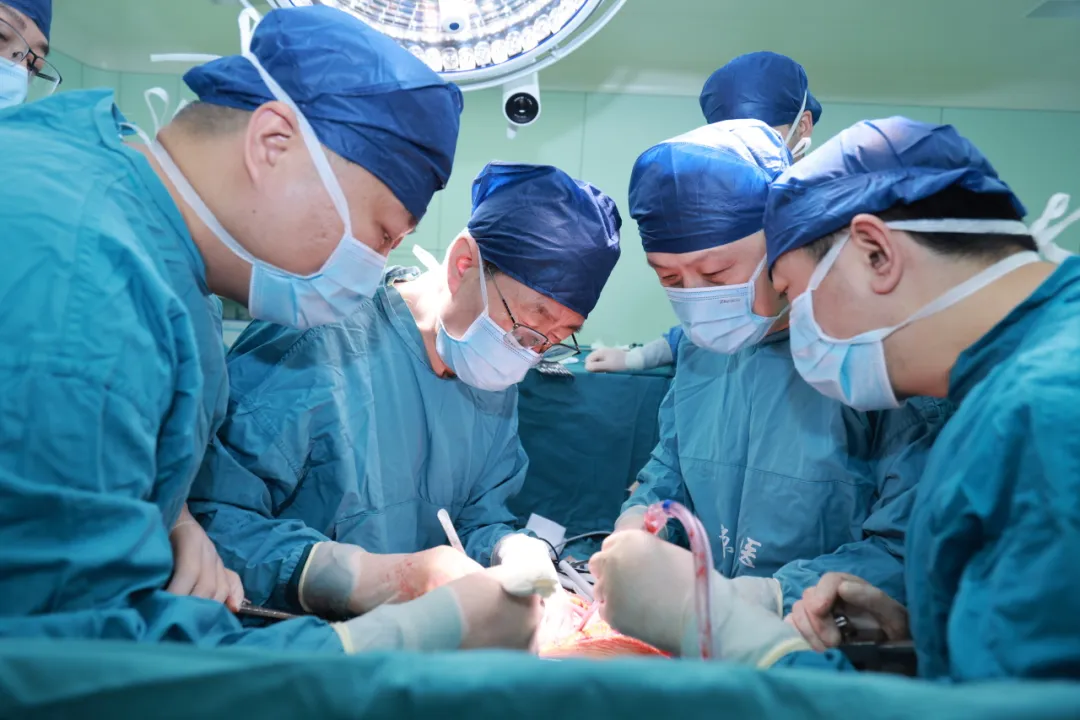
Academician Dou Kefeng and Associate Professor Yang Zhaoxu from the Hepatobiliary Surgery Department of Xijing Hospital, among others, performed a new liver transplant for the recipient. Image source: Xijing Hospital's official WeChat public account.
It was reported that after the pig liver transplant was completed and the blood flow was opened, the liver had good blood perfusion and immediately produced bile. This meant that the pig liver had replaced the "native liver" and was functioning normally in the patient's body. Postoperative continuous monitoring showed that the patient's basic vital signs such as circulation were stable, and liver function and other indicators gradually stabilized, marking the success of the surgery.
In fact, as early as March 2024, Xijing Hospital announced that it had successfully implanted a pig liver into the body of a brain-dead patient in an ectopic manner for the first time globally. Professor Pan Dengke explained to "MedJ," "Ectopic" means that the patient's original liver was still retained, and the pig liver was implanted in another part of the body. It can be understood as a preliminary feasibility test for pig liver human transplantation." However, ectopic auxiliary liver transplantation does not remove the recipient's own liver, and thus cannot fully understand the physiological replacement function of the transplanted pig liver. Professor Pan Dengke said, "This surgery completely relies on the implanted gene-edited pig liver to maintain the corresponding physiological functions of the patient, providing important theoretical basis for pig liver as a transitional treatment for acute liver failure to save patients' lives."
Academician Dou Kefeng stated that from the current results, gene-edited pig livers may be able to replace human livers in the early post-transplant period. This research provides important theoretical basis and technical support for future clinical applications.
More than a decade of exploration in pig organ transplantation
According to the World Health Organization, globally, less than 10% of organ transplant demands can be met each year. In China, about 300,000 patients with end-stage organ failure need transplants annually, but the supply-to-demand ratio of organs is only 1:30. Xenogeneic organ transplantation is not limited by the number of donor organs. Once successful, it will save the lives of countless patients with end-stage organ failure.
Since the United States first conducted gene-edited pig kidney transplantation in brain-dead patients in 2021, there have been 21 cases of xenogeneic large organ human transplants globally, mainly focusing on the heart, kidneys, and liver.
On this path, the scientific team of Xijing Hospital has also been exploring for more than a decade. In 2013, Xijing Hospital completed the first xenogeneic partial liver transplant from a transgenic pig to a monkey in Asia. The monkey survived for 14 days, setting a record for the international community at that time. In 2022, Xijing Hospital successfully conducted the world's first "6-gene-edited pig-monkey multi-organ and multi-tissue simultaneous combined transplant surgery."
On March 10th and 25th, 2024, the expert team of Xijing Hospital officially advanced pig organ transplantation into the human body, successively and successfully completing "pig liver" and "pig kidney" transplants in brain-dead patients, causing a sensation in the international academic community.
Professor Pan Dengke's team has been providing transplant pigs since 2013. In 2010, Professor Pan Dengke led his team to breed China's first "anti-immune rejection gene pig," officially opening a new era of xenogeneic large organ transplantation in China. It is introduced that the pigs used for xenogeneic organ transplantation are not ordinary-grade pigs. To solve the problem of biosafety, these gene-edited pigs are sent to super-clean pig houses as soon as they are born and are fed artificially after weaning.
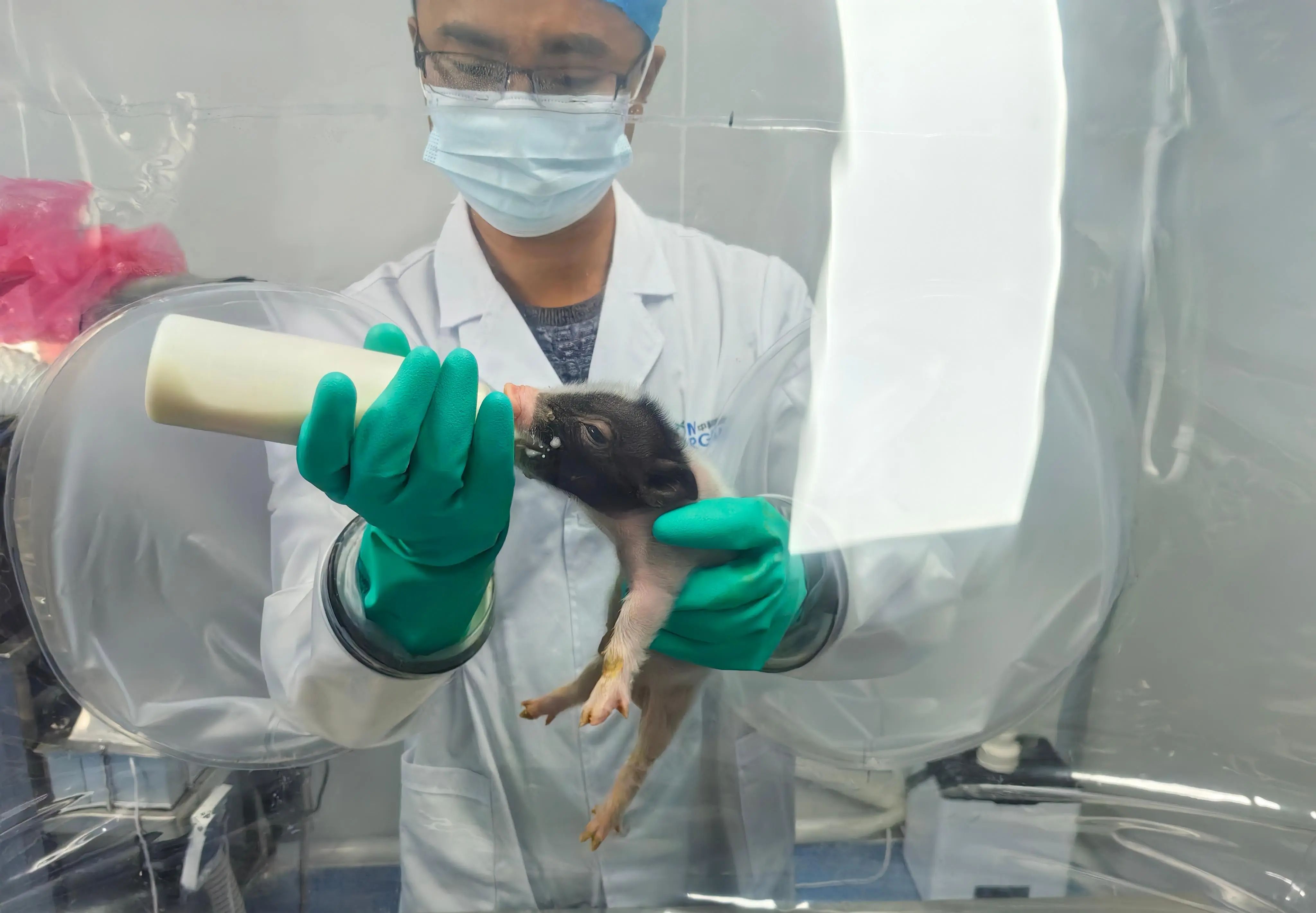
The gene-edited Bama miniature pigs used for xenogeneic organ transplantation are weaned and subjected to artificial sterile cultivation
After years of technical upgrades, optimizations, and improvements, the transplant pigs used in this surgery by Xijing Hospital underwent "6-gene editing," including knocking out three types of pig antigens that would cause "hyperacute rejection and acute humoral rejection" in humans, and introducing two types of "human complement regulatory proteins" and one type of "human coagulation regulatory protein."
"In fact, in the early days, there were many technical difficulties in pig large organ transplantation, and the clinical application prospects were not optimistic. Few people were willing to devote themselves to it," Professor Pan Dengke told "Medical Circle." "The forward-looking and far-sighted medical thinking of the doctors at Xijing Hospital has accumulated many valuable experiences for the development of this field in our country."
Taking the number of gene edits as an example, Professor Pan Dengke told "Medical Circle" that there is no unified consensus and standard internationally. "Theoretically, the more gene modifications, the closer the pig organs can get to the human body, but at the same time, it will also reduce the survival rate of pigs and increase other related potential risks."
The "Holy Grail" of organ transplantation
In addition to "transplantation itself," the choice of transplant organs also makes this surgery of milestone significance. In terms of implementation difficulty, xenogeneic liver transplantation is considered the "Holy Grail" of organ transplantation, and there are few cases internationally.
"The liver has multiple physiological functions and is involved in many human activities. To use a pig liver to completely replace a human liver, there are more mismatch problems and the difficulty is great," Professor Pan Dengke said.
The "Organ Transplantation" journal published in July 2022 pointed out that more than 100 proteins produced by the pig liver may not be able to function fully in the human body. In addition, there are species-specific differences in the expression and functional regulation of coagulation proteins between human liver cells and pig liver cells. These differences may lead to coagulation abnormalities, thereby affecting the blood supply of the transplanted liver, etc.
Academician Dou Kefeng also introduced that compared with kidneys and hearts, the liver is involved in synthesis, decomposition, coagulation, detoxification, and immune functions. Its anatomical structure and physiological functions are more complex, so the difficulty and scientific significance of gene-edited pig liver transplant technology are greater.
Professor Pan Dengke told "Medical Circle" that the success of this surgery proves that the transplanted pig liver can exercise normal physiological functions in the early stage.
It is introduced that since the current stage of pig liver transplantation is for "brain-dead patients," who need to rely on auxiliary medical equipment to maintain life, and considering ethical issues, it is impossible to conduct unlimited experiments on patients. Previously, the global first "brain-dead patient ectopic pig liver transplantation" was observed for 11 days after the surgery. "Therefore, the acute and chronic rejection reactions of patients several months later are still unknown," he said.
However, this does not affect the clinical application prospects of pig liver transplantation.
"In the short term, the greatest value of pig liver transplantation lies in 'transitional liver,' helping patients with liver failure to get through the dangerous period. Some acute liver failure patients' liver functions will gradually recover," Professor Pan Dengke introduced.
Xijing Hospital introduced that there are nearly 400 million liver disease patients in China, with 300,000 to 500,000 new liver failure patients added every year. For liver failure, liver transplantation is the only effective radical treatment. In reality, many people lose their lives because they cannot wait for human donor livers. Xenogeneic liver transplantation is not limited by the number of donor livers and can benefit more patients with end-stage liver diseases. In the future, it may replace allogeneic liver transplantation.
It is worth mentioning that although it seems like a pipe dream, xenogeneic organ transplantation is not as far from clinical application as one might think.
The United States already has teams stating that they will formally apply to regulatory authorities and hope to comprehensively promote pig organ transplantation into clinical trials within a year. China released the "Chinese Expert Consensus on Xenotransplantation Clinical Trials" in April 2022, proposing that the attitude of "encouraging research and cautious development" should be adopted, strengthening basic research, and prudently promoting clinical research.
Professor Pan Dengke said that compared with international counterparts, although China's research on xenogeneic organ transplantation started late, its development is very fast.
"The reason why China can gradually achieve international leadership is precisely because Chinese scientists have been tirelessly verifying in animal research for many years, reviewing every piece of data, and constantly thinking about the surgical process, transplant technology, and ethical aspects, which has led to the current achievements," Professor Pan Dengke said.

