


GAIA/CLL13 is a global, multicenter phase III randomized controlled trial designed to compare the long-term efficacy, safety, and patient-reported outcomes (PROs) of different first-line regimens for chronic lymphocytic leukemia (CLL), and to clarify the appropriate populations for triplet, doublet targeted, and conventional chemoimmunotherapy (CIT) approaches. Earlier 4-year follow-up data from this study confirmed only that the GIV triplet (Bruton's tyrosine kinase inhibitor [BTKi] + venetoclax + CD20 monoclonal antibody) and the GV doublet (venetoclax + obinutuzumab) were superior to CIT and to RV (venetoclax + rituximab), but did not demonstrate a survival advantage for GIV over GV.
Recently, Blood published the final comprehensive analysis at a median follow-up of 63.8 months (over 5 years), providing the first simultaneous disclosure of long-term PROs, second-line efficacy after relapse, and long-term safety data. This offers critical evidence-based support for stratified, precision treatment of fit, newly diagnosed CLL patients without TP53 abnormalities [1]. The key findings are summarized below.
 Fig. 1. Study Screenshot
Study Population
The study enrolled 926 previously untreated CLL patients who were medically fit [Cumulative Illness Rating Scale (CIRS) score ≤6, with no single item ≥4], had creatinine clearance ≥70 mL/min, and had no TP53 abnormalities (17p deletion and/or TP53 mutation). Patients were randomized 1:1:1:1 to one of four arms:
- l CIT arm (n=229): fludarabine + cyclophosphamide + rituximab (FCR) for patients ≤65 years, or bendamustine + rituximab (BR) for patients >65 years, both for 6 cycles;
- l RV arm (n=237): venetoclax + rituximab, fixed-duration 12 cycles;
- l GV arm (n=229): venetoclax (12 cycles) + obinutuzumab (6 cycles);
- l GIV arm (n=231): venetoclax + obinutuzumab + ibrutinib, with a base of 12 cycles; ibrutinib was extended up to 36 cycles based on minimal residual disease (MRD) status.
Five-Year Core Efficacy Data
1. Overall Progression-Free Survival: GIV Achieves the Most Durable Remission
At a median follow-up of 63.8 months, the 5-year PFS rates across the four arms showed clear stratification, with statistically significant differences:
- GIV: 81.3%; GV: 69.8%; RV: 57.4%; CIT: 50.7%;
- GIV vs. GV: progression/death risk reduced by 39%, HR=0.61, P=0.0046, confirming that the triplet is superior to the obinutuzumab doublet;
- Both GV and GIV were significantly superior to RV and CIT (both P<0.001); no significant survival difference between RV and CIT (P=0.53).
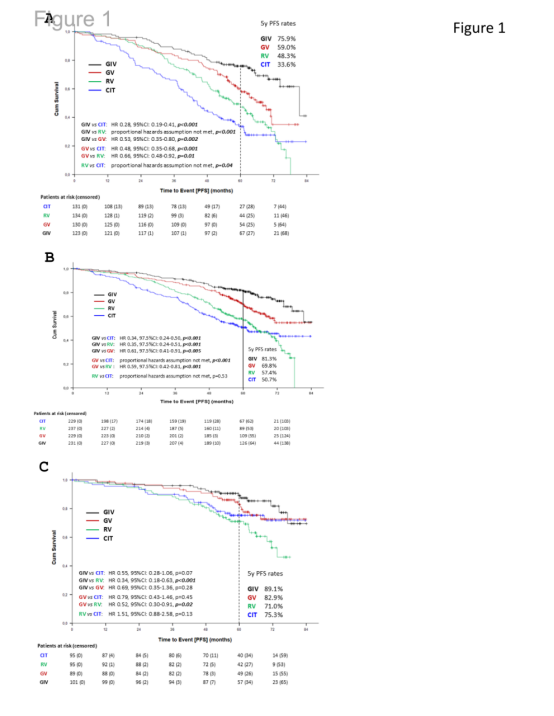 Fig. 2. Comparison of PFS Curves Across the Four Arms in Treatment-Naive CLL Patients
2. IGHV Subgroup Analysis: High-Risk Unmutated Patients Benefit Most
- l IGHV-unmutated (high-risk): GIV 5-year PFS reached 75.9%, significantly higher than GV (59.0%, HR=0.53, P=0.002), RV (48.3%), and CIT (33.6%);
- l IGHV-mutated (low-risk): GIV 89.1%, GV 82.9%, with a narrowing of the difference between the two arms; both were significantly superior to RV (71.0%); the 5-year PFS of FCR in ≤65-year-old mutated patients was 85.7%, with no statistically significant difference versus the targeted regimens.
- l Multivariate regression confirmed that IGHV-unmutated status is an independent adverse prognostic factor across all regimens; peripheral blood MRD positivity at 15 months (≥10⁻⁴) predicts shortened PFS, while MRD positivity at 9 months in the GIV arm had no significant prognostic impact, suggesting that continued ibrutinib therapy may offset the adverse effects of residual disease.
3. Overall Survival: No Significant Difference Between Arms
5-year OS rates: RV 94.7%, GIV 94.3%, GV 93.6%, CIT 90.7%, with no statistically significant differences between groups. The investigators noted that, owing to the widespread availability of subsequent targeted agents, patients in the chemotherapy arm could switch to BTKi/venetoclax after progression, narrowing the early PFS gap.
4. Second-Line Therapy: First-Line Venetoclax Exposure Does Not Compromise Subsequent Efficacy
l 5-year rates of initiating second-line therapy: GIV 7.4%, GV 12.5%, RV 22.9%, and CIT 32.9% — the triplet regimen substantially delayed relapse;
l Second-line treatment-free survival (TFS2): Among patients who received first-line venetoclax-based therapy and subsequently required second-line treatment for disease progression, TFS2 rates exceeded 77% regardless of whether BTKi monotherapy, venetoclax re-treatment, or their combination was chosen. The 2-year TFS2 rate reached 100% for venetoclax combined with a BTKi. These findings suggest that, after relapse from a fixed-duration venetoclax regimen, re-treatment with a targeted combination may still achieve high response rates.
Long-Term Safety and Patient-Reported Outcomes (PROs)
1. Long-Term Adverse Event Profile
Long-term adverse events (AEs) showed distinct profiles across the four arms.
For serious infections, the exposure-adjusted incidence was highest in the CIT arm, followed by GIV, with GV being the lowest. Cardiac-related risk was most prominent in the GIV arm, with a significantly higher incidence than the other three arms and substantially elevated risk of atrial fibrillation and hypertension.
For second primary malignancies, the follow-up-adjusted incidence in the GIV arm was 2.2 per 1,000 patient-months, higher than GV (1.2) and RV (1.5), while the CIT arm showed a significantly higher rate of non-melanoma skin cancer than any of the targeted-therapy arms.
For early treatment discontinuation, the rates showed a clear gradient: CIT 18.5%, GIV 13.9%, RV 7.6%, GV 6.1%, with CIT being the highest and GV the lowest. The causes of discontinuation also differed substantially: in GIV, early discontinuation was driven primarily by gastrointestinal discomfort and bleeding-related adverse events, whereas in CIT, early discontinuation was most often due to hematologic toxicity and infection-related AEs.
2. Patient-Reported Outcomes: Quality of Life and Symptom Burden
PRO analyses showed that, with the GV and RV regimens, patient-reported improvements in global health status (GHS) occurred earlier and were more pronounced, reaching and maintaining improvements above the minimal important difference (MID) from month 6 onward. In the GIV arm, although the median time to improvement was similar (5.8 months), clinically meaningful quality-of-life improvement was first observed only at month 15 (after the majority of patients had discontinued treatment).
In terms of symptom burden, CLL-related symptoms (such as fatigue) improved rapidly in the GV and RV arms. However, patients in the GIV arm reported more pronounced treatment-related symptoms during therapy, including nausea/vomiting, diarrhea, and bruising — a quality-of-life shortfall of the triplet regimen.
Summary and Clinical Discussion
The 5-year final analysis of the CLL13/GAIA trial yields the following key conclusions:
First, in fit, newly diagnosed CLL without TP53 abnormalities, the GIV triplet and GV doublet are both superior to RV and to conventional chemotherapy; the 5-year follow-up confirms for the first time that GIV further extends PFS compared with GV, with IGHV-unmutated high-risk patients deriving the greatest benefit from the triplet.
Second, overall survival is similar across all fixed-duration venetoclax regimens, but GIV significantly reduces long-term relapse and delays second-line treatment; for patients who relapse after first-line venetoclax, re-treatment with BTKi + venetoclax may still achieve long-term disease control.
Third, regimen selection should balance efficacy, toxicity, and quality of life: the GV doublet has favorable safety and rapid quality-of-life improvement, making it suitable for patients with underlying cardiac disease or those prioritizing short-term quality of life; the GIV triplet is preferentially recommended for IGHV-unmutated patients without cardiovascular disease who are seeking longer remission; the RV doublet's efficacy falls short of GV, and its first-line status is gradually declining; conventional CIT serves only as an alternative in settings where targeted agents are unavailable.
Of course, this study has limitations: it excluded very high-risk patients with TP53/17p deletion, so its conclusions cannot be extrapolated to this group; enrolled patients were overall younger and fitter, mostly from large centers, and real-world data are needed to confirm broader applicability; second-line treatment regimens were chosen at physician discretion, introducing selection bias, and the comparisons of subsequent-line efficacy are exploratory only.
In summary, the 5-year follow-up data from CLL13/GAIA further consolidate the position of fixed-duration venetoclax-based regimens as a first-line standard of care in newly diagnosed CLL and provide important evidence to inform individualized treatment decisions.
References
[1] Fürstenau M, Niemann CU, Robrecht S, et al. Venetoclax combinations in untreated CLL: 5-year results and patient-reported outcomes analysis of the CLL13/GAIA trial. Blood. 2026;147(25):3025-3038.

