


A team led by Prof. Shuguang Gao from the Department of Orthopaedics, Sports Medicine, at Xiangya Hospital of Central South University, working with institutions at home and abroad, has reported an important advance in evidence-based medicine for the treatment of adhesive capsulitis of the shoulder, also known as frozen shoulder or periarthritis of the shoulder.
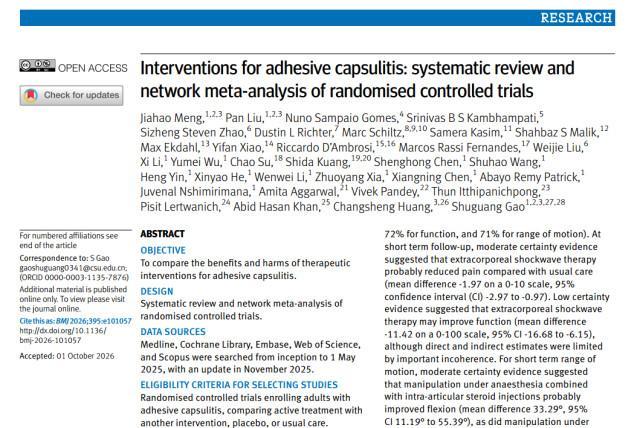
The study included 189 randomised controlled trials from around the world, involving 12,988 patients, and provided the first comprehensive assessment of the efficacy and safety of 59 interventions for adhesive capsulitis. The results were published in The BMJ under the title “Interventions for adhesive capsulitis: systematic review and network meta-analysis of randomised controlled trials”.
Article Key Points
- The review pooled 189 randomised trials with 12,988 patients across 59 interventions
- Short-term follow-up was defined as 3 months or less, and mid-term as more than 3 but no more than 6
- Extracorporeal shockwave therapy probably reduces short-term pain versus usual care, mean difference -1.97
- Manipulation under anaesthesia improved short-term flexion by 33.29 degrees with steroid injection and 26.16 alone
- Evidence for most other interventions, for outcomes beyond 3 months, and for safety was low or very low certainty
- Around 70% of the trials contributing to the main outcome analyses were at high risk of bias
- The study gave no absolute ranking and emphasised shared decision-making instead
- The team called for head-to-head trials with follow-up of more than 12 to 18 months
Many Treatment Options, but No Systematic Comparison
Adhesive capsulitis is a disabling musculoskeletal disease characterised by shoulder pain and restricted movement. It occurs most often in people aged 40 to 60 years, and its prevalence is higher in women than in men. A wide range of approaches is currently available in clinical practice, including medication, corticosteroid injection, physical therapy, and surgery, but the evidence base is neither comprehensive nor systematic. The relative efficacy and safety of these interventions remain uncertain, which leaves clinicians facing a “difficult choice” when working out the best treatment plan for an individual patient.
To address this clinical problem, the orthopaedics team at Xiangya Hospital worked with scholars from several countries. They followed PRISMA guidelines strictly, registered the study protocol on the PROSPERO platform, and conducted a comprehensive search of five databases including Medline and the Cochrane Library. The research team classified 59 interventions, spanning physical therapy, injections, and surgery, into a scientifically coherent structure, and strictly separated “usual care”, “placebo”, and “active comparators” to ensure that the comparisons were scientifically sound and rigorous.
Shockwave Therapy and Manual Manipulation Stand out in Short-Term Outcomes
The results showed that at short-term follow-up (3 months or less), moderate-certainty evidence indicated that extracorporeal shockwave therapy, which delivers low-energy sound waves to stimulate blood flow and healing in damaged tissue, may effectively reduce pain compared with usual care, with a mean difference of -1.97 on a 0-10 pain scale, and the point estimate exceeded the prespecified threshold for clinical importance.
Moderate-certainty evidence also indicated that manipulation under anaesthesia, performed by a clinician while the patient is under anaesthesia, may significantly improve short-term forward flexion whether or not it is combined with an intra-articular corticosteroid injection: the combination improved flexion by a mean of 33.29 degrees, and manipulation under anaesthesia alone by 26.16 degrees.
The research team also pointed out the limitations of the current evidence. For most other interventions, for outcomes beyond three months, and for comparative safety, the certainty of evidence was low or very low, because adverse event reporting was incomplete and inconsistent. In addition, approximately 70% of the trials contributing to the main outcome analyses were at high risk of bias, and the evidence was concentrated mainly in Asia.
The study did not produce an absolute “best treatment ranking”. Instead, it emphasises shared decision-making based on certainty of evidence, thresholds for clinically important effects, and individual patient circumstances.
The research team noted that the existing evidence mainly supports short-term, outcome-specific efficacy, and that clinical decisions should not rely on a single statistical ranking alone. Instead they should take into account the invasiveness of the intervention, cost, patient preference, and the uncertainty around long-term benefit and risk. Future clinical trials should be high-quality head-to-head studies with follow-up of more than 12 to 18 months, to establish whether early improvement translates into long-term rehabilitation outcomes.
The BMJ issued a press release alongside the publication, promoting the study to around 3,000 media outlets worldwide. The findings provide the most comprehensive evidence base to date on the treatment of adhesive capsulitis for the global orthopaedic, sports medicine, and rehabilitation communities, and also mark a new step for Xiangya Hospital in the field where sports medicine and evidence-based medicine intersect.

