


Nearly half a century of repeated setbacks in the cancer vaccine field has finally given way to a breakthrough.
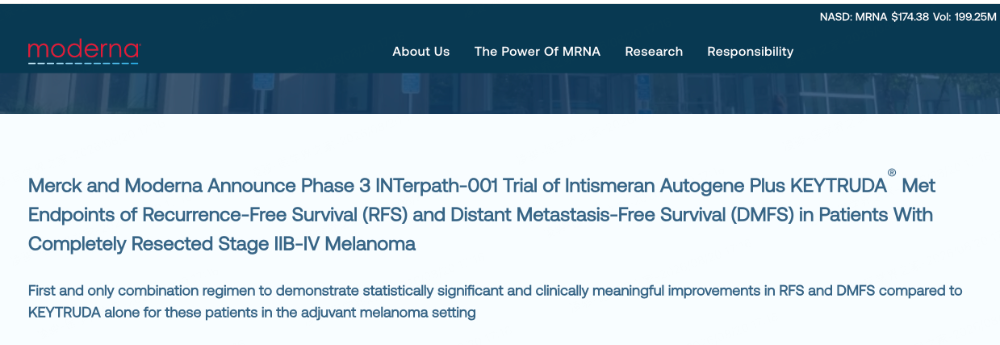
On August 19, 2026, Merck and Moderna jointly announced that intismeran autogene, an individualized neoantigen mRNA cancer vaccine, met its primary endpoint in a Phase III clinical trial for melanoma. When combined with the current standard-of-care PD-1 inhibitor pembrolizumab, the vaccine significantly reduced the risk of melanoma recurrence and the risk of metastasis to other organs.
Earlier Phase IIb data had shown that intismeran autogene further reduced the risk of recurrence or death by 49% in post-surgical melanoma patients. “This result is incredibly exciting. In the evolution of melanoma treatment, drug effects of this magnitude have been unprecedented,” Prof. Quanli Gao, Director of the Department of Immunotherapy at Henan Cancer Hospital, told MedJ.
According to relevant statistics, approximately 325,000 new melanoma cases are diagnosed globally each year, of which some 57,000 patients die. News of the Phase III results sent Moderna’s share price up 176.97% in a single trading day, with Merck (MRK.US) gaining 12.6%.
The implications go well beyond a positive trial result, Dr. Cheng Xudong, founder of the neoantigen cancer vaccine company Zhongsheng Kangyuan, told MedJ: “The success of this trial means that neoantigen cancer vaccines—once confined to specialized research—have moved closer to the general public and become a real, safe, and effective clinical treatment option.”
A Tailored Approach for Each Patient
Malignant melanoma is a lethal solid tumor. Per the figures cited, China sees roughly 20,000 new cases annually, and most patients are diagnosed at locally advanced or metastatic stages. Overall incidence has been rising by 3%-5% per year.
Prof. Quanli Gao told MedJ that although a large proportion of melanoma lesions can be surgically resected, recurrence remains the greatest clinical concern even after successful surgery—especially for stage III or IV disease, where the overall recurrence rate exceeds 50%.
“Earlier, the main approach was post-operative interferon, but the results were generally modest. After immunotherapy emerged, adjuvant PD-1 inhibitors became the internationally accepted standard—yet they could only reduce recurrence by a further approximately 10%,” Prof. Gao said. The success of intismeran autogene specifically addresses this unmet need.
Intismeran autogene is an individualized cancer vaccine based on tumor neoantigen targets delivered via an mRNA platform. Conceptually, it extracts the unique mutational signature from a patient’s own tumor tissue and uses it to design a bespoke therapeutic that trains the patient’s immune system to recognize and attack tumor cells.
At the American Society of Clinical Oncology (ASCO) Annual Meeting this May, 5-year follow-up data from the Phase IIb trial of intismeran autogene plus pembrolizumab were presented. Across 157 patients, the regimen reduced the risk of post-surgical recurrence or death by 49% and the risk of distant metastasis by 59%.
“These efficacy data represent a major clinical breakthrough. Compared with historical adjuvant therapy data, this is already a very substantial success,” Prof. Gao noted.
If the Phase IIb data were an early signal, what has truly shaken the field is the subsequent Phase III confirmatory trial. The trial enrolled 1,137 patients with resected stage IIb-IV melanoma, randomized 2:1 to receive intismeran autogene plus pembrolizumab or pembrolizumab alone, for one year.
The interim analysis announced on August 19 showed that, compared with standard immunotherapy, intismeran autogene combination therapy significantly improved recurrence-free survival (RFS) and distant metastasis-free survival (DMFS), with no new safety signals.
Notably, the companies have not yet disclosed specific efficacy numbers; overall survival (OS) data collection is ongoing. Moderna also stated that it is working with Merck to extend the approach to additional tumor types, including lung, bladder, and kidney cancers.
“As more data emerge, if the trial ultimately succeeds, this may establish a new treatment paradigm in malignant tumor therapy,” Prof. Gao said. “Cancer vaccines used in combination with other therapies, tailored to each patient to help them stay in a ‘cancer-free state’ as long as possible—that could be the direction of the future.”
30 Years of Cancer Vaccine Research
The therapeutic concept of “using individualized cancer vaccines against cancer” has a long history. From generic shared-antigen cancer vaccines in the last century to today’s individualized neoantigen cancer vaccines, the field has developed over nearly half a century, with hundreds of registered clinical trials—but intismeran autogene is the first to reach Phase III with a positive read-out.
In April 2010, the first prostate cancer immunotherapy sipuleucel-T (Provenge) was approved in the United States. It did not deliver a transformative clinical outcome, extending median overall survival by only 4.1 months. By comparison, the oral androgen receptor inhibitor enzalutamide, approved in 2012 for second-line treatment, extended median overall survival by 15.8 months.
High price, complex treatment regimen, and limited benefit gains led to Provenge’s commercial failure. Other therapeutic cancer vaccines that failed in development include the brain cancer vaccine Rintega and the pancreatic cancer vaccine algenpantucel-L.
Dr. Cheng Xudong told MedJ that earlier cancer vaccine designs were based on known, non-individualized “shared antigens.” “These vaccines have weak specificity, may carry toxicity risks, and the fixed targets are prone to resistance. More importantly, every cancer patient is different, so efficacy is hard to assess and quantify.”
This situation persisted until around 2016, when individualized tumor “neoantigen” technology entered the mainstream, opening a new direction for a field that had been at an impasse.
These cancer-specific antigens are unique to each tumor patient. For intismeran autogene, the patient’s tumor cells are first extracted and analyzed by genomic multi-omics to read out all the mutations and expression data. AI algorithms and big data are then used to sift through the massive sequencing results and identify up to 34 patient-specific neoantigens for individualized vaccine production.
According to Dr. Cheng, the rapid development of neoantigen technology has been driven by advances in tumor genomics, artificial intelligence, and tumor immunology, enabling more precise and quantitative tumor antigen selection. At the same time, industrial-scale manufacturing, gene sequencing, and delivery technologies have supported the clinical translation of a new generation of individualized cancer vaccines.
In addition, the success of mRNA technology during the COVID-19 pandemic has dramatically shortened the time required to prepare, quality-check, and deliver individualized mRNA cancer vaccines, while also improving efficacy.
In May 2023, Phase I data for another mRNA cancer vaccine, BNT122, showed that eight pancreatic cancer patients receiving a cancer vaccine combined with a PD-L1 blocker and chemotherapy remained cancer-free 18 months later. The latest data show that seven of them are still alive 4-6 years after treatment.
Beyond mRNA, Dr. Cheng noted that individualized cancer vaccines also include peptide-based and dendritic cell (DC) vaccines as alternative antigen-delivery approaches: “The underlying logic is the same—all require AI and big data to rapidly and precisely select neoantigen targets.”
“However, efficacy differs across technology platforms, as do applicable cancer types and optimal treatment windows. Currently, mRNA and peptide approaches are mostly used for adjuvant therapy in relatively early-stage ‘hot tumors’ to prevent recurrence, while the DC cell approach is often used for mid- to late-stage ‘cold tumors.’ The industry is also conducting clinical exploration of multiple indications and combination regimens across different platforms,” Dr. Cheng said.
Prof. Quanli Gao added: “The advantages of new-generation individualized cancer vaccines include convenient administration and low side-effect burden. Moreover, once the immune system is trained to recognize these individualized neoantigens, immune memory may theoretically form—even minimal residual tumor cells could potentially be cleared on an ongoing basis.”
He cautioned, however, that this success may not simply transfer to other cancer types. “Melanoma itself is highly antigenic. For tumors with weaker antigenity, whether vaccines can work still needs further verification.”
Future Challenges
In a sense, calling today’s “individualized cancer vaccines” by the traditional concept of “vaccines” is not entirely accurate, because these vaccines do not serve a preventive role. Instead, they aim to boost the body’s immune response against cancer cells and kill them.
Dr. Cheng told MedJ that most current mRNA vaccine development is still aimed at post-surgical adjuvant treatment in operable patients, and whether it works for patients with high tumor burden or inoperable mid- to late-stage malignancies remains unknown.
“One reason is the complex immune microenvironment of tumors,”Dr. Cheng explained. “Mid- to late-stage solid tumors are often chronically immunosuppressed, with antigen-presenting cells and effector immune cells in a functionally deficient or restricted state. Even if high-quality antigens are infused at this point, the antitumor immune response is difficult to fully activate.”
In Prof. Gao’s view, however, the bigger challenge lies in accessibility. According to media reports, in BNT122’s clinical trial, each patient received eight vaccine doses, at a cost of $100,000 per dose.
“These vaccines are inherently highly individualized products, requiring sequencing and bespoke manufacturing for every single patient—early costs are hard to bring down,” Prof. Gao said. “But as the technology matures, scale expands, and domestic companies accelerate their efforts, costs may gradually fall and the therapy may eventually reach more patients.”
According to public information, multiple Chinese companies have entered the cancer vaccine space:
Zhongsheng Kangyuan’s ZSNeo-DC1.1 is the world’s first neoantigen DC cancer vaccine to enter registrational Phase II clinical trials. Phase Ib data published in Nature Communications this year showed that, in newly diagnosed glioblastoma patients, median progression-free survival after treatment reached 16.2 months—far exceeding the 7-10 months seen with standard therapy. In recurrent glioblastoma, median post-recurrence survival exceeded 16 months—more than double the 4-6 months seen with best supportive care.
Everest Medicines’ EVM16, similar to intismeran autogene, is an individualized neoantigen mRNA vaccine. Data published in April this year showed that, of nine patients with advanced solid tumors who had failed multiple lines of therapy, eight successfully mounted a strong T-cell immune response, demonstrating preliminary safety and efficacy signals.
Beijing Likang Life’s LK101 received FDA clinical trial approval in 2025, becoming the first domestic product of its kind to go international.
Worth noting: whether mRNA, peptide, or DC cell platforms, virtually every individualized cancer vaccine that has reached the clinical stage has adopted combination therapy.
“Tumor neoantigens are like GPS, accurately navigating the individualized cancer vaccine ‘vehicle’ to the tumor cell,” Dr. Cheng told MedJ. “PD-1/PD-L1 antibodies release the brakes; chemotherapy fuels the engine; CD40 antibodies add armor. They work together to fight the tumor.”
Prof. Quanli Gao told MedJ that with the emergence of new immuno-oncology agents such as CAR-T, tumor-infiltrating lymphocyte (TIL) therapy, and cancer vaccines, overall cancer treatment outcomes continue to improve and patient survival is getting longer. “But this also raises the bar for clinicians.”
“The growing range of treatment options means the complexity of regimen design is increasing in parallel—how to formulate the optimal combination strategy based on a patient’s specific stage, biomarkers, and prior treatment history will be an increasingly central capability in oncology going forward,” Prof. Gao said.

