


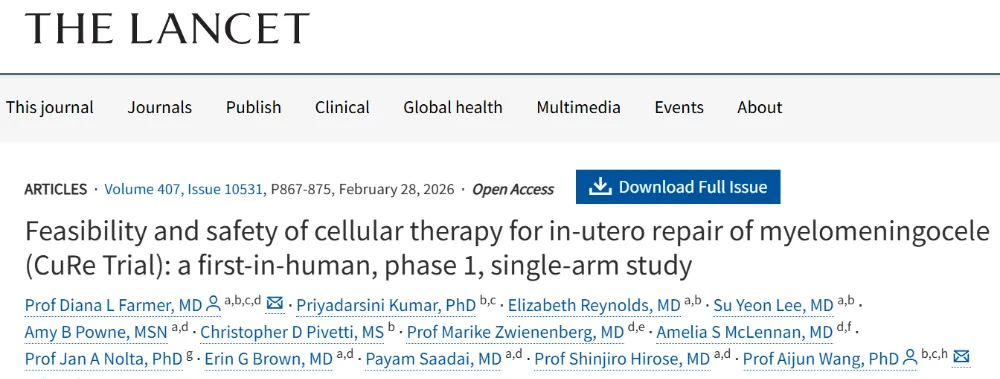
On February 28, The Lancet published a pioneering clinical trial describing the first spina bifida treatment to combine fetal surgery with stem-cell therapy.
The phase 1 single-arm CuRe trial, led by the University of California, Davis, showed that standard prenatal fetal surgery plus placenta-derived mesenchymal stromal cells could repair fetal myelomeningocele. All six treated newborns improved; none required a shunt for hydrocephalus, and no stem-cell-related safety issues were seen.
The study is a landmark because it is the first time stem-cell therapy has been applied directly to a damaged fetal spine in the clinic, opening a new path for spina bifida and other congenital diseases.
A new idea: patching a defective spine
Spina bifida, or myelomeningocele, is the most common neural-tube defect and one of the most common congenital diseases worldwide. China has about 4 million people with spina bifida, and the incidence in newborns is about 1 per 1,000.
The disorder arises when the neural tube fails to close properly early in embryonic development, leaving the spinal cord exposed and causing a series of birth defects. Although in utero surgery can now close the exposed tissue earlier and improve prognosis, lower-limb paralysis or weakness, bladder and bowel dysfunction, and hydrocephalus remain common after birth. In the United States alone, the associated medical costs exceed 2 billion US dollars per year.
After more than a decade of animal research, the team led by Prof. Diana Farmer, chair of surgery at the University of California, Davis, proposed a regenerative-medicine solution.
According to the Lancet paper, the stem-cell treatment was given at 24 to 25 weeks of gestation. Surgeons first performed standard fetal surgery, making a small opening in the mother’s uterus, fully exposing the fetus’s back and spinal defect, and dissecting the tissue around the neural plate.
The key innovation followed: placenta-derived mesenchymal stromal cells were seeded onto a biological scaffold to create a living patch, which was placed directly over the exposed fetal spinal cord with the cell side facing downward in contact with the neural tissue. The site was then closed layer by layer to create conditions for regeneration.
The stem cells came from donated placentas and were expanded in GMP facilities. Earlier animal studies showed that in a sheep model, the therapy could preserve neurological function. Treated lambs could stand at birth and run almost normally, with clear improvements in bowel and bladder function as well.
Safety met every endpoint, and expansion is approved
Safety is the primary goal of any phase 1 trial, and the CuRe study met all of its major safety endpoints.
According to The Lancet, six pregnant women were enrolled between 2021 and 2022. Gestational age ranged from 24 weeks plus 5 days to 25 weeks plus 5 days, and the upper boundary of the myelomeningocele defect ranged from T1 to S1, with most lesions centered around L1 to L2.
All surgeries were successful, all stem-cell patches were implanted as planned, all wounds healed completely, and there were no perinatal deaths. Postnatal evaluation showed reversal of hindbrain herniation in all six infants, a brain abnormality closely related to spina bifida and a key sign of surgical success.
Before discharge, none of the infants required hydrocephalus shunting. No safety problems related to stem-cell therapy occurred. The repair sites were intact in all six cases, with no sign of infection, cerebrospinal-fluid leakage, abnormal tissue overgrowth, or tumor formation.
Media reports noted that one infant was able to kick normally after birth, even though prenatal assessment had suggested impaired lower-limb function and expected paralysis at birth.
“We feel incredibly grateful and incredibly lucky to have participated in the CuRe trial,” another mother, Michelle Johnson, told the media. Her son Toby, born in 2022, has shown what she described as miraculous physical and intellectual development.
Because the early safety results were so strong, the U.S. Food and Drug Administration and the independent monitoring committee approved the study to move to the next stage. The team has already launched a phase 1/2a trial and plans to enroll 35 children.
The investigators will also continue long-term follow-up of the first six infants, including long-term safety, motor function, and bowel and bladder outcomes.

Dr. Aijun Wang, one of the corresponding authors and co-director of the Surgical Bioengineering Center at the University of California, Davis, said: “The CuRe trial is an important step toward new in utero therapies. It is not just about repair; it may allow us to heal and protect the developing spinal cord. This approach could change lifelong health trajectories and reduce the burden of chronic disability.”
A commentary published alongside the study in The Lancet said that if future research confirms the benefit, the implications would extend far beyond spina bifida and could mark a new era in fetal surgery.
It demonstrates the feasibility of delivering biologic agents during pregnancy. The scientific community may be able to build a scalable and clinically feasible platform that integrates cell therapy, under strict regulatory oversight and standardized surgical workflows, for targeted fetal delivery of biologic treatments.
It is worth noting that there is still no commercial regenerative stem-cell product anywhere in the world for treating disease in utero.

