


On 9 July 2026, the European Association for the Study of Obesity (EASO), the European Federation of the Associations of Dietitians (EFAD), and the European Coalition for People living with Obesity (ECPO) jointly published a Consensus Statement on Nutritional, Functional, and Psychological Considerations for Incretin-Based Therapies in Adults in The Lancet Diabetes & Endocrinology. The statement is described as the first global guideline-level document to systematically address the non-pharmacological dimensions of full-course management for adults receiving incretin-based therapies. It directly confronts a recurring clinical question: when the prescription is written and weight loss occurs, who is responsible for what comes next, and how should that care be delivered?
Redefining the Endpoint: Beyond Total Weight Loss
The statement opens by confirming the substantial weight loss efficacy of the leading agents. In Phase 3 clinical trials, once-weekly semaglutide 2.4 mg has shown a mean weight reduction of approximately 14.9%, and once-weekly tirzepatide 15 mg has shown a mean reduction of approximately 20.8%. At the same time, the statement highlights a widely under-recognized concern: weight reduction is not equivalent to fat reduction. Across available data, lean body mass — including skeletal muscle and metabolically active visceral protein compartments — accounts for approximately 24% to 30% of total weight lost. From a pathophysiological standpoint, this loss of muscle mass not only implies a progressive decline in resting metabolic rate, but also creates a metabolic substrate for subsequent weight-loss plateaus and rebound, and may directly compromise an individual’s functional reserve.
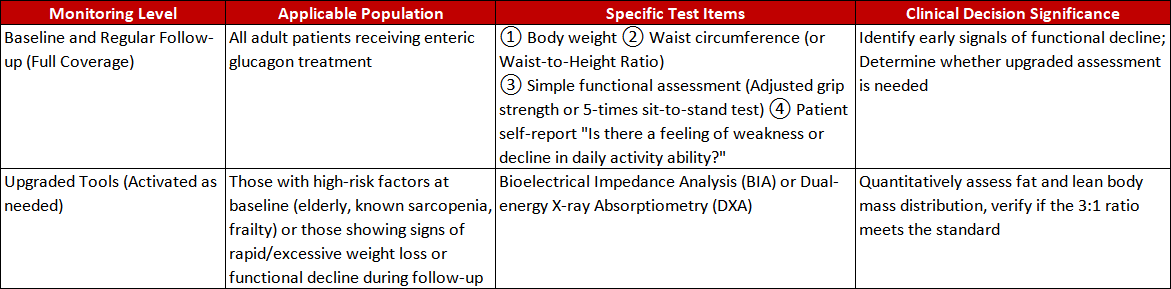
Against this background, the statement proposes a clinically pragmatic reference benchmark: during weight loss, a fat-to-lean-mass loss ratio close to 3:1 may be used as an aspirational target — that is, for every 4 kg of weight lost, at least 3 kg should ideally come from adipose tissue and no more than 1 kg from muscle. The consensus authors note that this ratio has not been validated as a hard endpoint in prospective studies; it is offered as a reference marker to help clinicians assess whether body composition changes are tracking in a beneficial direction.
If both quality and quantity of weight loss warrant scrutiny, how should body composition change be monitored in a cost-effective and practical way? The statement proposes a tiered, progressive monitoring pathway, summarized in Table 1.
Table 1. Tiered Implementation Pathway for Body Composition and Functional Monitoring
Three Nutritional Guardrails: Protein, Micronutrients, Hydration, and Fiber
Incretin-based therapies act through central appetite suppression and delayed gastric emptying, producing a distinctive nutritional risk profile alongside their efficacy. Drawing on mechanistic studies and clinical data, the statement notes that patients on these agents experience an average reduction in daily energy intake of approximately 300 kcal. When appetite is sustainedly suppressed and energy intake remains low over time, insufficient intake of protein, dietary fiber, and multiple micronutrients becomes a probable rather than possible event. The statement therefore offers a set of quantifiable, operational nutrition management indicators covering three core dimensions: protein and energy, micronutrients, and fluids and dietary fiber (Table 2).
Table 2. Three Core Quantitative Indicators for Nutrition Management During Incretin-Based Therapy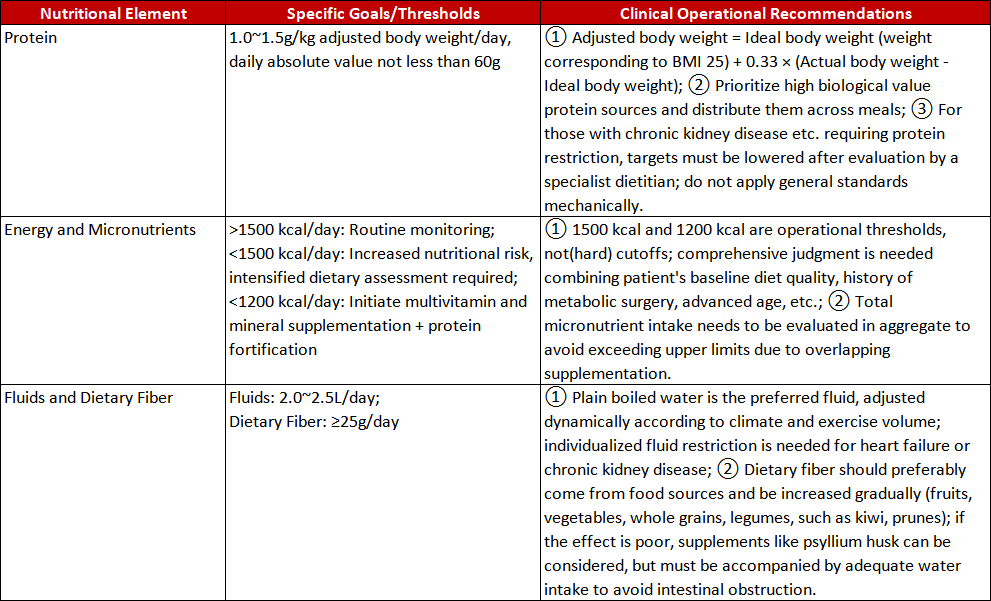
The statement emphasizes that the quantitative targets above are derived from expert clinical reasoning and evidence synthesis. In randomized controlled trials conducted specifically in patients receiving incretin-based therapy, these thresholds have not yet been prospectively validated. They are therefore better treated as reference guides for clinical decision-making than as hard endpoints, and should be adjusted dynamically according to each patient’s clinical response and tolerability.
Gastrointestinal adverse events are a major constraint on treatment tolerability and persistence. The statement incorporates nausea, vomiting, constipation, and diarrhea into the framework of medical nutrition therapy and proposes tiered, operationally defined response strategies (Table 3).
Table 3. Medical Nutrition Management Strategies for Common Gastrointestinal Adverse Events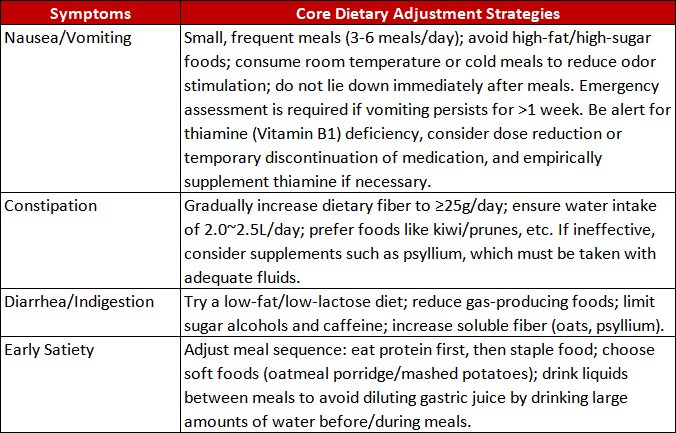
The statement emphasizes that when a patient develops persistent nausea and vomiting, clinicians should not simply treat the symptoms as a drug adaptation phase. Instead, they should conduct a timely clinical reassessment, consider temporary dose reduction or treatment interruption, evaluate fluid and electrolyte status, and provide empirical thiamine supplementation when deficiency is suspected.
Appetite, Reward, and Psychological Safety
Incretin-based agents modulate appetite and reward pathways, and the statement devotes substantial space to the under-recognized interaction between eating behavior and mental health.
On the positive side, some patients report a marked reduction in persistent food-related intrusive thoughts — often referred to in recent discussion as food noise — together with decreased preference for high-fat, high-sugar foods, and reduced emotional or cue-driven eating. However, if food has previously served a patient’s primary role in emotion regulation, stress relief, or social connection, the abrupt silencing of appetite may leave these psychological needs without their usual outlet, and they may seek new compensatory channels.
The statement draws on cautionary data from post-bariatric surgery follow-up studies, which have documented new-onset alcohol use disorder or substance misuse tendencies in a subset of patients. The true incidence of this kind of reward substitution in patients receiving incretin-based therapy has not yet been systematically studied, but the expert panel considers the potential risk high enough to warrant structured attention. Accordingly, the statement proposes a two-axis framework for psychological risk assessment (Table 4).
Table 4. Stratified Decision Matrix for Psychological Support (Clinical Complexity vs. Treatment Readiness)
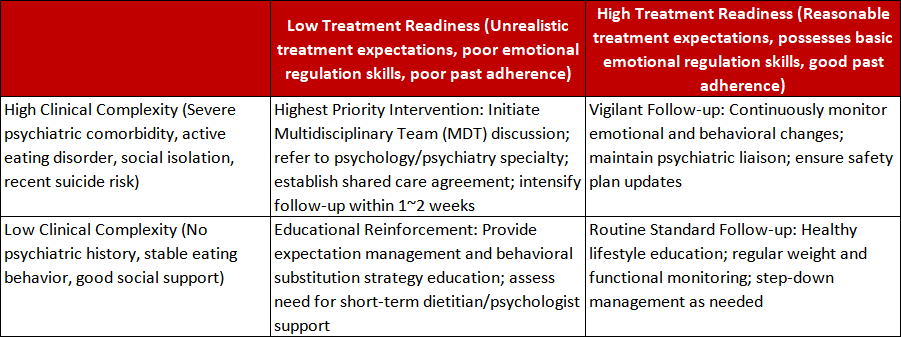
The framework uses two core dimensions — clinical complexity (covering psychiatric comorbidity, eating disorder severity, social support, and functional status) and treatment readiness (covering the patient’s understanding of the therapy, the realism of their expectations, prior adherence history, and emotion-regulation capacity) — to place each patient within a four-quadrant matrix, with corresponding responses ranging from routine follow-up to multidisciplinary team (MDT) and specialist mental health referral.
On safety signals, the statement reviews the largest available real-world and pharmacovigilance datasets to date and indicates that current meta-analyses and epidemiologic studies have not identified a clear signal of increased suicide risk associated with incretin-based agents in the general population. The expert panel notes, however, that patients with serious mental illness — such as schizophrenia or bipolar disorder — are often systematically excluded from registrational trials, leaving an evidence gap. For these patients, the statement recommends that a psychiatric history should not, in itself, justify routinely withholding or delaying therapy, as this may contribute to treatment inequity; however, a closer monitoring and follow-up plan should be established, including shared-care protocols with psychiatry, intensified mood assessment at dose-titration and discontinuation milestones, and attention to potential fluctuations in plasma levels of oral psychotropic agents (e.g., lithium, antipsychotics) in the context of delayed gastric emptying.
Bone, Muscle, and Functional Preservation
Another under-recognized consequence of rapid weight loss is its effect on skeletal health. Although patients with obesity often have higher absolute bone mineral density (BMD), their fracture risk is paradoxically elevated, related to reduced bone quality and altered mechanical loading. The statement notes that incretin-induced weight loss is accompanied by progressive reduction in BMD, and that this effect is largely mediated by the weight loss itself. Although no direct fracture-endpoint data are currently available to indicate additional drug-specific risk, the expert panel calls for baseline fracture risk assessment — using tools such as the Fracture Risk Assessment Tool (FRAX) — in patients with additional osteoporosis risk factors before treatment initiation. It specifically cautions that FRAX has not been validated in populations with significant weight loss and may underestimate actual fracture risk in patients with obesity, and should not be used as the sole basis for decision-making.
At the intervention level, the statement recommends an integrated musculoskeletal protection strategy: ensuring adequate calcium and vitamin D intake, and encouraging regular weight-bearing and resistance exercise. In patients with severe gastrointestinal intolerance or impaired oral absorption who require osteoporosis treatment, non-oral formulations such as intravenous bisphosphonates may be considered preferentially.
On exercise prescription, the statement reaffirms the general principle of combining aerobic and resistance training. Unlike conventional weight management, resistance training during incretin-based therapy has a clear pathophysiological rationale for counteracting muscle loss. The statement recommends a gradual, stepwise approach, with weekly moderate-intensity aerobic activity of at least 150 minutes and resistance training of major muscle groups at least twice per week as a longer-term target, rather than imposing this goal on every patient from the outset. It cites the STEP-3 trial exercise protocol as a model: starting at 100 minutes per week distributed across 4 to 5 days, then increasing by 25 minutes every 4 weeks, gradually progressing toward 200 minutes per week. This stepped approach offers clear advantages for safety and adherence. For patients with frailty, sarcopenia, or recurrent exercise-related injury, prompt escalation to physiotherapist or exercise specialist involvement is recommended.
Conclusion
Following the logic of the consensus, a clear clinical decision framework emerges: stratified management with progressive escalation. The core idea is not to deliver a uniformly high-intensity package of nutrition, functional, and psychological interventions to every patient on incretin-based therapy, but to establish an agile clinical response system. For low-risk patients with good tolerability and a stable weight-loss trajectory, basic weight, waist circumference, and functional monitoring plus standardized lifestyle guidance may be sufficient. Upgraded intervention — including registered dietitian-led medical nutrition therapy, precision body composition assessment, physiotherapy, or specialist psychological support — should be initiated only when baseline high-risk features, rapid or excessive weight loss, persistent gastrointestinal intolerance, functional decline, signs of nutritional risk, or psychological compensation are observed.
This dynamic matching of intervention intensity to clinical need directly addresses the tension, common in real-world practice, between limited healthcare resources and patient heterogeneity, and offers an operational bridge for incretin-based agents to evolve from a weight loss tool into a true component of chronic disease management across the full care continuum.
Reference
Dobbie LJ, Tolvanen L, Alves D, et al. Nutritional, functional, and psychological considerations for incretin-based therapies in adults — an EASO, EFAD, and ECPO Consensus Statement. Lancet Diabetes Endocrinol. 2026; published online July 9. DOI:10.1016/S2213-8587(26)00122-1.

