


From March 25 to 28, 2026, the European Lung Cancer Congress (ELCC), jointly organized by the European Society for Medical Oncology (ESMO) and the International Association for the Study of Lung Cancer (IASLC), was held in Copenhagen, Denmark.
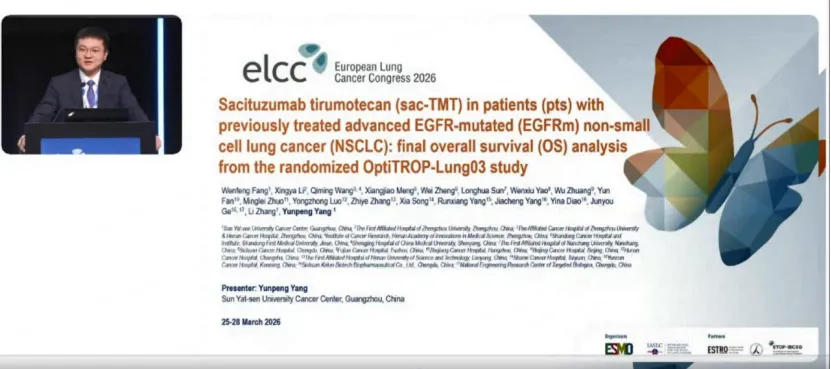
At the meeting, Prof. Yang Yunpeng of Sun Yat-sen University Cancer Center delivered an oral presentation on behalf of the team and reported the final overall survival (OS) results of the OptiTROP-Lung03 study (Abstract No. LBA4) [1]. The study focused on the Chinese novel antibody-drug conjugate (ADC) sacituzumab tirumotecan (sac-TMT), providing a new treatment option for patients with locally advanced or metastatic EGFR-mutant non-small cell lung cancer (NSCLC) whose disease had progressed after EGFR-TKI therapy and platinum-based chemotherapy.
Sac-TMT charts a new course for treated advanced EGFR-mutant NSCLC
Sac-TMT is a TROP2-targeting ADC with a unique bifunctional linker. The OptiTROP-Lung03 study had previously confirmed that, in previously treated EGFR-mutant NSCLC, sac-TMT delivered statistically significant benefits in both progression-free survival (PFS) and OS compared with docetaxel. At this meeting, the prespecified final OS analysis, along with updated PFS and safety data, was reported.
Study Design
Patients with advanced EGFR-mutant NSCLC whose disease had progressed after prior EGFR-TKI therapy and platinum-based chemotherapy were randomly assigned in a 2:1 ratio to receive sac-TMT or docetaxel. Patients in the docetaxel group with confirmed disease progression could cross over to sac-TMT if eligible. A rank-preserving structural failure time (RPSFT) model was used to correct for the effect of crossover on OS.
Study Results
A total of 137 patients were randomized to the sac-TMT group (n=91) or the docetaxel group (n=46). As of December 11, 2025, the median follow-up was 23.8 months. Investigator-assessed median PFS was 7.9 months in the sac-TMT group and 2.8 months in the docetaxel group (HR=0.23, 95% CI: 0.15-0.35); median OS was 20.0 months and 13.5 months, respectively (HR=0.63, 95% CI: 0.40-0.98).
In the docetaxel group, 41.3% of patients subsequently received sac-TMT. After RPSFT model correction, median OS remained as high as 20.0 months in the sac-TMT group, versus 11.2 months in the control group (HR=0.45, 95% CI: 0.28-0.73), and the 18-month OS rates were 54.7% and 9.1%, respectively.
Safety Profile
No cases of interstitial lung disease were reported in the sac-TMT group. The incidence of treatment-related adverse events of grade 3 or higher was lower with sac-TMT than with docetaxel, and the rates of treatment-related serious adverse events were 16% and 41%, respectively.
In the presentation, Prof. Yang Yunpeng said, "In previously treated patients with advanced EGFR-mutant NSCLC, sac-TMT has continued to demonstrate clinically meaningful and significant survival benefit versus docetaxel, together with manageable safety, highlighting sac-TMT as a promising new treatment option for this patient population."
Reference
[1] Fang WF.et al. Sacituzumab tirumotecan (sac-TMT) in patients (pts) with previously treated advanced EGFR-mutated (EGFRm) non-small cell lung cancer (NSCLC): Final overall survival (OS) analysis from the randomized OptiTROP-Lung03 study. 2026 ELCC LBA4.

