


The annual flagship event in global oncology, the 2026 American Society of Clinical Oncology (ASCO) Annual Meeting, was held in Chicago from May 29 to June 2. On May 31 at 12:12 PM local time, Prof. Lu Yen-Shen from the National Taiwan University Hospital, representing the research team, presented the highly anticipated final overall survival (OS) analysis results from the randomized, double-blind, placebo-controlled Phase III PATHWAY study. The study confirmed that palbociclib plus tamoxifen not only provides sustained progression-free survival (PFS) benefit and a clear trend toward OS improvement, offering high-level evidence for precision treatment of Asian patients with characteristic breast cancer profiles.
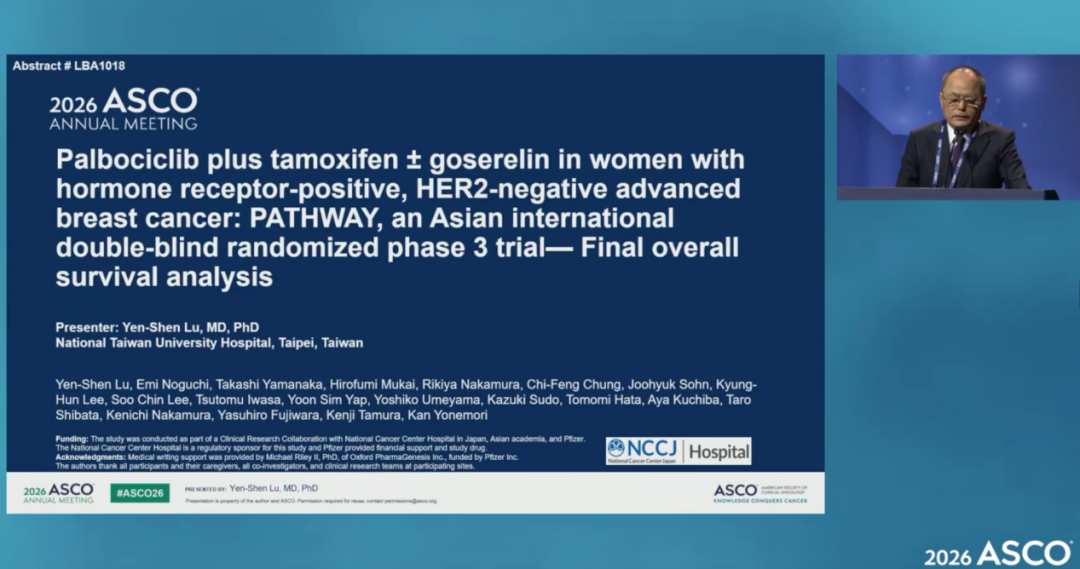
Median OS of 71.7 Months, Greater Benefit in Premenopausal Patients! Final BIG PATHY Data Shine at ASCO 2026
Study Background: Treatment Dilemma and Unmet Need for Asian Patients with HR+/HER2- Advanced Breast Cancer
HR+/HER2- is the most common molecular subtype of breast cancer, accounting for over 60% of all cases. Endocrine therapy combined with targeted agents is the standard first-line treatment for patients with advanced disease. Unlike Western populations, Asian breast cancer patients exhibit distinct epidemiological characteristics, with a younger peak age of onset and a higher proportion of premenopausal and perimenopausal women.
Currently, CDK4/6 inhibitors combined with endocrine therapy have become the global standard first-line treatment for HR+/HER2- advanced breast cancer, significantly improving patient outcomes. However, in most Asian countries and regions, the approved indications for these combination regimens are limited, leaving a lack of high-quality treatment options tailored to Asian populations that balance efficacy and safety. Furthermore, key questions regarding the impact of menopausal status on treatment efficacy and long-term survival benefits in Asian patients lack support from large-scale, prospective, Asia-specific studies – a gap the BIG PATHY study was designed to fill.
Study Design: First Asia-Led Multicenter Randomized Double-Blind Controlled Trial
The BIG PATHY study is an investigator-initiated, multinational, multicenter, randomized, double-blind, placebo-controlled Phase III trial conducted across Japan, Korea, Taiwan (China), and Singapore, specifically designed for Asian patients with HR+/HER2- advanced breast cancer. It aims to evaluate the efficacy and safety of a novel endocrine plus targeted therapy combination.
A total of 184 patients were randomized 1:1 to receive palbociclib + tamoxifen or placebo + tamoxifen. Premenopausal and perimenopausal women also received goserelin for ovarian suppression. The primary endpoint was investigator-assessed PFS, and secondary endpoints included OS. Baseline characteristics were balanced between the two arms; approximately half of the patients had visceral metastases, and the distribution of mutations (e.g., PIK3CA, ESR1, BRCA1/2) was also comparable.
Of significant clinical value, the benefit was more pronounced in the premenopausal/perimenopausal subgroup, where the risk of disease progression was substantially reduced by 66% (HR=0.34). This strongly supports the unique advantage of this novel combination for younger, premenopausal Asian patients with HR+/HER2- advanced breast cancer, precisely aligning with the epidemiological characteristics of breast cancer in Asia.
Sustained PFS Benefit, Particularly Prominent in Premenopausal Subgroup
At the final analysis data cutoff (October 29, 2025), the PFS advantage remained significant. The median PFS was 24.4 months in the palbociclib + tamoxifen arm versus 11.1 months in the placebo + tamoxifen arm, representing a 41% reduction in the risk of disease progression (HR=0.59, P<0.001).
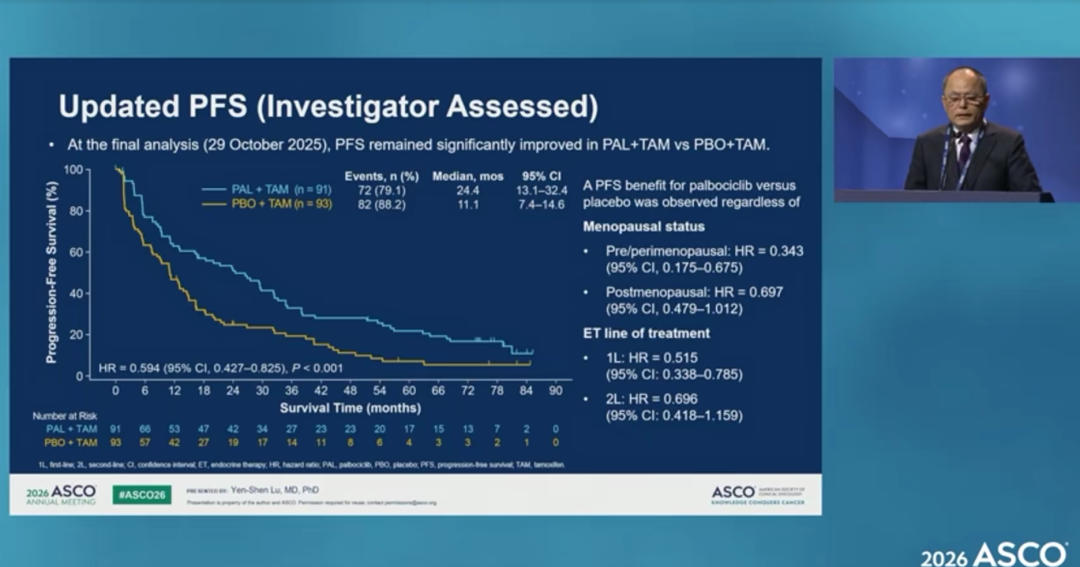
In the prespecified premenopausal/perimenopausal subgroup, the magnitude of benefit was even more striking, with a 66% reduction in the risk of progression (HR=0.34).
Final OS Analysis: Median OS of 71.7 Months, Nearly 10-Month Absolute Gain
The core of this presentation was the final OS results. After a median follow-up of 82 months, the palbociclib + tamoxifen arm showed an encouraging survival trend: median OS was 71.7 months compared to 62.0 months in the placebo + tamoxifen arm, an absolute gain of approximately 10 months (HR=0.77, P=0.09).
Although the p-value did not reach the conventional statistical significance threshold, Prof. Lu Yen-Shen noted that the direction and magnitude of the difference are clinically meaningful. Notably, in the placebo arm, 41% and 18% of patients received CDK4/6 inhibitors as first and second subsequent therapy, respectively. This high rate of subsequent crossover may have diluted the statistical difference in OS to some extent.
OS subgroup analyses showed that the trends of benefit were generally consistent across various subgroups, with most hazard ratios favoring the palbociclib + tamoxifen arm.
Consistent Safety Profile, No New Signals with Long-Term Follow-up
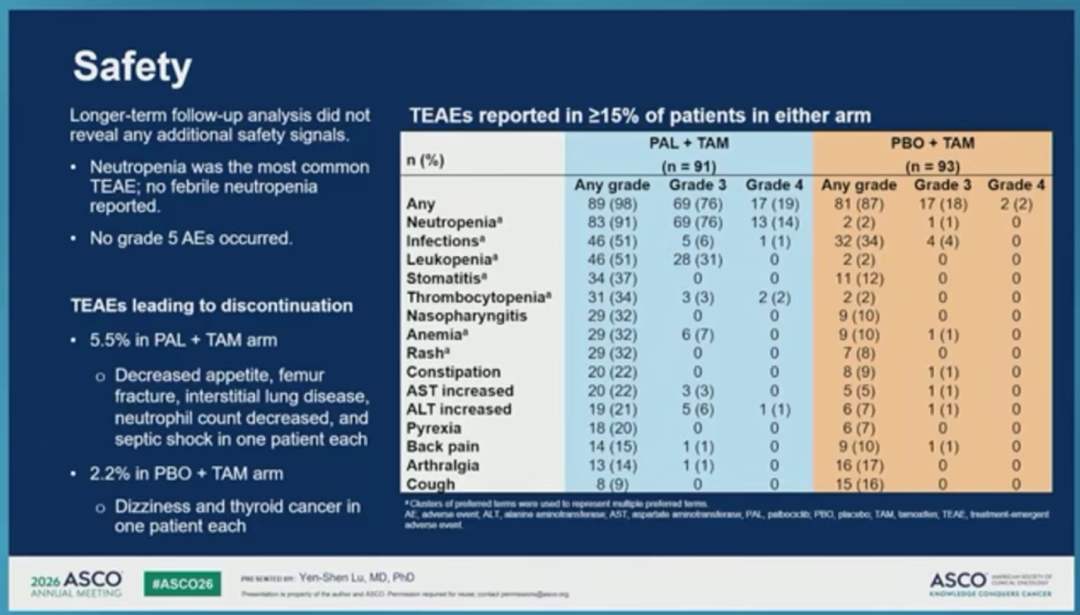
Regarding safety, long-term follow-up revealed no new safety signals. The most common treatment-related adverse event was neutropenia; however, no febrile neutropenia was reported. Overall tolerability was good, consistent with the known safety profile of palbociclib.
Summary:
The final data from the BIG PATHY study confirm that, for Asian patients with HR+/HER2- advanced breast cancer, this novel endocrine plus targeted combination provides sustained and significant PFS benefit and a clear trend toward OS clinical benefit. The efficacy is independent of menopausal status and is particularly favorable for the Asian-prevalent premenopausal/perimenopausal subgroup. The combination has a manageable safety profile and does not interfere with subsequent standard therapies, making it a highly effective and safe optimized treatment option for Asian patients. As the first large-scale targeted combination study focused specifically on the Asian population, it fills an Asia-specific evidence gap, is expected to drive updates to breast cancer treatment guidelines in Asia, and further optimize the comprehensive management model for HR+/HER2- advanced breast cancer.

