


On October 26, 2026, the US Food and Drug Administration (FDA) approved talazoparib in combination with enzalutamide for the treatment of adults with metastatic hormone-sensitive prostate cancer (mHSPC) who carry homologous recombination repair (HRR) gene mutations, confirmed by an FDA-authorized test [1]. Talazoparib is the first PARP inhibitor approved for men with mHSPC.
The recommended dose is talazoparib 0.5 mg orally once daily, given with enzalutamide, until disease progression or unacceptable toxicity. Patients receiving the combination should also receive a gonadotropin-releasing hormone (GnRH) analogue or should have undergone bilateral orchiectomy; the specific use of enzalutamide follows its prescribing information.
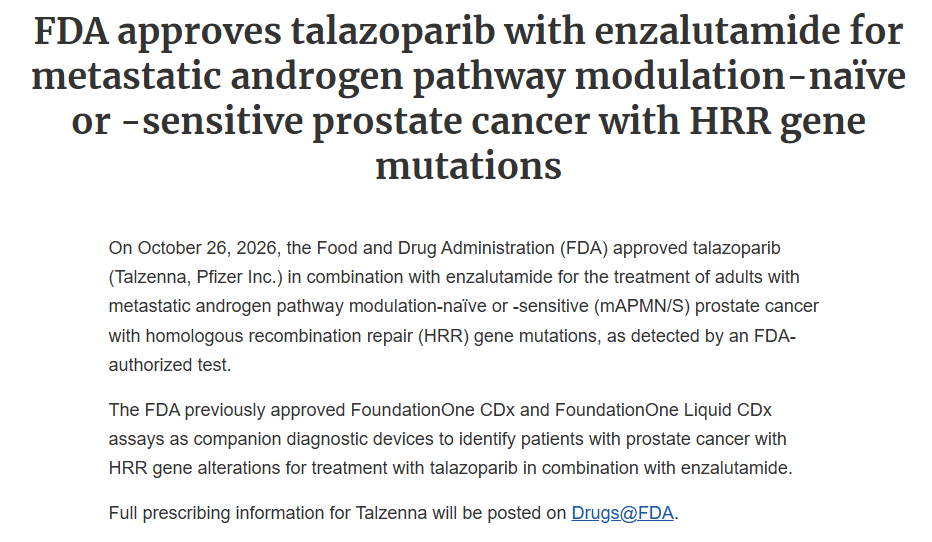 Fig. 1. FDA Approval Announcement
Article Key Points
- FDA approval October 26, 2026: talazoparib plus enzalutamide for HRR-mutated mHSPC
- First PARP inhibitor approved for men with mHSPC; HRR mutation must be confirmed by an FDA-authorized test
- Dosing: talazoparib 0.5 mg once daily plus enzalutamide, with a GnRH analogue or after bilateral orchiectomy
- TALAPRO-3: 599 patients randomized 1:1, all receiving continued androgen deprivation therapy
- Median rPFS not reached versus 45.8 months; HR 0.48 (95% CI 0.36-0.65, p<0.0001)
- Three-year rPFS 77% versus 56%; three-year OS 78% versus 72% (HR 0.77, 95% CI 0.56-1.04)
- Serious adverse events 42% versus 32%; grade 3 or higher anemia 51%; 2 treatment-related deaths
- Labeling carries warnings for MDS/AML, myelosuppression, and embryo-fetal toxicity
3-Year PFS Rate Reaches 77%! mHSPC Targeted Therapy Achieves New Breakthrough
The approval is based mainly on the phase 3 TALAPRO-3 trial [2], a randomized, double-blind, placebo-controlled study that enrolled 599 patients and assigned them 1:1 to enzalutamide plus talazoparib or enzalutamide plus placebo. All patients also received continuous androgen deprivation therapy (ADT).
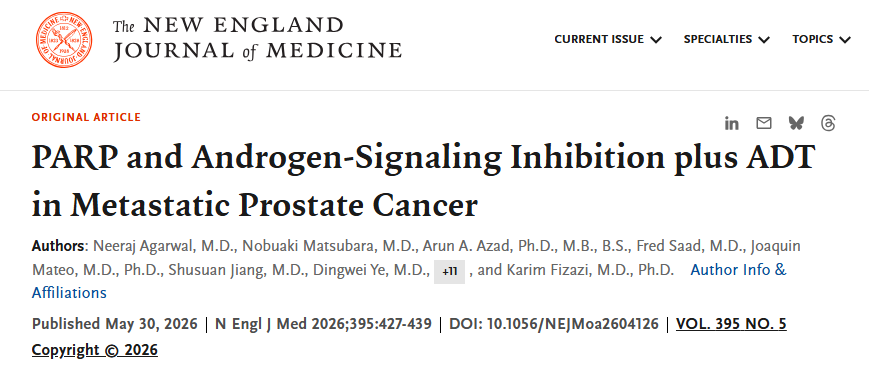 Fig. 2. Design of the TALAPRO-3 Trial
A total of 300 patients were assigned to talazoparib and 299 to the control arm. Median radiographic progression-free survival (rPFS) had not been reached with talazoparib plus enzalutamide (NR, 95% CI NR, NR), whereas it was 45.8 months in the control arm (95% CI 37.7, NR), a 52% reduction in the risk of disease progression or death (HR 0.48, 95% CI 0.36-0.65, p<0.0001).
At 3 years, the radiographic PFS rate was 77% with talazoparib and 56% in the control arm.
Overall Survival Immature at 3 Years
Overall survival (OS) data are not yet mature. The 3-year OS rate was 78% in the talazoparib arm and 72% in the control arm (HR 0.77, 95% CI 0.56-1.04).
Safety: Anemia and Serious Adverse Events
Serious adverse events (SAEs) occurred in 42% of patients receiving talazoparib and in 32% of the control arm. The most common adverse events in the talazoparib arm were anemia, fatigue, and decreased neutrophil count; the most common grade 3 or higher adverse event was anemia, at 51%. Two treatment-related deaths occurred during the study. The prescribing information includes warnings and precautions for myelodysplastic syndrome and acute myeloid leukaemia (MDS/AML), myelosuppression, and embryo-fetal toxicity.
From Castration-Resistant to Hormone-Sensitive Disease
The combination of talazoparib and enzalutamide now holds two approved indications, covering two populations: HRR-mutated metastatic castration-resistant prostate cancer (mCRPC) and HRR-mutated mHSPC.
This approval marks a move of PARP inhibitor use in prostate cancer from the castration-resistant stage to the hormone-sensitive stage, and offers patients with HRR-mutated mHSPC a combination model of PARP inhibition plus androgen receptor inhibition plus ADT.
Reference
[1]US Food and Drug Administration. FDA approval notification, October 26, 2026.
[2]TALAPRO-3 study. Abstract published in the New England Journal of Medicine.

