


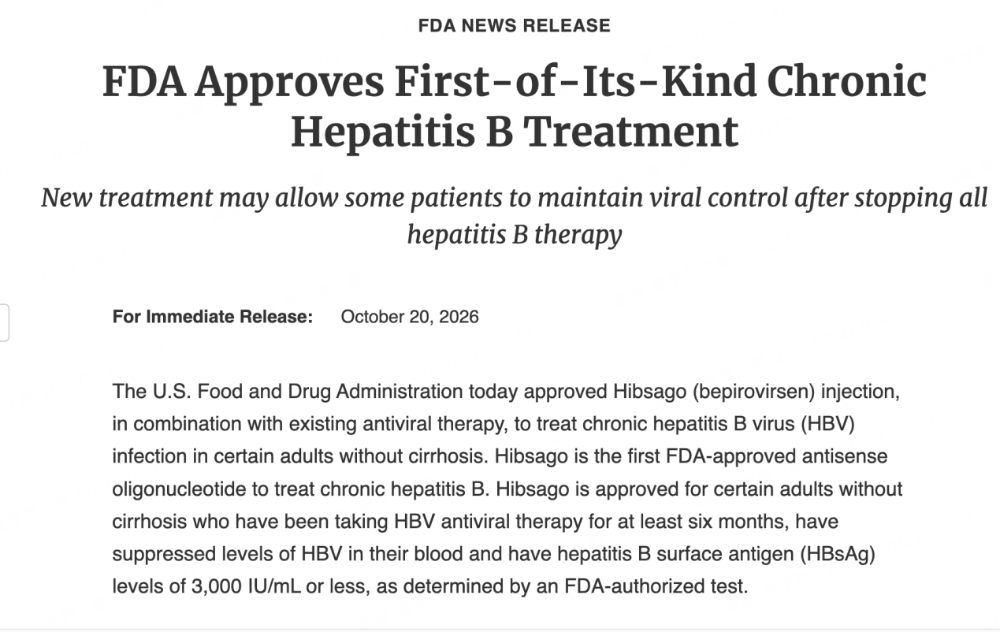
On October 20, 2026, the US Food and Drug Administration (FDA) approved bepirovirsen, developed by GSK, for use in combination with a nucleos(t)ide analogue to treat adults with chronic hepatitis B virus (HBV) infection without cirrhosis. It is the first drug that can achieve functional cure of chronic hepatitis B, an outcome the field has pursued for decades: patients may be able to stop lifelong antiviral therapy, and the risk of liver cancer and cirrhosis approaches that of the general population.
Japan approved the drug first, in August 2026, and added it to the reimbursement price list on October 14 at JPY 183,015 per injection. A standard 24-week course requires 52 injections, or about JPY 9.52 million, roughly CNY 450,000.
In China, a marketing application was filed in March 2026 with priority review. The first submission was not approved, and the company filed again on May 27, 2026; review is still under way.
Article Key Points
- FDA approval October 20, 2026: bepirovirsen plus a nucleos(t)ide analogue for chronic HBV without cirrhosis
- First drug approved with functional cure as an achievable outcome; approved in Japan in August 2026
- Pooled B-Well 1 and B-Well 2: 1,838 patients on nucleos(t)ide therapy across 29 countries
- Functional cure 19% (233/1220) versus none of 614 on placebo after 24 weeks, with follow-up to week 72
- Baseline HBsAg 1000 IU/mL or less: functional cure 26%; 24% met criteria to stop nucleos(t)ide therapy
- China subgroup: functional cure 24% at HBsAg 3000 IU/mL or less, 35% at 1000 IU/mL or less
- Grade 3 or higher adverse events 16% versus 3%; boxed warning for liver reactions and thrombocytopenia
- China application resubmitted May 27, 2026 and under priority review
A Breakthrough in Hepatitis B “Functional Cure”
An estimated 257 million people worldwide have chronic hepatitis B. The infection accounts for about 39% of global liver cancer cases and for tens of millions of cases of HBV-related cirrhosis, and causes about 1.1 million deaths each year.
Treatment today relies mainly on long-term daily nucleos(t)ide analogues, which suppress replication of HBV DNA and thereby substantially lower the risk of progression to cirrhosis and liver cancer.
Prof. Jie Peng, chief physician in the Department of Infectious Diseases at Nanfang Hospital, Southern Medical University, told MedJ that after several years to more than a decade of treatment, surface antigen levels fall to a low level in some patients, forming an “advantageous population.” At that point, clinicians may add interferon to pursue clearance of hepatitis B surface antigen (HBsAg).
The process is long, however, and side-effect management during prolonged treatment, adverse reactions to interferon, and cost all weigh on adherence. “Overall, only about 1% to 3% of patients on long-term nucleos(t)ide analogues eventually achieve functional cure,” Prof. Peng said.
Antisense oligonucleotides emerged against this backdrop, and bepirovirsen is among the leading examples.
The approved population is limited to adults who have received nucleos(t)ide therapy for at least 6 months, whose HBV DNA is already suppressed, whose HBsAg is 3000 IU/mL or less, and who have no cirrhosis. Treatment lasts 6 months and is given by subcutaneous injection; after the first dose, patients may self-inject at home.
The approval rests on pooled data from two global multicentre phase 3 trials, B-Well 1 and B-Well 2, which enrolled 1,838 adults with chronic hepatitis B receiving nucleos(t)ide therapy across 29 countries.
After 24 weeks of bepirovirsen and follow-up to week 72, functional cure was achieved in 19% of the overall population (233/1220), whereas no patient in the placebo group achieved functional cure. Among patients with baseline HBsAg of 1000 IU/mL or less, the functional cure rate rose to 26%. In addition, 24% of treated patients met the criteria for stopping nucleos(t)ide analogues.
In the China subgroup, functional cure was achieved in 24% of patients with baseline HBsAg of 3000 IU/mL or less and in 35% of those with 1000 IU/mL or less.
The FDA added a boxed warning for hepatic reactions and thrombocytopenia during treatment. Across the two trials, grade 3 or higher adverse events occurred in 16% of treated patients versus 3% of those on placebo. The most common adverse reactions were injection site reactions, pyrexia, fatigue, and headache.
A New Era in Hepatitis B Treatment
Bepirovirsen is an antisense oligonucleotide (ASO). It acts at the level of viral RNA, blocking synthesis of viral proteins so that HBsAg and other viral proteins fall sharply.
Prof. Peng explained why nucleos(t)ide analogues cannot cure the infection. They suppress HBV DNA replication but do not clear covalently closed circular DNA (cccDNA) in the hepatocyte nucleus, the stable viral DNA reservoir. That reservoir keeps producing viral proteins, including HBsAg, and HBsAg in turn causes immune paralysis, so the immune system cannot clear the virus effectively and replication persists in hepatocytes.
ASOs instead target viral RNA directly, so viral proteins cannot be synthesized. More importantly, when HBsAg production is continuously blocked, the immune system is reawakened, strengthening its ability to kill the virus.
Prof. Peng said that the longer-term efficacy of bepirovirsen, and whether dose, combinations, and course length can be further optimized, still require study. “But on the available data, half a year of treatment already brings a higher proportion of patients to an outcome that previously might have taken years or more than a decade to reach. That is a qualitative leap.”
He also expects antisense drugs to improve willingness to treat and adherence. With nucleos(t)ide analogues, neither patients nor physicians know when treatment can stop, and many lose confidence; in past practice, about 50% of patients stopped following medical advice on their own after 6 months to a year, greatly increasing the risk of cirrhosis and liver cancer. Many patients also present late, when cirrhosis or liver cancer is already advanced.
A finite course should change this, Prof. Peng said: when physicians can tell patients that 6 months may be enough, they are more likely to follow advice.
He stressed, however, that current evidence indicates antisense drugs alone will not be sufficient for rapid functional cure; combination with nucleos(t)ide analogues or immunotherapy is needed. The lower the baseline HBsAg when antisense treatment starts, the more likely functional cure becomes. “It tells our patients not to wait and watch, but to start existing nucleos(t)ide treatment promptly and bring the virus down as low as possible, so that when new drugs become available in China they can be added immediately,” he said.

