


The 2026 World Conference on Lung Cancer (WCLC), organized by the International Association for the Study of Lung Cancer (IASLC), was held September 12-15, 2026, in Seoul, Korea. At the Presidential Symposium, Prof. Giannis Mountzios of Henry Dunant Hospital Center (Greece) presented the primary results of the phase 3 EVOKE-03/KEYNOTE D46 trial.
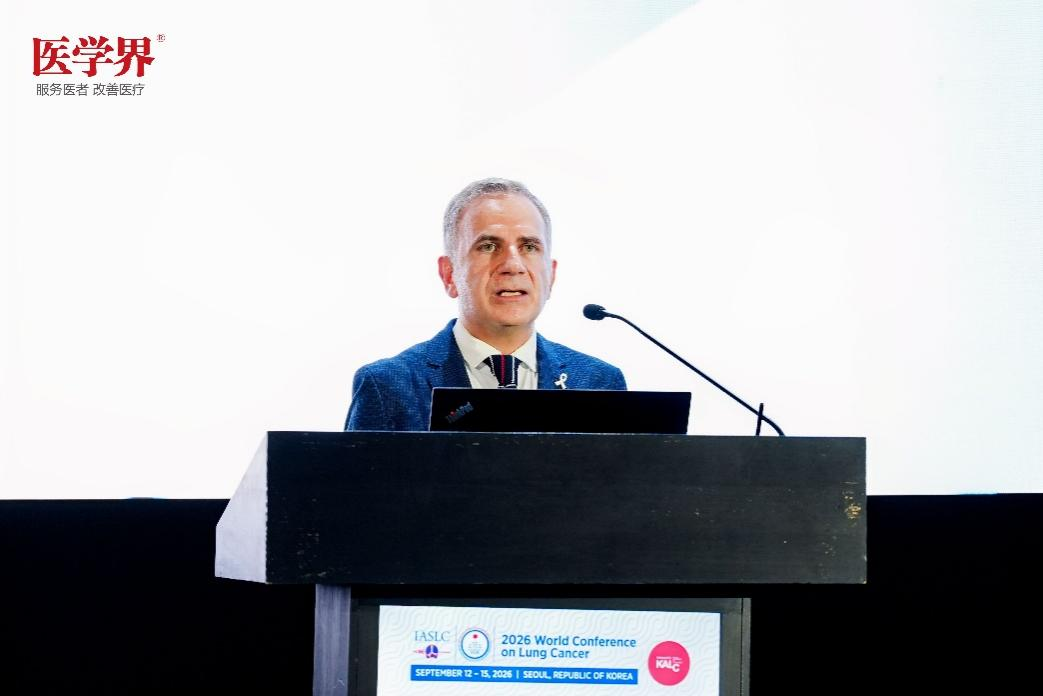 Fig. 1.Prof.Giannis Mountzios’s Presentation
EVOKE-03 Provides New Evidence for Precision Treatment in Lung Cancer
Although immune checkpoint inhibitor monotherapy has substantially reshaped the treatment landscape for metastatic non-small cell lung cancer (NSCLC) with high PD-L1 expression (TPS ≥50%), more than 50% of patients still do not respond to, or become resistant to, pembrolizumab monotherapy. Sacituzumab govitecan (SG) is an antibody-drug conjugate (ADC) targeting Trop-2, with the topoisomerase I inhibitor SN-38 as its payload, and has shown antitumor activity in multiple prior studies.
Study Design
EVOKE-03/KEYNOTE D46 is an open-label, multicenter, randomized phase 3 study designed to evaluate SG plus pembrolizumab versus pembrolizumab monotherapy in this population. A total of 620 patients with previously untreated stage IV NSCLC were randomized 1:1 to receive SG plus pembrolizumab (n=311) or pembrolizumab monotherapy (n=309).
- Combination arm: SG 10 mg/kg on days 1 and 8 of each 3-week cycle (maximum 35 cycles), plus pembrolizumab 200 mg intravenously on day 1 of each 3-week cycle (maximum 35 cycles).
- Monotherapy arm: Pembrolizumab 200 mg intravenously on day 1 of each 3-week cycle (maximum 35 cycles).
Endpoints
The primary endpoint was progression-free survival (PFS). Secondary endpoints included overall survival (OS), objective response rate (ORR), duration of response (DOR), patient-reported outcomes (PROs), and safety.
Baseline Characteristics and Follow-Up
As of April 3, 2026, 620 patients had been randomized and received study treatment, with a median follow-up of 14.7 months. Baseline characteristics including age, sex, geographic region, ECOG performance status, histology, smoking status, and disease stage were balanced between arms. In the combination arm, the median number of treatment cycles was 10 for SG and 12 for pembrolizumab, compared with 9 cycles of pembrolizumab in the monotherapy arm. At data cutoff, 70.4% of patients in the combination arm and 71.2% in the monotherapy arm had discontinued study treatment for any reason, with disease progression being the leading reason.
From Global to East Asia: Study Confirms That SG Combined with Pembrolizumab Significantly Delays Disease Progression
PFS Significantly Improved
In the intention-to-treat (ITT) population, the combination arm had a median PFS of 11.8 months (95% CI 8.8-14.5), significantly longer than the 7.7 months (95% CI 6.9-9.7) in the monotherapy arm (HR 0.81, 95% CI 0.66-1.00, P=0.0252). The 12-month PFS rates were 48.3% versus 36.9%, and the 18-month PFS rates were 36.0% versus 29.9%, respectively, suggesting that SG plus pembrolizumab may reduce the risk of disease progression or death in patients with PD-L1-high metastatic NSCLC.
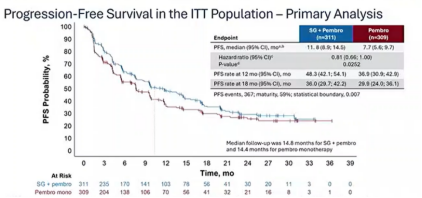 Fig.2. Primary Study Endpoint: PFS Results
Subgroup analyses showed that the PFS benefit was consistent across most pre-specified subgroups, including age, sex, race, geographic region, ECOG PS, histology, smoking status, and brain/liver metastasis status. Notably, the PFS benefit of the combination appeared more pronounced in patients with non-squamous histology, prior smoking history, no brain metastases, and no liver metastases.
OS Interim Analysis and Subgroup Data
Median OS was 21.5 months (95% CI 18.5-26.7) in the combination arm versus 22.8 months (95% CI 19.7-29.0) in the monotherapy arm (HR 1.07, 95% CI 0.85-1.35, P=0.7155). OS data remain immature, requiring further follow-up to confirm any long-term survival benefit.
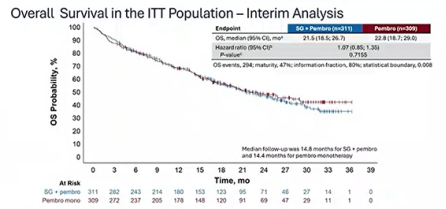 Fig.3. OS Interim Analysis
In an exploratory analysis of the East Asian subgroup (n=270), median OS was not reached (NR) in the combination arm versus 27.9 months (95% CI 16.7-NE) in the monotherapy arm (HR 0.73, 95% CI 0.48-1.10). In the China subgroup (n=102), median OS was also NR in the combination arm versus 27.9 months (95% CI 15.6-NE) in the monotherapy arm (HR 0.80, 95% CI 0.36-1.76). Although sample sizes were limited, the data suggest a possible OS trend favoring the combination in East Asian and Chinese populations that warrants further investigation.
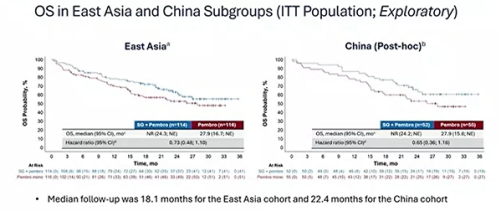 Fig.4. East Asian population data
Secondary Endpoints
The confirmed ORR was 55.6% (95% CI 49.9-61.2) with the combination versus 43.7% (95% CI 38.1-49.4) with monotherapy, an absolute difference of approximately 12%. Disease control rates (DCR) were 83.3% versus 73.1%, respectively. Median DOR was similar between arms, at 21.4 months (95% CI 14.9-NE) with the combination versus 21.3 months (95% CI 15.7-NE) with monotherapy.
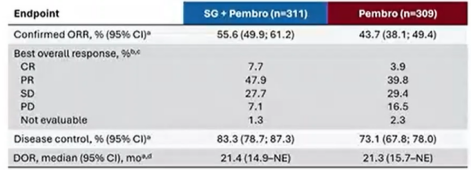 Fig. 5. Secondary Study Endpoint: ORR Results
Safety
The median drug exposure was 8.5 months in the combination arm versus 6.2 months in the monotherapy arm. Grade ≥3 treatment-related adverse events (TRAEs) occurred in 36.0% versus 13.3% of patients, serious TRAEs in 30.6% versus 3.3%, and TRAEs leading to treatment discontinuation in 30.9% versus 20.1%. The most common TRAEs (≥15% in either arm) included anemia (36% vs 7%), alopecia (40% vs 1%), neutropenia (24% vs 2%), diarrhea (27% vs 5%), and nausea (28% vs 2%). The safety profile of the combination was consistent with the known toxicity profiles of each agent, with no new safety signals observed.
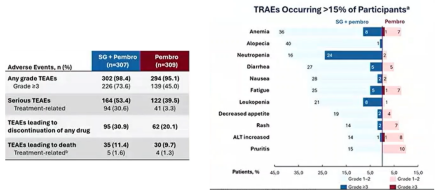 Fig.6. Safety Outcomes
Summary
EVOKE-03/KEYNOTE D46 showed that SG plus pembrolizumab as first-line therapy significantly extended PFS and improved ORR and DCR versus pembrolizumab alone in patients with PD-L1 TPS ≥50% metastatic NSCLC, with a manageable safety profile. The findings offer a new combination option for PD-L1-high NSCLC patients, particularly those who may gain insufficient benefit from immune-monotherapy alone, although OS data remain immature.
The findings are derived from a conference abstract presented at WCLC 2026 and have not yet been peer-reviewed.
This article is intended to provide scientific information to healthcare professionals and does not represent the editorial position of MedJ.
Reference
[1] Mountzios G, et al. Primary Results from Phase 3 EVOKE-03/KEYNOTE D46: Sacituzumab Govitecan + Pembrolizumab in PD-L1 TPS ≥50% Metastatic NSCLC. 2026 WCLC.

