


The European Respiratory Society (ERS) 2026 Annual Congress has concluded. As one of the most influential international academic platforms in respiratory medicine, this year’s congress once again witnessed the convergence of global expertise, with Chinese scholars making a notable impact.
Prof. Weimin Li’s team from West China Hospital of Sichuan University contributed 20 studies to ERS 2026, including 3 oral presentations and 17 poster presentations, focused primarily on lung cancer and other major respiratory diseases. The research systematically maps the scientific trajectory of disease onset, progression, intervention, and outcomes. Among them, Dr. Sisi Dai received the Best Assembly Abstract Award at ERS 2026 for her breakthrough exploration in lung cancer immunotherapy.
Decoding Immunotherapy: Best Abstract Award at ERS 2026
The Best Assembly Abstract Award is the highest abstract-based honor awarded annually by ERS, with each of the society’s 14 scientific assemblies selecting one winning abstract. China-based researchers accounted for approximately half of this recipients (6/14). Dr. Sisi Dai’s study, titled “Systemic Activation and Tissue Infiltration of CD8+CX3CR1+ T cells in Non-Small Cell Lung Cancer Treated with Neoadjuvant Immune Checkpoint Blockade,” received the Best Abstract Award in the Thoracic Oncology Assembly, reflecting the depth of Chinese respiratory medicine in lung cancer research.
 Fig. 1. ERS Award Recipients
The study focused on neoadjuvant immunotherapy for resectable non-small cell lung cancer (NSCLC), aiming to characterize the specific T-cell subsets responsible for efficacy. The team performed single-cell RNA sequencing, TCR repertoire analysis, and flow cytometry on tumors, paired normal lung tissue, and peripheral blood from 26 treated and 14 treatment-naive patients. They found that CD8+CX3CR1+ T cells were significantly enriched and clonally expanded in responsive tumors; this cell population proliferated in peripheral blood after treatment, with shared TCR clones between blood and tumor. Pseudotime analysis suggested that, after infiltrating tumors, these cells differentiated into exhausted and NK-like cytotoxic T cells.
The findings may represent the first characterization of the systemic activation and tissue infiltration patterns of this subset, suggesting its potential as a predictive biomarker for neoadjuvant immunotherapy efficacy and a potential target for adoptive cell therapy, providing a key scientific basis for precision treatment strategies in locally advanced lung cancer.
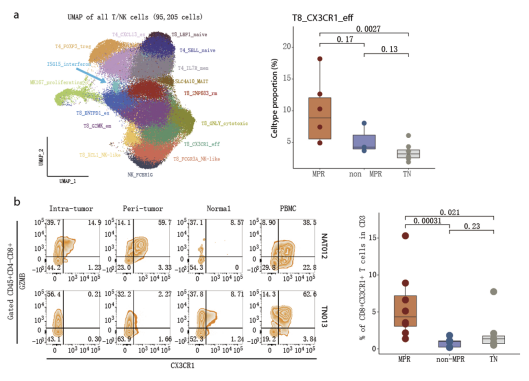 Fig. 2. Study Findings
Three Oral Presentations: From Metastatic Organotropism to Multifocal Disease—Mapping the Full Trajectory of Lung Cancer Progression
Oral 1: Multi-omic Profiling Defines Distinct Primary Tumor Ecosystems That Predetermine Metastatic Organotropism in Non-Small Cell Lung Cancer
Presenter: Wen Zhe
Organ-specific metastasis is a key driver of poor prognosis in lung adenocarcinoma (LUAD), but the intrinsic mechanisms governing organotropism remain unclear. The study enrolled 24 primary LUAD samples stratified by metastatic status (no metastasis stage I, intrapulmonary metastasis, pleural metastasis, bone metastasis, bone-pleural metastasis, and brain metastasis) for single-cell RNA sequencing, with 48 independent samples for validation, applying generalized binary covariance decomposition (GBCD) and CoVarNet to resolve tumor gene programs and microenvironment modules. Bone-metastasis tumors showed module upregulation characterized by EXT1, PVT1, and RANBP17, while pleural-metastasis tumors displayed distinct modules comprising SOX4, FGF13, and MACC1; bulk sequencing further validated these organ-specific signatures. In the microenvironment, the CM04 module, centered on CXCL10+ macrophages, was most enriched in bone metastasis, with abundance significantly lower in stage I and intrapulmonary-metastasis groups than in brain metastasis. Pseudotime analysis showed that the CM04 score progressively increased with microenvironment evolution.
These findings confirm the existence of pre-determined organotropic features in primary LUAD, offering promising biomarkers for risk-stratified, organ-specific metastasis prevention strategies.
Oral 2: Genomic and Immune Microenvironment Characteristics of Multiple Primary Lung Cancers
Presenter: Pan Yang
Multiple primary lung cancers (MPLC) feature multiple independent tumor foci within the same patient, and distinguishing MPLC from intrapulmonary metastasis (IM) remains a clinical challenge. This study enrolled 17 MPLC patients, 13 solitary lung cancer patients, and 5 IM patients, integrating whole-exome sequencing and single-cell RNA sequencing. Mutation analysis showed that the most frequently mutated genes in MPLC were TTN (43%), EGFR (33%), MUC16 (30%), RBM10 (23%), TP53 (20%), and OBSCN (20%); different foci in the same patient shared no mutations, supporting independent clonal origin. Functional pathway analysis showed consistent downregulation of EMT, angiogenesis, hypoxia and metabolism, and cell-cycle pathways in MPLC, reflecting an indolent biological phenotype of low invasion and low proliferation—in stark contrast to IM.
Regarding the immune microenvironment, MPLC appeared to maintain a delicate balance—sufficient immune surveillance to prevent metastatic spread of any single clone, while avoiding excessive immune attack that would otherwise preclude long-term coexistence of multiple independent tumor clones. These findings provide a basis for distinguishing MPLC from IM, and suggest that MPLC patients may exhibit distinct immunotherapy response patterns.
Oral 3: CEBPD-Driven Glycolytic Reprogramming Shapes Immune Evasion During Early Lung Adenocarcinoma Progression
Presenter: Denian Wang
The progression of early LUAD from ground-glass nodules (GGN) to solid nodules (SN) is a critical transition reflecting escalating tumor invasive behavior, but the metabolic and immunological determinants of this shift remain poorly understood. The study integrated single-cell transcriptomics and spatial metabolomics, analyzing 34 early LUAD cases (18 solid nodule adenocarcinoma [SN-ADC] and 16 ground-glass nodule adenocarcinoma [GGN-ADC]). SN-ADC displayed a highly immunosuppressive microenvironment, enriched in M2-like macrophages, PD-L1+LAMP3+ dendritic cells, and exhausted CD8+ T cells, accompanied by markedly enhanced glycolytic activity and lactate accumulation. The study identified a CEBPD+ tumor cell subset selectively enriched in SN-ADC and associated with poor prognosis. Mechanistically, CEBPD upregulates LDHA and mediates P300-dependent lactylation of PDHA1 at lysine 313, driving a glycolysis-dominant metabolic state, impairing CD8+ T cell function and promoting immune evasion.
The study defines a “metabolism-immunity” regulatory axis during early LUAD progression, linking metabolic dysregulation to immune failure. CEBPD and its downstream lactylation pathway represent potential immuno-metabolic intervention targets.
16 Posters: From Etiology to Mechanism—A Full-Chain Exploration of Respiratory Diseases
1. Etiology and Risk Factors
Focusing on disease development and influencing factors, the team reported 5 posters drawing on large population cohorts, retrospective analyses, and genetic approaches, providing evidence for primary prevention and early screening.
Poster 1: Blood Cell Biomarker Trajectories and Subsequent Lung Cancer Risk in Patients with Pulmonary Nodules: A 13-Year Longitudinal Cohort Analysis
Presenter: Peiji Yao
Based on a Chinese health-checkup cohort of over 680,000 individuals, the study enrolled 120,918 pulmonary nodule subjects; during a median follow-up of 3 years (maximum 13 years), 922 (0.7%) were diagnosed with lung cancer. Adjusted Poisson regression analysis showed that five blood biomarkers—red cell distribution width, eosinophil count, and the percentages of neutrophils, lymphocytes, and monocytes—were significantly associated with lung cancer risk. Longitudinal trajectory analysis further revealed that high-growth trajectories of basophil count (OR=1.53), basophil percentage (OR=1.50), and platelet count (OR=1.81) were closely associated with elevated lung cancer risk. The findings suggest that specific hematologic indicator trajectories may have potential value in risk stratification and monitoring of pulmonary nodule patients.
Poster 2: Comorbidity Network Characteristics and Clustering Patterns in Chinese Lung Cancer Patients: A Population-Based Cohort Study
Presenter: Xiumei Tang
The study retrospectively analyzed 126,130 hospitalized lung cancer patients diagnosed in China between 2016 and 2024, building comorbidity weighted networks using the Salton cosine index. Secondary malignancy was the most common comorbidity (21.72%), with substantial heterogeneity across subgroups: COPD prevalence was significantly higher in men (21.66%) than women (9.83%), while hypertension was more common in women (23.30% vs 20.11%) and urban residents (23.19% vs 18.44%). The study systematically maps the comorbidity network of Chinese lung cancer patients, revealing heterogeneity driven by sex and urban-rural differences.
Poster 3: Increased Risk of the Onset and Exacerbation of COPD in Metabolic Syndrome Patients: A Two-Sample Mendelian Randomization Study
Presenter: Lan Yang
Using two-sample Mendelian randomization analysis, the study evaluated the causal relationship between metabolic syndrome (MetS) and its components and COPD outcomes. IVW analysis showed that MetS increased the risk of COPD onset (OR=1.27), respiratory insufficiency (OR=1.66), and pneumonia (OR=1.13). Among components, abdominal obesity (waist circumference) had the strongest associations: COPD onset (OR=1.69), respiratory insufficiency (OR=2.27), and pneumonia (OR=1.20). Hypertension also increased pneumonia risk (OR=1.10). The findings clarify the genetic link between MetS and adverse COPD outcomes and underscore the need for COPD screening in abdominal obesity patients.
Poster 4: Small Airway Dysfunction as an Independent Predictor of Incident COPD: A Community-Based Prospective Cohort Study
Presenter: Yuepeng Li
Based on a prospective cohort of 9,389 community residents in Sichuan, China (mean follow-up 2.3 years), the incidence of new-onset COPD during follow-up was 5.22% (22.4/1,000 person-years). Multivariable analysis showed that baseline small airway dysfunction (SAD) was an independent predictor of new-onset COPD (OR=3.31, HR=3.04). Other independent risk factors included male sex, age ≥60 years, baseline FEV1%pred of 80-99%, and FEV1/FVC <0.75. The findings suggest that early small-airway assessment may help identify high-risk individuals for preventive interventions.
Poster 5: Comorbidity Network Characteristics and Clustering Patterns in Hospitalized COPD Patients: A Retrospective Cohort Study
Presenter: XiuMei Tang
Based on 43,456 hospitalized COPD patients (2012-2025), the study constructed comorbidity networks identifying 81 comorbidities, most commonly primary hypertension (24.73%), respiratory failure (15.85%), and electrolyte disorders (13.03%). Network analysis showed electrolyte disorders, glycoprotein metabolism disorders, and respiratory failure as core network hubs, with network complexity peaking at age 70-79. Male networks were larger while female networks had tighter connectivity. The study identified six comorbidity clusters: structural respiratory disease; complex multisystem disease; metabolic-respiratory critical illness; hypertension-pulmonary heart disease; diabetes-centered cardiac-renal disease; and metabolic-cardiovascular-cerebrovascular disease.
1. Assessment and Diagnosis
The team reported 5 posters on novel diagnostic biomarkers, validation of existing indicators, and predictive models in eosinophil-related diseases, lung microbiome, radiomics, and early-stage lung cancer.
Poster 1: Etiological Spectrum and Stratification Characteristics of Peripheral Blood Eosinophilia in Hospitalized Adults: A Retrospective Study
Presenter: Dongyu He
The study retrospectively analyzed 2,841 hospitalized adults with eosinophilia, with the etiological spectrum distributed as: unknown cause (33.3%), solid tumors (31.8%), allergic diseases (9.3%), infections (9.2%), connective tissue diseases (7.5%), and hematologic malignancies (5.7%). Solid tumors were more common in older patients (mean 59.6 years), mainly involving the digestive (34%), respiratory (24%), and urinary systems (12%). Mild, moderate, and severe eosinophilia accounted for 64.6%, 19.6%, and 15.7%, respectively. The proportion of unknown causes decreased with rising eosinophil counts (37.7%→22.4%), while solid tumors increased (29.7%→35.6%).
Poster 2: Absolute Quantitative Metagenomics Uncovers Disease-Specific Microbial Burdens and Host Immune Landscapes in Pulmonary Diseases: A Multi-Omics Machine Learning Study
Presenter: Xin Wang
The study developed KCQ, an absolute quantitative metagenomics method based on spiked internal standards, achieving accurate quantification as low as 10 copies/reaction. Applied to 251 bronchoalveolar lavage fluid (BALF) samples (covering infection, lung cancer, COPD, ILD, and healthy controls), with parallel cytokine and transcriptome analyses, the study revealed disease-specific microbial enrichment and depletion patterns. A multi-omics integration model demonstrated high diagnostic performance in benign-malignant differentiation (XGBoost AUC=0.958).
Poster 3: Dissociation Between Eosinophil Counts and Granule Protein Levels: Implications for Diagnosis in Type 2 Inflammatory Disorders
Presenter: Lei Li
The study measured six eosinophil granule proteins in 92 subjects (healthy controls, asthma, COPD, and other type 2 inflammatory diseases), and found no significant correlation between eosinophil count (EOS) and any granule protein, with differential expression patterns across diseases. COPD showed a unique pattern: eosinophil cationic protein (ECP) was intermediate between healthy and asthma, while eosinophil-derived neurotoxin (EDN), major basic protein (MBP), and galectin-10 were below those in asthma and other diseases; eosinophil peroxidase (EPX) showed no inter-group difference.
Poster 4: Progenitor Exhausted T Cell-Associated Radiomics Signature to Predict Immunotherapy Response in Patients with Advanced NSCLC
Presenter: Haoyu Wang
The study enrolled 370 advanced NSCLC patients receiving immune checkpoint inhibitors (ICIs), integrating CT radiomics, neutrophil-lymphocyte ratio (NLR), and PD-L1 to construct a combined prediction model. AUCs reached 0.813 and 0.733 for binary and three-class response prediction, respectively, and 0.683 and 0.857 for 3-month progression-free survival (PFS). Immunofluorescence showed that progenitor exhaustion markers were highly expressed in the low-risk group, suggesting a more activated tumor microenvironment (TME).
Poster 5: Clinical and Imaging Findings in Stage IA1 Lung Cancer
Presenter: Ruiyuan Yang
The study analyzed 1,947 surgically resected stage IA1 lung cancer patients. Diagnostic age in 2023 decreased by 2.5 years compared with 2019 (49.7→47.2 years), the invasive cancer proportion decreased significantly, subsolid nodules increased (31.6%→39.5%) while solid nodules decreased (11.6%→7.9%), and 97.7% were detected by physical examination. In 2023, wedge resection accounted for 52.7%, with lobectomy reduced. Only 2 cases had recurrence/metastasis (both solid nodules). Stage IA1 lung cancer showed indolent biological behavior, with favorable prognosis for subsolid nodules.
16 Posters: From Etiological Warning to Mechanistic Breakthroughs — Exploring End-to-End Breakthroughs in the Field of Respiratory Diseases
1. Treatment Strategy
The team’s treatment-focused research covers neoadjuvant chemoimmunotherapy, local ablation, and related strategies, aiming to provide real-world evidence for clinical decisions.
Poster 1: MPR and pCR Are Associated with Event-Free Survival in Neoadjuvant Chemoimmunotherapy of NSCLC
Presenter: Haoyu Wang
In a retrospective analysis of 126 resectable NSCLC patients receiving neoadjuvant chemoimmunotherapy, 70 achieved MPR. Pre-operative objective response (RECIST 1.1) was significantly associated with MPR (adjusted OR=2.69) and pCR (adjusted OR=2.81); MPR (adjusted HR=0.21) and pCR (adjusted HR=0.24) were independently associated with EFS, while pre-operative objective response was not (HR=0.66). MPR and pCR may serve as reliable surrogate endpoints for EFS, with detailed pre-operative imaging potentially helping to identify patients most likely to benefit.
Poster 2: Initial Experience with Cryoablation for Oligoprogressive Metastatic NSCLC on First-Line Immunotherapy
Presenter: Dan Li
The prospective study enrolled 10 metastatic NSCLC patients with oligoprogression during first-line immunotherapy, who underwent percutaneous cryoablation followed by continuation of the original immunotherapy regimen. Technical success rate was achieved (defined as ≥90% target lesion coverage). Only one mild hemoptysis and one spontaneous pneumothorax were observed postoperatively, with no serious adverse events. Three-month disease control rate was 70% (7/10); PFS ranged from 1.7 to 6 months. The preliminary findings suggest cryoablation combined with immunotherapy maintenance is safe and effective in oligoprogressive patients.
Poster 3: Percutaneous/Transbronchial Ablation for Thoracic Lesions/Tumors: A Prospective Cohort Study (the PATCH Study)
Presenter: Yue Chen
PATCH is a prospective observational cohort of patients with non-surgical thoracic lesions undergoing percutaneous or transbronchial ablation, with a planned sample of 1,000 and 10-year follow-up; the primary endpoints are 1-year and 3-year local control rates. Currently, 253 patients have been treated (mostly with percutaneous cryoablation), with curative intent. Adverse events were generally low, though bleeding and pneumothorax risk was higher with concurrent ablation and biopsy. The cohort is expected to provide high-level evidence on the effectiveness and value of thoracic lesion ablation.
1. Mechanism Exploration
These studies employ single-cell sequencing, spatial transcriptomics, and other frontier technologies to explore the mechanisms underlying respiratory tumor development and progression, providing theoretical basis for targeted therapy and immune interventions.
Poster 1: The Transcriptional Characteristics of Lung Cancer Combined with Chronic Obstructive Pulmonary Disease
Presenter: Cheng Cheng
Based on TCGA data, lung cancer patients were categorized by lung function into LC without COPD (N=70) and LC with COPD (N=129). GSVA pathway and CIBERSORT immune infiltration analyses showed that the LC-COPD group had upregulated G2M checkpoint pathway, with downregulation of KRAS signaling, angiogenesis, and EMT pathways, revealing distinct molecular subtype features of lung cancer with COPD.
Poster 2: The Significance of Hsp70 Expression Before and After Metastasis in Stage T1 Lung Adenocarcinoma
Presenter: YiHan Guo
Single-cell sequencing of 28 T1-stage LUAD biopsy samples showed that Hsp70 family genes (HspA6, HspA1A, HspA1B) were significantly downregulated in the metastasis group, with activated EMT and cell-cycle pathways. Hsp70 expression was negatively correlated with EMT and G2/M phase, and positively correlated with CDKN1A. IHC and Western blot analyses showed low E-cadherin and CDKN1A expression in the metastasis group. Hsp70 may serve as a predictive biomarker of T1-stage LUAD metastatic risk and a potential intervention target to prevent progression to metastatic disease.
Poster 3: Single-Cell and Spatial Transcriptomics Reveal the Spatiotemporal Evolution of the Immune Microenvironment in TP53-Mutant Lung Cancer
Presenter: Xinggang Yang
The study integrated longitudinal single-cell RNA sequencing, spatial transcriptomics, and high-multiplex spatial proteomics to map lung cancer progression in Kras-driven (K) and Kras/Trp53-mutant (KP) mouse models. Trp53 loss reprograms tumor cells toward a stemness-like, invasive state via activation of MYC, WNT, and Hedgehog pathways, triggering a shift from macrophages to a neutrophil-dominant myeloid landscape. A specific immunosuppressive neutrophil population (Mmp9+ TAN) with MDSC-like features and impaired differentiation was identified. Mechanistically, stemness-like KP tumor cells recruit Mmp9+ TAN via Bmp2/Tgfβ1 signaling; Mmp9+ TAN promotes terminal Treg differentiation through the JAG1-NOTCH1 and ICOSL-ICOS axes. Spatial analysis showed that these MDSC-like neutrophils dissolve immune hotspots and displace tissue-resident macrophages in the tumor microenvironment.
Summary
At this year’s ERS, Prof. Weimin Li’s team delivered 3 oral and 17 poster presentations, systematically covering multiple dimensions of respiratory disease research. From a research paradigm perspective, the team has built a full-chain framework spanning etiology, early diagnosis, treatment optimization, and mechanistic innovation, with each component closely integrated. The research provides accessible tools for clinical practice through the construction of etiology-risk networks, the discovery of diagnostic biomarkers, and the exploration of local treatment strategies. Taken together, the series of findings combines theoretical innovation with translational potential.

