


Asthma is a chronic, heterogeneous airway inflammatory disease, and achieving long-term control while reducing related risks remains the central management goal, according to the GINA 2026 strategy report. However, because disease evolution spans multiple dimensions, no single endpoint fully captures the trajectory of progression. The composite endpoint of clinically important deterioration (CID), which integrates lung function, symptom control, quality of life, exacerbations, and antibiotic use, has been widely used in COPD research and is now being extended to asthma studies to better quantify progression risk and treatment benefit.
At ERS 2026 (September 5-9, 2026, Barcelona), several asthma-focused studies were presented. Two long-term follow-up studies from Hong Kong and Switzerland described the prevailing asthma control landscape and multidimensional outcome patterns, while a tertiary (post-hoc) analysis of the KALOS and LOGOS trials adopted CID as its primary endpoint to assess the clinical benefit of budesonide/glycopyrronium/formoterol fumarate (BGF) triple therapy over budesonide/formoterol (BFF) dual therapy.
 Fig.1.Prof. Ruchong Chen introducing the CID post-hoc analysis poster from the KALOS/LOGOS studies to experts attending the meeting
Two Regional Studies Show That Asthma Control Remains Suboptimal and Cannot Be Captured by Single-Dimensional Measures
A Hong Kong prospective, multicenter study enrolled 419 patients with moderate-to-severe asthma (GINA steps 4-5). At baseline, only 54.9% were well-controlled (Asthma Control Test [ACT] score ≥20), while 24.3% were partly controlled (ACT 16-19) and 20.8% uncontrolled (ACT <16). Over 2 years of guideline-directed treatment, more than 36% (152 patients) experienced ≥1 exacerbation requiring systemic corticosteroids, and 42.7% (179 patients) failed to achieve good control.
A 3-year follow-up study of 304 patients with severe asthma from the Swiss Severe Asthma Registry (SSAR) examined outcomes by age group. Across age strata, fewer than 20% simultaneously met all four clinical-remission criteria (ACT ≥20, no oral corticosteroid [OCS] use, FEV1 >80% predicted, and no exacerbations) at baseline. Over time, ACT scores improved in all groups and the proportions achieving “no OCS” and “no exacerbation” rose, yet the proportion achieving FEV1 >80% predicted remained low, particularly in middle-aged and older patients.
Together, these two studies suggest that even with guideline-based treatment, many patients with moderate-to-severe asthma continue to fall short across symptom, exacerbation, and lung-function dimensions. Single endpoints capture only one facet and miss broader progression signals, underscoring the need for a composite measure such as CID that integrates lung function, symptoms, quality of life, exacerbations, and antibiotic use.
BGF Triple Therapy Delayed Disease Progression Versus Dual Therapy When Assessed by CID
To address the persistent unmet need, the KALOS/LOGOS tertiary analysis adopted CID as its post-hoc endpoint to compare BGF fixed-dose triple therapy with BFF dual therapy. The analysis pooled data from 4,311 patients aged ≥12 with uncontrolled asthma who were randomized 1:1:1:1 to the following arms for 24-52 weeks:
- BGF 28.8: budesonide/glycopyrronium/formoterol fumarate 160/14.4/4.8 μg per actuation via Aerosphere co-suspension delivery technology.
- BGF 14.4: budesonide/glycopyrronium/formoterol fumarate 160/7.2/4.8 μg per actuation via Aerosphere co-suspension delivery technology.
- BFFA: budesonide/formoterol 160/4.8 μg per actuation via Aerosphere co-suspension delivery technology.
- BFFS: budesonide/formoterol 160/4.5 μg per actuation via Symbicort standard suspension.
Patients received two inhalations twice daily.
CID was defined as the first occurrence of any of the following:
- ≥12% pre-bronchodilator FEV1 decline from baseline.
- ≥0.5 decrease from baseline in the Asthma Quality of Life Questionnaire for patients aged ≥12 (AQLQ-12).
- ≥0.5 increase from baseline in the Asthma Control Questionnaire (ACQ)-5 score.
- ≥1 moderate or severe asthma exacerbation.
- Antibiotic use for a respiratory illness.
For time to first CID, BGF 28.8 significantly extended the time to event versus BFFA (HR 0.78, 95% CI 0.71-0.87, P<0.001) and versus BFFS (HR 0.74, 95% CI 0.67-0.82, P<0.001), corresponding to roughly 22% and 26% reductions in risk, respectively (Fig. 1).
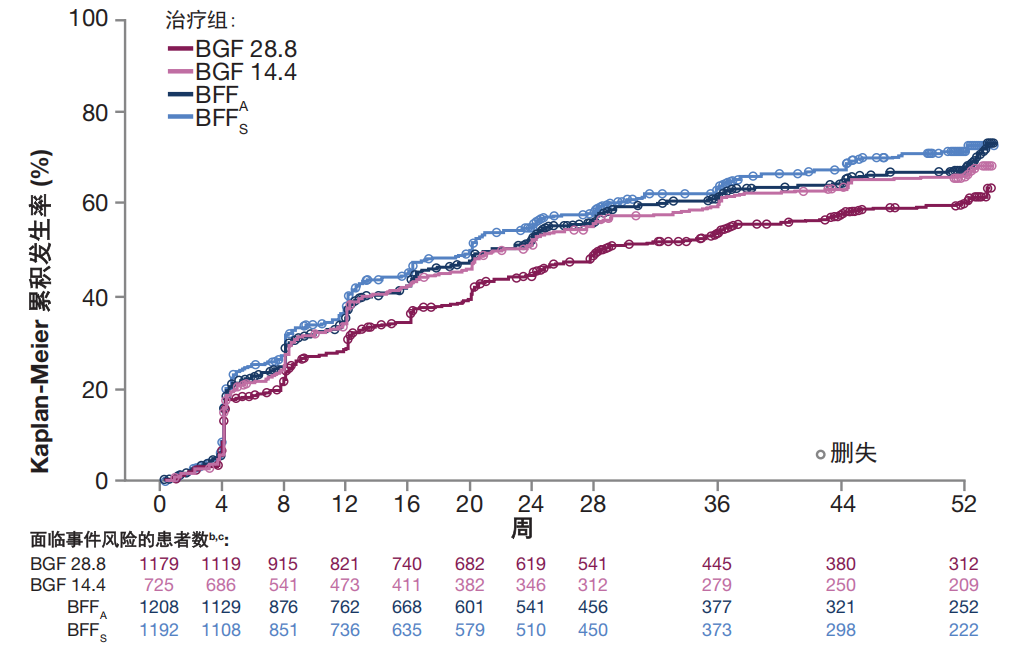 Fig.1. BGF 28.8 delayed the time to first CID compared with BFFA and BFFS^a[4]
a Cox regression models were used to compare treatment groups, with adjustment for baseline history of severe asthma exacerbations (0, 1, ≥2), prior ICS dose (medium vs high), region, study, baseline trough FEV1, and bronchodilator reversibility percentage. b Participants who experienced an intercurrent event (ICE) but did not develop CID were censored on the day after the ICE (+1 day). c Participants who neither developed CID nor experienced an ICE were censored on the day after the last dose (+1 day).
Table 1: Compared with BFFA, BFFS, and the combined BFF group, BGF demonstrated a favorable NNT value with respect to time to first CID [4].
|
Time Point |
Comparison Between Treatment Groups |
NNT(95% CI) |
|
24 Weeks |
BGF 28.8 vs BFF_A |
13(9,21) |
|
BGF 28.8 vs BFF_S |
10(8,15) |
|
|
BGF 28.8 vs BFF_Pooled |
11(9,16) |
|
|
52 Weeks |
BGF 28.8 vs BFF_A |
12(8,20) |
|
BGF 28.8 vs BFF_S |
10(7,14) |
|
|
BGF 28.8 vs BFF_Pooled |
10(8,15) |
* The formula for calculating NNT is as follows, where Sc(t) is the Kaplan-Meier estimated survival probability of the control group (BFFA, BFFS, or the combined BFF group) at time t; h is the hazard ratio (HR) between the treatment group and the control group derived from a Cox regression model; the covariates adjusted for in the Cox regression model included: baseline history of severe asthma exacerbations (0, 1, ≥2), prior ICS dose (medium vs high), region, study, baseline trough FEV1, and bronchodilator reversibility percentage. Based on the Kaplan-Meier survival probability at the 52-week treatment time point (i.e., the proportion of patients without CID at 52 weeks), the NNT values for each comparison were calculated using the above formula.
The number-needed-to-treat (NNT) at 52 weeks was 12 (95% CI 8-20) for BGF 28.8 versus BFFA and 10 (95% CI 7-14) versus BFFS (Table 1), meaning that for every 12 (or 10) patients with uncontrolled asthma treated with BGF 28.8 instead of BFFA (or BFFS), one additional CID event could be averted.
These findings support the clinical value of BGF triple therapy for uncontrolled asthma. Compared with the two BFF comparators, BGF 28.8 extended time to first CID with favorable NNT, suggesting that prompt escalation to BGF may be an effective strategy for reducing overall disease-deterioration risk in patients with inadequately controlled moderate-to-severe asthma.
Why CID Works as a Composite Endpoint for Asthma
Asthma is highly heterogeneous, and progression may manifest as lung-function decline, symptom worsening, impaired quality of life, or exacerbations—patterns that no single measure can fully capture. CID bundles these dimensions into a single framework and is triggered by any single threshold, enabling earlier detection of subtle worsening in patients whose deterioration may be dominated by one dimension (for example, lung-function decline without overt symptoms, or vice versa). By combining objective physiology with patient-reported outcomes, CID helps bridge the gap between “lung function” and “the patient’s experience.”
In COPD, the prognostic value of CID has been established. A post-hoc analysis of the TORCH and ECLIPSE trials showed that patients who experienced a CID within 6-12 months of follow-up had a 61% higher 36-month exacerbation risk (HR 1.61, 95% CI 1.50-1.72) and a 41% higher all-cause mortality risk (HR 1.41, 95% CI 1.15-1.72), with sustained clinically meaningful declines in FEV1 and health status. In asthma, the present analysis extends CID into treatment trials, supporting its feasibility as an endpoint and offering a reference for future study design and endpoint selection.
The findings were derived from a conference abstract presented at ERS 2026 and have not yet been peer-reviewed.
Summary
These data confirm the persistent burden of uncontrolled asthma—a substantial proportion of patients with moderate-to-severe disease fail to achieve or sustain good control over 2-3 years—and highlight the need for composite measures such as CID to better assess disease progression. The KALOS/LOGOS tertiary analysis further suggests that, versus dual therapy, budesonide/glycopyrronium/formoterol fumarate triple therapy may effectively delay and reduce CID events, providing evidence-based support for timely treatment escalation in clinical practice.
The findings in this article are derived from conference abstracts presented at ERS 2026 and have not yet been peer-reviewed. As the underlying data come from a tertiary (post-hoc) analysis, the results are hypothesis-generating and should be interpreted with caution.
This article is intended to provide scientific information to healthcare professionals and does not represent the editorial position of MedJ.
References
[1] Global Initiative for Asthma. GINA 2026 Strategy Report. https://ginasthma.org/2026-gina-strategy-report/. Accessed September 1, 2026.
[2] Fanny W.S. Ko, Hoi Yee Kwan, Steven Tseng, et al. A 2-year multicentre prospective study to assess the change in asthma control of moderate to severe asthma patients over time and the predictors of poor control in Hong Kong. ERS 2026. PA462.
[3] Fabienne Jaun, Maria Boesing, Giorgia Luethi-Corridori, et al. Three-year outcome trajectories by age in severe asthma: evidence from the Swiss Severe Asthma Registry. ERS 2026. PA3758.
[4] Ruchong Chen, Robert A Wise, Alberto Papi, et al. Budesonide/glycopyrronium/formoterol fumarate dihydrate effects on time to first clinically important deterioration and number needed to treat for clinically important deterioration rate: tertiary analyses of KALOS and LOGOS studies. ERS 2026. PA3852.
[5] Naya IP, Tombs L, Muellerova H, et al. Long-term outcomes following first short-term clinically important deterioration in COPD. Respir Res. 2018;19(1):222.

