


The European Respiratory Society (ERS) 2026 International Congress opened September 5 in Barcelona. A post-hoc analysis of the KALOS/LOGOS phase 3 trials, presented as a poster at the congress, examined clinical remission rates with budesonide-glycopyrronium-formoterol (BGF) triple therapy in patients with asthma inadequately controlled by medium-to-high dose inhaled corticosteroid/long-acting β2-agonist (ICS-LABA) treatment.
Asthma affects hundreds of millions of patients globally. Even with standard ICS-LABA therapy, a proportion of patients continue to experience symptoms and suboptimal lung function, and traditional symptom-control strategies may not meet their deeper needs. In recent years, “clinical remission” has gained attention as a higher-order treatment goal, requiring long-term absence of acute exacerbations, no need for systemic corticosteroids, well-controlled symptoms, and stable or normal lung function.
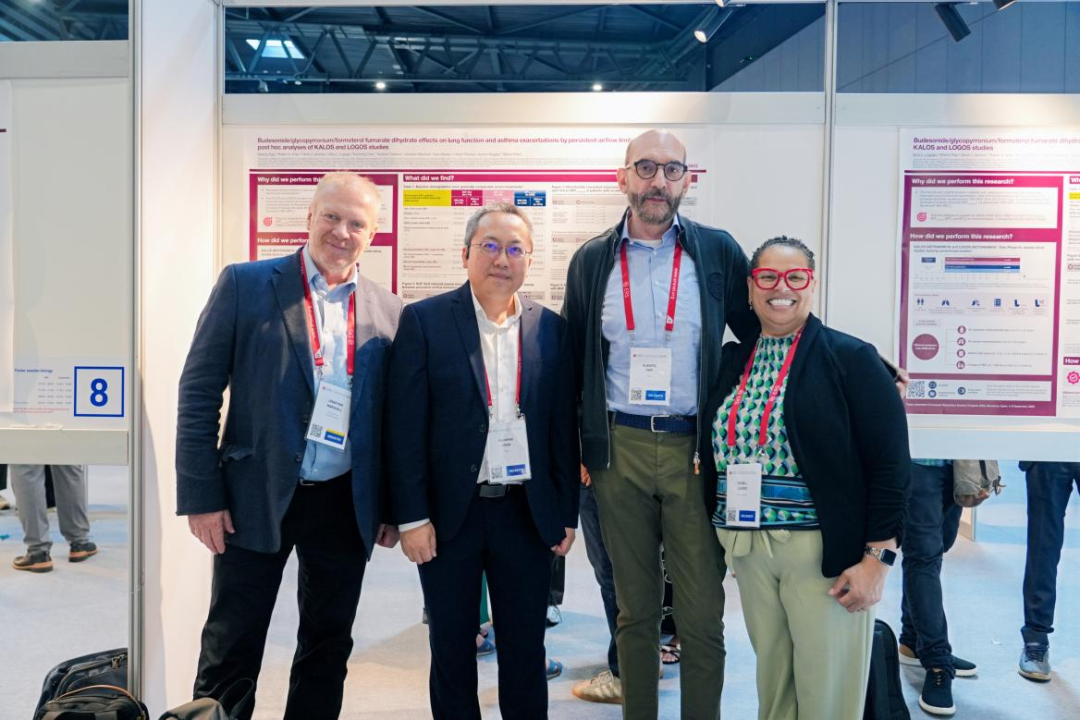 The photo shows the principal authors of the KALOS/LOGOS study ERS poster posing together at the ERS 2026 Congress (from left to right: Prof. Jonathan Marshall, Prof. Ruchong Chen, Prof. Alberto Papi, Prof. Njira Lugogo).
The Evolution of “Clinical Remission” Criteria
The concept of “clinical remission” aligns with the long-term goals of asthma management advocated by the Global Initiative for Asthma (GINA), which seeks the best long-term outcomes for each patient. The Chinese Bronchial Asthma Prevention and Treatment Guideline (2024 Edition) similarly recommends that asthma treatment selection and response monitoring balance symptom control and future risk, with the goal of achieving “overall control” or “clinical remission” through reassessment of pharmacotherapy.
Table 1: Comparison of Core Elements of the Definition of “Clinical Cure” Across Countries [2–7]
|
Country |
Guidelines |
Acute Exacerbation |
OCS |
Symptom Control |
Lung Function |
|
China |
Guideline for the Prevention and Treatment of Bronchial Asthma (2024 Edition) [2] |
None |
Not Required |
Asymptomatic for ≥1 year |
Normal or near-normal |
|
Japan |
2024 Japanese Guidelines for Asthma Prevention and Management (JGL 2024) [3] |
None |
Not Required |
Asthma Control Test (ACT) score ≥23 or Asthma Control Questionnaire (ACQ) score ≤0.75 (multiple assessments) |
• Normalization: Post-bronchodilator FEV₁ ≥80% of predicted value; |
|
Germany |
German Society of Pulmonology (DGP) [4] |
None |
Not Required |
Asymptomatic |
Stable |
|
Italy |
Italian Network for Severe Asthma (SANI) [5] |
None |
Not Required |
ACT≥20, ACQ<1.5 |
Stable |
|
Spain |
Spanish Remission Working Group on Asthma (REMAS) [6] |
None |
Not Required |
ACT≥20 |
Normalization (FEV₁≥80%) or FEV₁>90% of individual best; Negative bronchodilator test |
|
USA |
US Consensus (jointly issued by the American College of Allergy, Asthma & Immunology [ACAAI], the American Academy of Allergy, Asthma & Immunology [AAAAI], and the American Thoracic Society [ATS]) [7] |
None |
Not Required |
ACT>20 or ACQ<0.75 or Asthma Impairment and Risk Questionnaire (AirQ) <2; Rescue medication ≤1 time/month; No absences |
Stable and optimized (≥2 times/year) |
The international consensus on clinical remission generally includes four core dimensions: no acute exacerbations, no need for oral corticosteroids (OCS), well-controlled symptoms, and stable or normalized lung function. However, thresholds vary across national guidelines. The main differences concern the lung function dimension. Most countries use qualitative descriptions such as “normal/stable” without specific quantitative criteria, while Japan’s JGL 2024 provides the most detailed lung function “stabilization” criteria for patients whose lung function is difficult to normalize. Most studies use FEV1 ≥80% predicted as the threshold for lung function normalization.
Compared with most guideline definitions, the KALOS/LOGOS post-hoc analysis applied a more stringent quantitative criterion: improvement in morning trough FEV1 ≥100 mL from baseline, in addition to the composite endpoint.
KALOS/LOGOS Study Design
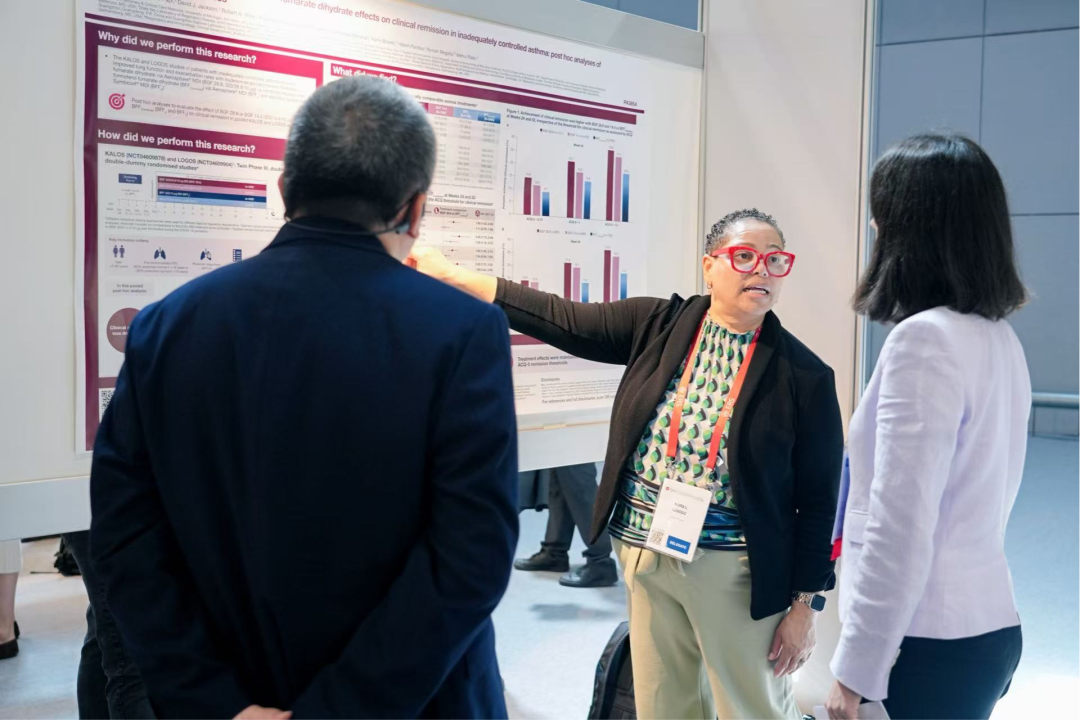 The figure shows Prof. Njira Lugogo presenting the KALOS/LOGOS study’s “clinical cure” post-hoc analysis poster to attending experts
Research Design
KALOS and LOGOS are twin global multicenter, randomized, double-blind, double-dummy, parallel-group phase 3 trials. The studies enrolled 4,311 patients aged 12-80 years whose asthma remained inadequately controlled (ACQ-7 score ≥1.5) on medium-to-high dose ICS-LABA. Notably, the trials did not require patients to have a history of asthma exacerbations in the previous year, thus covering a broader population of patients with inadequately controlled asthma on medium-to-high dose ICS-LABA therapy.
After a 4-week run-in period, patients were randomized 1:1:1:1 to four treatment arms, each receiving two inhalations twice daily (BID) for 24-52 weeks:
- BGF 28.8: budesonide 160 μg/glycopyrronium 14.4 μg/formoterol fumarate 4.8 μg (delivered via Aerosphere co-suspension delivery technology)
- BGF 14.4: budesonide 160 μg/glycopyrronium 7.2 μg/formoterol fumarate 4.8 μg (delivered via Aerosphere co-suspension delivery technology)
- BFFA: budesonide/formoterol 160/4.8 μg (delivered via Aerosphere co-suspension delivery technology)
- BFFS: budesonide/formoterol 160/4.5 μg (Symbicort standard suspension formulation)
Doses are per single actuation; patients received two inhalations per dose.
The primary endpoints were changes from baseline in morning pre-dose trough FEV1 and FEV1 AUC0-3 at week 24, as well as annualized rate of severe exacerbations (pooled analysis), with safety as an additional endpoint.
The post-hoc analysis presented at ERS 2026 used a composite endpoint consistent with the international consensus framework, requiring patients to meet all four dimensions simultaneously to be classified as achieving clinical remission at week 24 or 52:
- No OCS use during the 24- or 52-week period
- No severe exacerbations during the 24- or 52-week period
- ACQ-5 score meeting threshold at week 24 or 52
- Morning trough FEV1 improvement ≥100 mL from baseline at week 24 or 52
Primary Results of the Post-Hoc Analysis
Under the ACQ-5 ≤1.5 threshold, the BGF 28.8 group had higher proportions achieving clinical remission than the BFFCombined group (BFFA + BFFS) at week 24 (29.8% vs 20.6%) and week 52 (27.6% vs 17.2%). Under the ACQ-5 ≤1 threshold, BGF 28.8 outperformed BFFCombined at week 24 (23.1% vs 15.6%) and week 52 (19.0% vs 13.0%). Under the more stringent ACQ-5 ≤0.75 threshold, BGF 28.8 again outperformed BFFCombined at week 24 (14.8% vs 9.7%) and week 52 (14.0% vs 7.9%).
Compared with BFFCombined, BGF 28.8 showed consistent odds ratio (OR) advantages at all time points. At week 24, the OR for clinical remission at ACQ-5 ≤1.5 was 1.76 (95% CI 1.44-2.15) versus ICS-LABA controls; at week 52, the OR increased to 2.05 (95% CI 1.62-2.58). At ACQ-5 ≤1, the 24- and 52-week ORs were 1.83 (95% CI 1.45-2.31) and 2.30 (95% CI 1.75-3.02), respectively. At ACQ-5 ≤0.75, the 24- and 52-week ORs were 1.92 (95% CI 1.42-2.60) and 2.45 (95% CI 1.73-3.48), respectively.
Main KALOS/LOGOS Trial Results
The main results of the KALOS/LOGOS trials were formally published in The Lancet Respiratory Medicine in April 2026.
Severe exacerbations: Compared with BFFS, BGF 28.8 significantly reduced the rate of severe exacerbations by 18% (RR 0.82; 95% CI 0.71-0.94; P=0.0043). The reduction in severe exacerbation risk was consistent regardless of baseline exacerbation history.
Lung function: In the LOGOS trial, the least-squares mean difference in morning pre-dose trough FEV1 change from baseline at week 24 was 91 mL (95% CI 60-121, P<0.0001) for BGF 28.8 versus BFFS, and FEV1 AUC0-3 improved by 105 mL (95% CI 75-134, P<0.0001). Benefits were observed from the first dose, with a 180 mL FEV1 improvement versus baseline at 5 minutes after the first dose on day 1 (least-squares mean 95% CI 162-197, P<0.0001).
Symptom improvement: Pre-specified analyses showed that 72.7% of patients in the BGF 28.8 group achieved an ACQ-5 improvement of ≥0.5 points (the minimum clinically important difference) at week 24. According to the Onset of Effect Questionnaire (OEQ), approximately 74% of patients in the BGF 28.8 group perceived onset of action within 5 minutes of the first dose on day 1.
Mechanism
BGF triple therapy combines three mechanisms: ICS reduces airway inflammation; LABA provides β2-receptor-mediated bronchodilation; and the long-acting muscarinic antagonist (LAMA) glycopyrronium provides a complementary anticholinergic bronchodilation mechanism. According to the article, LAMA may also reduce pro-inflammatory mediator release and attenuate airway remodeling. The co-suspension delivery technology is intended to ensure simultaneous deposition of the three components throughout central and peripheral airways.
Summary
According to the post-hoc analysis, in patients with asthma inadequately controlled by ICS-LABA, BGF triple therapy showed higher odds ratios for clinical remission than dual therapy at weeks 24 and 52. As a post-hoc analysis, the results are hypothesis-generating and should be interpreted with caution.
The post-hoc analysis is a conference abstract presented at ERS 2026 and has not been peer-reviewed. The main KALOS/LOGOS results have been published in The Lancet Respiratory Medicine (April 2026). Two additional ERS 2026 KALOS/LOGOS analyses—PAL efficacy consistency and CID tertiary analysis—and a MedJ interview with Prof. Ruchong Chen on KALOS/LOGOS evidence and asthma step-up therapy are scheduled for release between September 9 and 11.
References
[1] Global Initiative for Asthma. GINA 2026 Strategy Report. Available at: <https://ginasthma.org/wp-content/uploads/2026/05/GINA-2026-Strategy-Report-WMS.pdf>. Accessed May 19, 2026.
[2] Chinese Thoracic Society. [Guideline for the Prevention and Treatment of Bronchial Asthma (2024 Edition)]. Chinese Journal of Tuberculosis and Respiratory Diseases. 2025;48(3):208-248.
[3] Nagase H, Harada N, Tezuka J, et al. Consensus definition of clinical remission in asthma for the Japanese asthma prevention and management guidelines (JGL 2024): A modified Delphi survey and comprehensive review. Allergol Int. 2026;75(1):3-14.
[4] Lommatzsch M, Criée CP, de Jong CCM, et al. [Diagnosis and Treatment of Asthma: A Guideline for Respiratory Specialists 2023—Published by the German Respiratory Society (DGP)]. Pneumologie. 2023;77(8):e3. German.
[5] Canonica GW, Blasi F, Carpagnano GE, et al. Severe Asthma Network Italy Definition of Clinical Remission in Severe Asthma: A Delphi Consensus. J Allergy Clin Immunol Pract. 2023;11(12):3629-3637.
[6] Álvarez-Gutiérrez FJ, Casas-Maldonado F, Soto-Campos G, et al. Spanish Consensus on Remission in Asthma (REMAS). Arch Bronconeumol. 2024;60(8):503-509.
[7] Blaiss M, Oppenheimer J, Corbett M, et al. Consensus of an American College of Allergy, Asthma, and Immunology, American Academy of Allergy, Asthma, and Immunology, and American Thoracic Society workgroup on definition of clinical remission in asthma on treatment. Ann Allergy Asthma Immunol. 2023;131(6):782-785.
[8] Papi A, Wise RA, Jackson DJ, et al. Budesonide-glycopyrronium-formoterol fumarate dihydrate in uncontrolled asthma (KALOS and LOGOS): twin multicentre, double-blind, double-dummy, parallel-group, randomised, phase 3 trials. Lancet Respir Med. 2026;14(4):350-362.
[9] Jackson D, Wise R, Papi A, et al. Budesonide/glycopyrronium/formoterol fumarate dihydrate effects on clinical remission in inadequately controlled asthma: post hoc analyses of KALOS and LOGOS studies. ERS 2026 International Congress. Poster #PA3854.
[10] Patel M, Wise RA, Papi A, et al. Budesonide/Glycopyrrolate/Formoterol Fumarate Effects on Patient Reported Outcomes and Symptoms in Inadequately Controlled Asthma. Am J Respir Crit Care Med. 2026;212(Supplement_1):A32-15; aamag162.310.
[11] Rayner DG, Bakaa L, Hoyte F, et al. Triple therapy vs dual inhaler therapy for moderate-to-severe asthma: An updated systematic review and meta-analysis. Ann Allergy Asthma Immunol. 2025;135(3):278-286.e11.
[12] Calzetta L, Manzetti GM, Pistocchini E, et al. Long-Acting Muscarinic Antagonists for the Treatment of Difficult-to-Treat and Severe Asthma: A Narrative Review Focusing on Inflammation from Bench to Bedside. J Inflamm Res. 2026;19:552261.

