


CA: A Cancer Journal for Clinicians, with an impact factor of 685.2, stands as the "Mount Everest" of medical journals. Recently, this top-tier journal published online a review led by Chinese physicians — "Extranodal Natural Killer/T-cell Lymphoma: From Fatal to Curable". The corresponding author is Prof. Weili Zhao from Ruijin Hospital, Shanghai Jiao Tong University School of Medicine, co-authored with experts from China, Japan, South Korea, France, and the United States. This review systematically delineates the diagnostic and therapeutic evolution of extranodal NK/T-cell lymphoma (ENKTCL), a rare lymphoma once regarded as "fatal." The Hematology Channel of MedJ has summarized it for our readers.
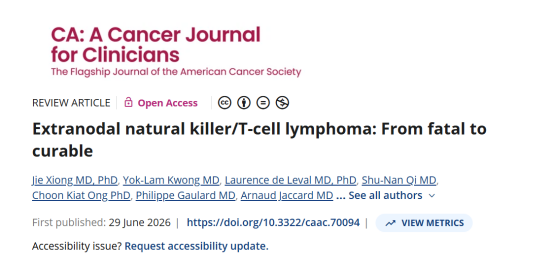
Fig. 1. Screenshot of the paper
Disease Background: A "Asia-Specific" Fatal Lymphoma
ENKTCL is one of the most aggressive subtypes of peripheral T-cell lymphoma (PTCL), closely associated with Epstein-Barr virus (EBV) infection. It is characterized pathologically by angiodestructive lesions and extensive necrosis, with rapid clinical progression. Over 80% of cases occur in the nasal cavity or upper aerodigestive tract, while approximately 20% are extranasal (most commonly in skin/soft tissue and gastrointestinal tract).
Epidemiologically, it is highly "selective" — the annual incidence is approximately 0.25–0.28 per 100,000 in Asia and South America, compared with only 0.06–0.07 per 100,000 in the West. This disparity is thought to result from a combination of genetic susceptibility, EBV strain differences (predominantly type A), and environmental factors.
How desperate was the situation for ENKTCL in the past? The International T-Cell Project reported that in the anthracycline-based chemotherapy era, the 5-year progression-free survival (PFS) was only 26%, and overall survival (OS) was only 31%. However, the landscape has been completely reversed over the past decade — asparaginase (now commonly pegylated asparaginase, with lower immunogenicity and longer half-life) has been proven highly effective against this tumor type. With the addition of radiotherapy, immunotherapy, and targeted agents, long-term survival rates in newly diagnosed patients now approach 80%, and "curability" is no longer an aspiration.
The Multi-Omics Era: Redefining the Face of the Enemy in ENKTCL
Prof. Weili Zhao’s team has systematically constructed a precision diagnostic and therapeutic system for ENKTCL across four dimensions: clinical, pathological, imaging, and biological characteristics.
Pathology and Imaging: At the pathological level, the angioinvasive infiltration of tumor cells and associated coagulative necrosis have been clearly defined, with EBER in situ hybridization positivity established as the diagnostic gold standard. In imaging, MRI is used to precisely delineate radiotherapy target volumes, while PET-CT metabolic parameters (such as SUVmax and MTV) are employed to optimize staging and prognostic assessment.
Molecular Subtyping: Based on multi-omics data (genomics, transcriptomics, epigenomics, and metabolomics), ENKTCL has been innovatively classified into three molecular subtypes, providing a basis for stratified clinical management:
- TS type (Tumor Suppressor/Immune type): Characterized by frequent TP53 mutations and 9p24 amplification leading to PD-L1 overexpression, sensitive to immune checkpoint inhibitors.
- MB type (MYC-driven type): Exhibits MAPK/NOTCH pathway activation, poor prognosis, suggesting potential benefit from MYC inhibitors.
- HEA type (Epigenetic type): Harbors HDAC/EP300 mutations, of T-cell origin, shows significant response to HDAC inhibitors with favorable prognosis.
Pathogenesis: The research has redefined the role of EBV, revealing that it is no longer merely a biomarker but directly drives tumor development through multiple mechanisms: LMP1 activates NF-κB, BNRF1 hijacks histone chaperones, and BILF1/BNLF2A mediate immune evasion.
Early-Stage ENKTCL: Combined Chemoradiotherapy Pushes 5-Year Survival Beyond 80%
Treatment for early-stage (Ann Arbor Stage I/II) ENKTCL has reached a clear consensus — a treatment model combining radiotherapy with pegylated asparaginase-containing chemotherapy.
Multiple clinical trials have established this standard:
- ESA regimen (etoposide, dexamethasone, pegylated asparaginase) plus radiotherapy: 5-year PFS rate of 80.3%, OS rate of 85.1%;
- GELAD regimen (gemcitabine, etoposide, pegylated asparaginase, dexamethasone) plus radiotherapy: 4-year PFS and OS rates of 90.4% and 94.2%, respectively;
- P-GemOx (pegylated asparaginase, gemcitabine, oxaliplatin) plus radiotherapy: 5-year PFS and OS rates of 65.9% and 80.5%, respectively.
Advanced and Relapsed/Refractory Disease: Immunotherapy Opens a New Window
The prognosis for advanced-stage (Stage III/IV) ENKTCL remains suboptimal, with 5-year PFS and OS rates of 30.1% and 39.8%, respectively. However, the integration of immunotherapy is changing this landscape.
The randomized trial comparing the DDGP regimen (dexamethasone, cisplatin, gemcitabine, pegylated asparaginase) with the SMILE regimen (dexamethasone, methotrexate, ifosfamide, L-asparaginase, etoposide) showed that DDGP achieved a CR rate of 67.5% and 5-year OS of 74.3%, significantly superior to SMILE’s 47.5% and 51.7%, respectively.
Even more encouraging are the breakthroughs in immuno-combination therapy:
- Sintilimab + P-GemOx (SPIRIT study): Among 34 advanced patients, 85% achieved CR, with 2-year PFS of 64% and 3-year OS of 76%;
- Sintilimab + pegylated asparaginase (chemotherapy-free regimen): 2-year PFS and OS rates of 68% and 86%, respectively.
For relapsed/refractory patients, PD-1/PD-L1 inhibitor monotherapy achieves an objective response rate (ORR) of 38%–75%. In addition, the CD38 monoclonal antibody isatuximab combined with PD-1 inhibitors achieved a CR rate of 51%; the JAK1 inhibitor golidocitinib achieved an ORR of 25%–38%; and the HDAC inhibitor chidamide combined with PD-1 inhibitors achieved an ORR of 59.5%.
Two Special Scenarios: Transplantation and Hemophagocytic Lymphohistiocytosis (HLH)
For early-stage ENKTCL, first-line autologous hematopoietic stem cell transplantation (Auto-HSCT) is generally not recommended given the already favorable outcomes. However, for advanced/high-risk patients who achieve CR after chemotherapy, Auto-HSCT significantly extends survival. For patients achieving only partial remission (PR) or no response, allogeneic HSCT (Allo-HSCT) may be considered, though transplant-related mortality is relatively high. Continuous monitoring of peripheral blood EBV DNA before and after transplantation is an independent marker for predicting relapse.
HLH is a fatal complication with a median OS of less than 6 months. The standard regimen is high-dose dexamethasone plus etoposide; the ruxolitinib combination regimen can raise the ORR to 78%, and Allo-HSCT consolidation is recommended after remission.
Discussion and Summary
This CA review clearly delineates the "comeback" of ENKTCL: from "anthracycline ineffective → 5-year OS of 31%" to "nearly 80% long-term survival in newly diagnosed cases," driven by three key threads — radiotherapy plus pegylated asparaginase chemotherapy controls local disease in early stages; PD-1 inhibitors are brought into the first-line setting for advanced disease, with chemotherapy-free regimens also proving viable; and molecular subtyping (TS/MB/HEA) together with EBV mechanisms point the way toward novel approaches including CAR-T, EBV vaccines, and JAK inhibitors for relapsed/refractory patients.
However, the shortcomings are also evident: outcomes for advanced and relapsed patients remain suboptimal, HLH-complicated patients continue to face a grim prognosis, and standardized treatment protocols are lacking. Future directions are largely focused on two areas — whether EBV-targeted strategies (CTL, mRNA vaccines, TCR-T) can be implemented in the front-line setting, and whether AI combined with multi-omics can more precisely stratify which patients should receive early PD-1 therapy and which should proceed to early transplantation.
From "fatal" to "curable," ENKTCL is arguably one of the most dramatic reversals in hematologic oncology over the past decade. This CA review serves as a monument to this turning point, and a reminder that once the mechanisms of a rare disease are cracked, the benefit curve can be remarkably steep.
References
[1] Xiong J, et al. Extranodal natural killer/T-cell lymphoma: from fatal to curable. CA Cancer J Clin. 2026;76(4):e70094. doi:10.3322/caac.70094

