


The prognosis of pediatric mature B-cell non-Hodgkin lymphoma (B-NHL) has significantly improved in the rituximab era, yet 10%–15% of patients still experience relapse or refractory disease. Once relapse occurs, the complete remission rate (CRR) of conventional salvage chemotherapy is less than 50%, with substantial toxicity. Although CAR-T therapy holds promise, it is constrained by long manufacturing lead times, high costs, and limited accessibility. Finding a treatment path that is "less traumatic and faster to recovery" for these children has long been a critical challenge in pediatric hematology-oncology.
Recently, the team of Prof. Hua Jiang andProf. Lin Qiu from Guangzhou Women and Children’s Medical Center, Guangzhou Medical University, published a landmark original study in the international hematology journal Haematologica, providing the first preliminary evidence from individual cases that the chemotherapy-free Glofitamab + Polatuzumab vedotin (Glofit-Pola) regimen shows high efficacy and safety as salvage therapy in pediatric relapsed/refractory B-NHL (R/R B-NHL). In this edition of Investigator’s Perspective, MedJ invitedProf. Lin Qiu, the corresponding author and lead principal investigator of the study, for an in-depth discussion of the core findings and clinical implications.
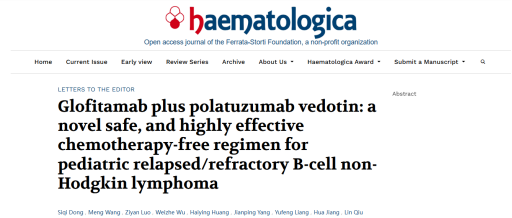
Fig. 1. Study screenshot
Triple Dilemma: Why Are Relapsed/Refractory Pediatric Patients So Challenging?
"The first-line prognosis for pediatric mature B-cell lymphoma is acceptable, but treatment options for the relapsed/refractory population are indeed very limited," noted Prof. Qiu. Currently, there is no standard salvage regimen for this population in clinical practice, and treatment is often based on individual center experience. The typical treatment pathway is salvage chemotherapy followed by autologous stem cell transplantation (ASCT), but this path is fraught with obstacles.
1. Limited efficacy and significant toxicity of conventional salvage chemotherapy
Prof. Qiu pointed out that the objective response rate (ORR) of salvage chemotherapy reported across different centers or studies is generally less than 50%, with a recent report showing an even lower CRR of approximately 24.3%—meaning that more than 70% of relapsed children fail to achieve a second remission with conventional chemotherapy. These patients have mostly already undergone intensive multi-agent first-line chemotherapy, leaving their bone marrow reserve and vital organ function in varying degrees of cumulative impairment. If they receive high-intensity salvage chemotherapy again, not only does tolerance decrease significantly due to limited organ reserve, but the risk of treatment-related infections, bleeding, and other complications increases markedly, potentially further raising transplant-related mortality and diminishing an already slim chance of cure.
2. CAR-T therapy faces multiple real-world barriers
There is no commercially available CAR-T product formally approved for pediatric mature B-cell lymphoma in China. The therapy involves an individualized manufacturing process that typically takes about 2 weeks and is extremely costly. For highly aggressive, rapidly proliferating tumors such as Burkitt lymphoma, most relapsed cases progress rapidly—or even develop life-threatening complications—during the cell manufacturing window, ultimately rendering some patients ineligible for cell infusion and missing the therapeutic window.
3. Particularly difficult treatment decisions for patients with central nervous system involvement
For cases with central nervous system (CNS) involvement at relapse, re-treatment with high-dose methotrexate (HD-MTX) combined with repeated intrathecal injections not only yields poor efficacy due to the blood-brain barrier and prior treatment tolerance, but the cumulative neurotoxicity may also cause irreversible long-term functional damage to the developing pediatric brain.
Synergistic Breakthrough: How Do Two Targeted Agents Achieve 1+1>2?
Faced with these challenges, Prof. Qiu’s team turned to the combination of Glofitamab and Polatuzumab vedotin.
Glofitamab is a CD20×CD3 bispecific antibody with a unique 2:1 molecular structure (two CD20-binding sites and one CD3-binding site). It simultaneously binds T cells and B cells, recruiting T cells to the tumor site, activating T-cell proliferation, and releasing perforin and granzymes to lyse tumor cells. Polatuzumab vedotin is a third-generation antibody-drug conjugate (ADC) targeting CD79b. After binding to tumor cells via the CD79b monoclonal antibody, it releases the microtubule inhibitor monomethyl auristatin E (MMAE), which kills tumor cells through a "bystander effect".
"The two drugs have different targets and different mechanisms. We hope that through multi-target, multi-mechanism synergy, we can reduce the risk of resistance due to antigen escape," Prof. Qiu added.
This combination strategy was not conceived in a vacuum. Prof. Qiu noted that an in vivo model study published in Blood in the second half of last year showed that while either drug alone had limited antitumor effect, the combination led to rapid tumor regression, suggesting synergistic potential.
High Efficacy, Low Toxicity: Both High-Risk Pediatric Patients Achieved Deep Remission
An ideal synergistic mechanism still needs to be translated into clinical practice. Children are not simply "smaller adults." Both drugs are approved for adults, with very limited pediatric data—determining an appropriate dosing regimen for children became the team’s primary challenge. "Ideally, we would conduct multicenter clinical studies to establish a recommended dose based on children’s own physiological and immunological characteristics, but currently the evidence is very limited," Prof. Qiu acknowledged.
To address this, the team adopted a pragmatic, individualized dosing strategy. The two enrolled patients were highly representative:
- Case 1: A 17-year-old patient with diffuse large B-cell lymphoma (DLBCL), weighing 60 kg—meeting adult body weight criteria—received the adult dose directly.
- Case 2: An 8-year-old patient with Burkitt lymphoma (BL), for whom the dose was calculated based on body surface area using adult dose conversion.
Both cases were clinical high-risk stage IV with multi-organ and CNS involvement, and had progressed after one to two lines of standard therapy. After implementing this dosing strategy:
- Case 1 achieved complete metabolic remission (CMR) after 6 cycles of the Glofit-Pola regimen and successfully bridged to ASCT.
- Case 2 achieved complete regression of both systemic and CNS lesions after just 3 cycles and also successfully bridged to transplantation.
Both patients remain in continuous disease-free survival (DFS).
"The implications of this regimen are multi-layered," said Prof. Qiu.
First, high accessibility. Both drugs are off-the-shelf, commercial products—no manufacturing, no waiting. For highly aggressive tumors, this is crucial.
Second, effective clearance of CNS lesions. Although Glofitamab is a large-molecule drug and theoretically struggles to cross the blood-brain barrier, a study published in Blood Advances in March this year showed that the drug can clear CNS lymphoma lesions as monotherapy even at very low cerebrospinal fluid concentrations.
The team validated this phenomenon in both pediatric cases—whether brain parenchymal lesions or cerebrospinal fluid-disseminated lesions were deeply cleared, without the need for HD-MTX or repeated intrathecal injections, potentially reducing the long-term damage to children’s neurocognitive development associated with conventional CNS-directed therapy.
Beyond efficacy, the improvement in quality of life was equally striking. "Case 1 presented with an extremely high tumor burden. After second-line treatment, the patient developed severe myelosuppression complicated by SARS-CoV-2 infection, with an oxygen saturation of only about 80% on arrival," Prof. Qiu recalled. "But about two months after initiating the Glofit-Pola regimen, the child gained more than ten jin (over 5 kg) in weight and experienced no myelosuppression. The parents told us that the child was living like any normal kid at home and could even breakdance."
Safety outcomes also exceeded expectations. Both patients were high-risk with high tumor burden and CNS involvement, yet only one experienced grade 1 cytokine release syndrome (CRS), and no immune effector cell-associated neurotoxicity syndrome (ICANS) was observed.
Looking Ahead: From Case Reports to Clinical Adoption—How Far Are We?
Does the success of these two cases mean that the Glofit-Pola regimen could become the preferred salvage option for pediatric R/R B-NHL? Prof. Qiu’s response was measured: "Objectively speaking, any preferred or universally applicable regimen must be validated through multicenter, prospective, randomized controlled clinical trials before it can become a standard. But these two cases have indeed shown us a clear direction."
She also noted several current limitations: the sample size is small, and safety and efficacy need to be validated in a broader population; the optimal clinical scenario and timing of initiation remain to be explored; whether the regimen can be used for maintenance therapy or as a substitute for autologous transplantation is unknown; and long-term follow-up data on late toxicities are lacking.
While there is still a long way to go from case reports to standard of care, the fact that two high-risk pediatric patients achieved deep remission with a chemotherapy-free regimen and successfully bridged to transplantation provides compelling preliminary evidence for this approach and lays the foundation for larger-scale clinical studies.
In the era of immunotherapy, as scientific research continues to advance, the treatment philosophy for pediatric R/R B-NHL is gradually shifting from an intensive chemotherapy model toward a chemotherapy-free, precision-targeted, low-toxicity paradigm. We look forward to the continued validation and optimization of the Glofit-Pola regimen in larger clinical studies, so that more children may not only gain long-term survival but also enjoy a high-quality survivorship—perhaps the warmest testament to the precision medicine era.

