


In hematologic oncology, T-cell acute lymphoblastic leukemia and lymphoma are highly aggressive diseases and remain very difficult to treat, especially in the relapsed or refractory setting, where prognosis is extremely poor and current options are inadequate.
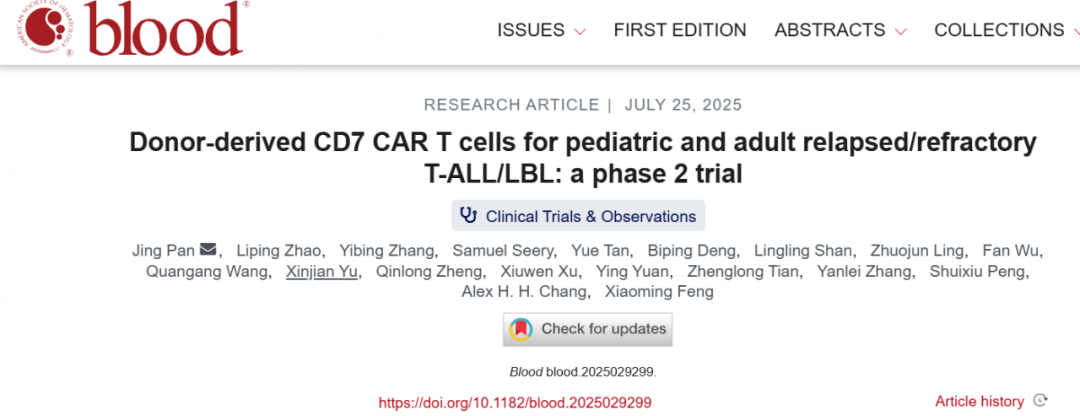
Recently, a phase II trial led by Prof. Jing Pan at Beijing GoBroad Hospital and investigating donor-derived CD7 CAR-T cells in children and adults with relapsed or refractory T-ALL/LBL was published online in Blood and attracted broad academic attention. The donor-derived CD7 CAR-T therapy developed in this study offers an innovative treatment solution for these patients. MedJ invited Prof. Pan to the “Researchers Speak” livestream to discuss the story behind the study.
Why Donor-Derived CD7 CAR-T Was Chosen as the Breakthrough Strategy
T-ALL/LBL remains trapped in a treatment impasse. Compared with B-lineage malignancies, T-lineage tumors have far fewer therapeutic options. Patients who relapse after first-line chemotherapy rarely achieve a second remission with additional chemotherapy or targeted therapy. Even patients who relapse after high-risk chemotherapy followed by allogeneic transplantation are, in practice, left with almost no effective treatment worldwide.
T-lineage tumors progress extremely rapidly and provide only a narrow treatment window. Because the malignancy arises from T cells, standard CAR-T approaches have difficulty distinguishing malignant T cells from normal T cells, which has severely restricted the development of cellular immunotherapy in this disease and made the need for new strategies especially urgent.
Against this background, Prof. Pan’s team chose to use CD7 CAR-T cells generated either from the patient’s previous transplant donor or from a newly HLA-matched donor. Prof. Pan explained that many patients who relapse with T-lineage disease no longer have enough normal T cells available for collection. Their peripheral blood may contain a high proportion of malignant cells, or after intensive or relapse-directed therapy they may simply have too few lymphocytes to support autologous CAR-T manufacture. Donor-derived CAR-T therefore solves the problem of limited cell source from the very start.
Compared with autologous CAR-T cells, donor-derived CD7 CAR-T cells have both advantages and challenges. On the positive side, cell source is not limited, the cells come from healthy donors and are therefore of higher quality, manufacturing is faster, and relapse risk may be relatively low as long as the tumor does not lose the CD7 target. On the negative side, these are allogeneic cells, so toxicity can be greater and clinical risk higher than with autologous CAR-T. At the same time, donor-derived CAR-T cells can continue attacking normal T cells after infusion, leading to prolonged immune dysfunction and slow recovery of blood counts.
Donor selection also matters. Prof. Pan said that for patients who have previously undergone transplantation, using cells from the original transplant donor is relatively easier. For patients without a transplant history, or for those who relapse after transplant but cannot access the original donor, a newly matched healthy donor must be chosen, and these situations carry the greatest risk. Treatment design must therefore be tailored carefully to each patient’s circumstances.
Behind the 89% Short-Term Remission Rate: Balancing Efficacy and Safety
In this phase II trial, 55 patients with relapsed or refractory T-ALL/LBL received donor-derived CD7 CAR-T cells. The short-term efficacy was striking: within 3 months, 89% of patients achieved a best overall response of partial remission or better, demonstrating the therapy’s potential to induce temporary disease control.
After a median follow-up of 26.3 months, median event-free survival reached 5.0 months and median overall survival reached 8.5 months, representing an improvement in long-term survival compared with previous treatment baselines.
Safety, however, remained a major challenge. The study showed that 38% of patients developed grade 1 to 2 graft-versus-host disease and 2% developed grade 3 graft-versus-host disease. Even more concerning, 20% of patients experienced non-relapse mortality more than 30 days after treatment, and 35% of those were responders who had not gone on to consolidative stem cell transplantation. These results underscore the central tension between efficacy and safety. Although CD7 CAR-T can effectively induce remission, delayed blood-count recovery and persistent long-term toxicities may become key barriers to long-term survival.
In response, Prof. Pan’s team has already launched multiple lines of optimization. For patients with bulky mediastinal disease, the group is considering combined radiotherapy to strengthen local control and improve remission quality. To avoid severe immune deficiency caused by residual CAR-T cells at the time of transplantation, a donor-switch strategy is also being explored. By using HLA mismatch, all cells derived from the donor who provided the CAR-T product can theoretically be cleared completely from the patient before transplantation. In addition, new clinical trials are evaluating knockout T cells as a way to improve immune competence during infection. These efforts directly address current unmet needs and point toward the next stage of development for CAR-T in T-ALL/LBL.
From the Laboratory to the Clinic: The Difficult Story Behind the Study
During the development of donor-derived CD7 CAR-T cells, Prof. Pan’s team made an important methodological discovery: control of tumor contamination can be handled as a quantifiable set of clinical parameters. By setting entry criteria such as peripheral blood tumor proportion below 20%, lymphocyte count above 1 x 10^9/L, and a drug washout interval longer than 2 weeks, and by carrying out dynamic monitoring at three key points during culture, the team was able to identify contamination risk precisely without complex cell sorting.
This strategy improved manufacturing safety. Donor-derived cells, taken from healthy individuals, avoid tumor contamination at the source, and the more stable function of healthy donor T cells also leads to a very low culture-failure rate, overcoming a major limitation of autologous CAR-T.
The team faced repeated challenges during the research. Prof. Pan described one 6-year-old child whose peripheral blood tumor burden met the entry criteria, but in whom the proportion of tumor cells rose abnormally during mid-culture. The team immediately stopped manufacturing and activated a backup plan, eventually repeating the culture successfully and achieving effective treatment. In the early clinical-trial period beginning in 2019, all enrolled patients were terminal cases with extremely poor baseline status after failure of standard therapy. Under intense pressure, the team had to break through technically while also managing unusual complications, including severe pneumonia triggered by BK virus viremia. Through accumulated data and repeated iteration, they gradually built a complete management system covering infection prevention, toxicity control, and clinical decision making.
The phase II study originally set objective response rate as the primary endpoint. During the trial, however, the team found that patients receiving CAR-T from a new donor often reached complete remission within one month and then needed to proceed immediately to bridging transplantation, making it impossible to observe a 3-month post-infusion complete-remission endpoint before transplant. The primary endpoint was therefore changed to best overall response at 3 months after infusion. Prof. Pan insisted on presenting these data honestly, even though the adjustment could complicate the publication process, because it more accurately reflected the real treatment pathway and clinical decision rhythm.
The Road Ahead
Many challenges still remain before donor-derived CD7 CAR-T can be widely implemented in clinical practice. Prof. Pan said that current CAR-T products for T-lineage malignancies are like a car with an accelerator but no brakes: they are not yet smart enough, and treatment still requires extensive experience and careful supportive strategies to manage complications and identify the right treatment window.
The team’s next work will focus on two directions. In basic science, they aim to develop a “smart car” CAR-T structure with both a braking system and an accelerator, so that the cells can remain strongly antitumor while also being controllable. In clinical research, they aim to optimize treatment pathways further to address viral infection, hematologic toxicity, and prolonged persistence of CAR-T cells after transplantation. Multicenter trials launched by the team are already underway at several hospitals to validate these new strategies. Prof. Pan hopes that recognition from more centers will ultimately translate into real benefit for more patients with T-ALL/LBL.

