


On June 15, Daiichi Sankyo announced that quizartinib (brand name: Vanflyta®) has been approved for marketing in China for the treatment of adult patients with newly diagnosed FLT3-ITD mutation-positive acute myeloid leukemia (AML).
Quizartinib is an oral, selective, second-generation inhibitor targeting FMS-like tyrosine kinase 3 (FLT3). It was first approved in Japan in June 2019 for the treatment of patients with relapsed or refractory FLT3-ITD mutation-positive AML. FLT3 is normally expressed by hematopoietic stem cells and plays a key role in cell growth, differentiation, and survival. Internal tandem duplication (ITD) is the most common FLT3 mutation in AML and is associated with poor prognosis, including increased relapse risk and shortened overall survival (OS).
Results from the Phase III Quantum-R Study (n=367),In adult patients with relapsed or refractory FLT3-ITD mutation-positive AML, with a median follow-up of 23.5 months, the median OS was 6.2 months for the quizartinib group vs. 4.7 months for the chemotherapy group (HR=0.76, P=0.02). Event-free survival (EFS) was 1.4 months vs. 0.9 months (HR=0.90, P=0.11).
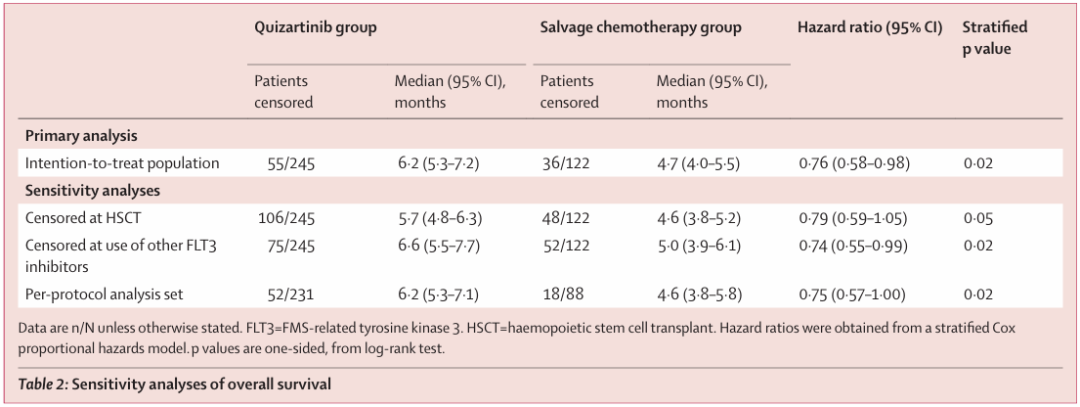
Safety: The most common non-hematologic Grade 3-5 treatment-emergent adverse events (TEAEs) in the quizartinib and chemotherapy groups were sepsis or septic shock (19% vs 19%), pneumonia (12% vs 9%), and hypokalemia (12% vs 9%). The most common treatment-related serious adverse events (TRSAEs) in the quizartinib group were febrile neutropenia (7%), sepsis or septic shock (5%), QT prolongation (2%), and nausea (2%). During treatment, 80 patients (33%) in the quizartinib group died, with 31 (13%) due to adverse events; 16 patients (17%) in the chemotherapy group died, with 9 (10%) due to adverse events.
Results from the Phase III QuANTUM-First Study (n=539),In adult patients with newly diagnosed FLT3-ITD mutation-positive AML, with a median follow-up of 39.2 months, the median OS was 31.9 months for the quizartinib group vs. 15.1 months for the placebo group (HR=0.78, P=0.032). Relapse-free survival (RFS) was 39.3 months vs. 13.6 months (HR=0.61).
Safety: The most common serious adverse events (SAEs) in the quizartinib and placebo groups were febrile neutropenia (11% vs 6%), pneumonia (6% vs 6%), septic shock (4% vs 3%), sepsis (4% vs 5%), pyrexia (3% vs 2%), and thrombocytopenia (1% vs 3%). The incidence of drug-related SAEs was 15% in the quizartinib group and 11% in the placebo group.
In 2022, there were approximately 82,000 new leukemia cases in China. AML is a common and aggressive subtype, accounting for about 50% of all leukemia cases. Up to 37% of newly diagnosed AML patients harbor FLT3 gene mutations, of which approximately 80% are FLT3-ITD mutations that drive tumor growth and lead to increased relapse risk and shortened overall survival. The five-year survival rate for FLT3-ITD mutation-positive AML patients is reported to be approximately 20%.

