


Introduction
The China Clinical Oncology Annual New Advances Symposium (BOC) and Best of CSCO 2026 China recently concluded in Hohhot, Inner Mongolia. At the MedJ Researcher Insights interview room, Prof. Nan Bi of the National Cancer Center / Cancer Hospital, Chinese Academy of Medical Sciences (CAMS) was invited to systematically review four core advances in small cell lung cancer (SCLC): radiotherapy-combination strategies, precision technology innovations, biomarker challenges, and molecular residual disease (MRD)-guided precision stratification. This article summarizes the highlights.
The Core Bottleneck: Drug Resistance and Combination Toxicity
Prof. Bi opened by identifying the most pressing challenges in current SCLC clinical practice.
She noted that the biggest bottleneck in SCLC treatment is disease progression after systemic therapy, which is the main reason for poor long-term outcomes. Compared with non-small cell lung cancer (NSCLC), SCLC is highly malignant, proliferates rapidly, and easily develops drug resistance. Most patients still progress after first-line standard systemic treatment, and durable survival benefit remains difficult to achieve.
At the same time, SCLC patients generally have a large tumor burden and extensive intrathoracic infiltration, which makes definitive radiotherapy highly challenging. Large-field irradiation significantly increases the risk of radiation-induced injury, particularly radiation pneumonitis and radiation esophagitis — the core treatment-related adverse events (TRAEs). With immunotherapy now fully integrated into the entire SCLC treatment continuum, the combination of radiotherapy and immunotherapy further compounds the risk of tissue damage and organ toxicity. Some patients are forced to discontinue treatment because they cannot tolerate these adverse events, directly affecting treatment completeness and clinical efficacy — a key issue that remains to be addressed in clinical practice.
Treatment Strategy Iteration: Concurrent Chemo-Immunoradiation Hits a Bottleneck, Precise Dose Reduction Becomes the Mainstream
To address the toxicity challenges of radiotherapy-immunotherapy combinations, Prof. Bi outlined the central direction of current SCLC radiotherapy strategy iteration. She noted that, for limited-stage SCLC (LS-SCLC), the immune-combined radiotherapy regimen has formed a clearly preferred pattern: currently approved PD-L1 inhibitor combinations with radiotherapy are associated with significantly lower overall toxicity than PD-1 inhibitor combinations, providing a foundation for safe combination therapy and driving the evolution of clinical radiotherapy concepts.
Compared with the traditional large-field prophylactic irradiation approach, current clinical practice has moved away from over-irradiation. Instead, it focuses on residual lesions and potential microscopic infiltrative disease for precise local intervention, ensuring antitumor efficacy while minimizing irradiation volume and normal-tissue damage.
On the much-debated “concurrent radiotherapy-immunotherapy” model, Prof. Bi drew a clear conclusion based on the TRIPLEX study presented at the 2026 American Society of Clinical Oncology (ASCO) Annual Meeting. The study, in extensive-stage SCLC (ES-SCLC), tested whether adding radiotherapy early and concurrently could enhance systemic therapy efficacy — and ultimately returned a negative result.
Prof. Bi summarized: based on multiple global clinical studies to date, concurrent radiotherapy and immunotherapy — except in nasopharyngeal carcinoma — have generally not yielded efficacy breakthroughs in most solid tumors, while toxicity has increased. Based on current evidence, concurrent use of radiotherapy and immunotherapy is not the preferred approach for NSCLC; sequential combination with precise timing of intervention remains the safer and more reliable clinical choice.
Technology Innovation: Precision Radiotherapy Substantially Reduces Toxicity and Enables Higher Doses
In recent years, the widespread adoption of precision radiotherapy has fundamentally changed the SCLC treatment landscape, achieving multiple breakthroughs in “toxicity reduction, dose escalation, efficacy improvement, and treatment acceleration.” Prof. Bi emphasized: “The continuous iteration of radiotherapy technology is the key lever for resolving the contradiction between efficacy and toxicity.”
The clinical application of multimodal image fusion (MMIF) has enabled tumor target delineation to evolve from “experience-based” to “precision-based,”clearly distinguishing tumor-involved regions from normal tissue and effectively avoiding unnecessary irradiation of sensitive organs such as the heart, lungs, and esophagus. Given the rapid tumor shrinkage characteristic of SCLC, adaptive radiotherapy can adjust the irradiation field and dose in real time according to dynamic tumor regression, continuously optimizing the treatment plan and substantially reducing the risk of radiation injury.
In this context, Prof. Bi’s team has innovatively developed hypofractionated radiotherapy combined with esophageal-sparing techniques based on intensity-modulated radiotherapy (IMRT). While preserving efficacy, this approach has significantly reduced the incidence of radiation esophagitis and radiation pneumonitis during concurrent chemoradiation, effectively addressing the high-incidence toxicity challenge. The esophageal-sparing advantage is particularly pronounced compared with the classic INT0096 (2D conventional radiotherapy) regimen. The reduction in toxicity has also created conditions for radiotherapy dose escalation and regimen optimization.
Hyperfractionated radiotherapy can now be safely delivered at 54-60 Gy, and conventional fractionation has been escalated from the traditional 45 Gy to 66-70 Gy, intensifying antitumor effect through dose escalation. Meanwhile, hypofractionated regimens effectively shorten the treatment course, improving treatment efficiency while substantially enhancing patient compliance and completion, further supporting overall treatment outcomes.
Original Research Breakthrough: ctDNA-MRD Dynamic Monitoring Precisely Identifies Beneficiaries of Immunotherapy Consolidation
Precision stratification is central to precision oncology, but SCLC has long lacked mature, clinically actionable biomarkers for radiotherapy stratification — its diagnostic and treatment framework lags far behind that of NSCLC. The previously proposed RACK four-tier classification and tumor mutational burden (TMB) candidates have each faced limitations, including high technical barriers, poor clinical stability, and inconsistent screening performance, and have not been able to guide individualized radiotherapy decisions.
To address this clinical gap, Prof. Bi’s team conducted the world’s first ctDNA-MRD dynamic study of post-chemoradiation immunotherapy consolidation in LS-SCLC, breaking through the diagnostic-and-treatment bottleneck. Concurrent chemoradiation is the standard of care, but only 20%-30% of patients achieve clinical cure, while the majority are at risk of recurrence and metastasis.
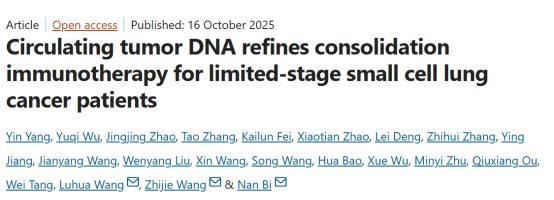
Fig. 1. Study Screenshot
The study confirmed that the dynamic clearance status of ctDNA-MRD is the core indicator for prognosis assessment and for guiding immunotherapy consolidation. Patients who achieve ctDNA clearance and MRD-negative status after chemoradiation have favorable prognosis and do not require additional immunotherapy; in contrast, high-risk patients with persistently positive indicators can derive significant benefit from immunotherapy consolidation. Prof. Bi noted: this finding resolves the challenge of precise patient selection, avoids ineffective and excessive treatment, and — once validated in larger samples — ctDNA-MRD is expected to become a core stratification tool, driving an upgrade of the diagnostic and treatment system.
Summary
From the innovation of precision radiotherapy to the breakthrough of the ctDNA-MRD stratification strategy, Prof. Bi’s report is not only a highlight of CSCO BOC 2026, but also points SCLC toward a practical path of “efficacy enhancement and toxicity reduction.” True to the spirit of “annual new advances” advocated by the meeting, these original data from the Chinese population are accelerating the rewriting of clinical practice.
About the Expert — Prof. Nan Bi

Chief physician, doctoral supervisor
Deputy Director, Department of Radiation Oncology, and Director, Thoracic Radiation Oncology Group, National Cancer Center / Cancer Hospital, Chinese Academy of Medical Sciences (CAMS)
Principal Investigator, State Key Laboratory of Molecular Oncology
Visiting scholar, Department of Radiation Oncology, University of Michigan, United States
Council member, Chinese Society of Clinical Oncology (CSCO); Vice Chair, SCLC Committee; Standing Committee member, NSCLC Committee; member, Radiation Oncology Committee
Youth Group Vice Chair, Radiation Oncology Branch, Chinese Medical Association; Radiation Therapy Committee, China Anti-Cancer Association
Committee member, Lung Cancer Committee and Radiation Oncology Committee, China Anti-Cancer Association
Review expert, National Health Commission (NHC) Standardized Diagnosis and Treatment Guidelines for Primary Lung Cancer (2022 Edition)
Drafting expert, CSCO Guidelines for Small Cell Lung Cancer
Awards: International Association for the Study of Lung Cancer (IASLC) “Developing Nation Award”; National Science and Technology Progress Award (Second Class); three Provincial/Ministerial Science and Technology Progress Awards (Second Class); Beijing Excellent Physician; National Renowned Physician
First/corresponding-author publications in Lancet Oncol, J Clin Oncol, Ann Oncol, Mol Cancer (2), Clin Cancer Res (2), Cancer Res, Int J Radiat Oncol Biol Phys (3, top specialty journal), and Radiother Oncol (7, top specialty journal); selected for the American Society for Radiation Oncology (ASTRO) Continuing Medical Education (CME) course, C100, and ESI Highly Cited Papers

