


Traditional treatment for nasopharyngeal carcinoma is based on baseline tumor characteristics and follows a fixed regimen, but it overlooks dynamic differences in how tumors respond during therapy. Low-risk patients may be overtreated and exposed to unnecessary toxicity, while high-risk patients may receive insufficient intensity and remain at high risk for progression and relapse. How to achieve individualized and precise treatment for nasopharyngeal carcinoma has therefore become a key unsolved question in clinical care.
On March 12, the EP-STAR study led by Prof. Ying Sun and Dr. Jiawei Lu from Sun Yat-sen University Cancer Center was published online in Nature. The study provided the first systematic validation of risk-adaptive therapy (RAT) guided by dynamic ctDNA monitoring during treatment for locoregionally advanced nasopharyngeal carcinoma. This work represents a major advance in precision treatment for nasopharyngeal carcinoma and offers a new paradigm for dynamic individualized therapy in oncology more broadly. MedJ invited the two experts to the “Researchers Speak” column to discuss the clinical background, study design, core data, and future implications of this landmark research.
The Clinical Dilemma: Why a Fixed Script No Longer Fits Every Patient
Over the past 15 years, the “induction chemotherapy plus concurrent chemoradiotherapy” regimen established by Sun Yat-sen University Cancer Center became the standard treatment model for nasopharyngeal carcinoma and was listed as category 1 evidence by both NCCN and CSCO guidelines. Yet one core problem has persisted in clinical practice: even when given the same standard treatment, patients can have strikingly different responses and outcomes.
Prof. Ying Sun pointed out that current guideline-recommended treatment remains, in essence, a fixed script based on baseline characteristics. In real-world practice, however, the tumor’s response to treatment is dynamic, and treatment decisions should also adapt in real time. Some low-risk patients achieve excellent remission after induction chemotherapy but still must undergo the full intensified course, thereby bearing unnecessary physical burden. Some high-risk patients respond poorly to induction chemotherapy, continue to face a high risk of recurrence, and yet do not receive timely escalation. How to adjust treatment “up or down” according to real-time tumor response has therefore been a major gap in nasopharyngeal carcinoma research and guideline development.
Choosing the Right Biomarker: cfEBV DNA as a Real-Time Gold Standard
Dynamic treatment adjustment requires an “eye” that can reflect tumor status accurately and in real time. Dr. Jiawei Lu explained that the team selected Epstein-Barr virus DNA, or cfEBV DNA, as the ctDNA target because of the unique biology of nasopharyngeal carcinoma.
More than 90% of nasopharyngeal carcinomas in South China are associated with EBV infection, providing what Dr. Lu called a natural signal amplifier. Each nasopharyngeal carcinoma cell contains about 50 EBV genomes, and each genome offers 10 to 20 detection targets, effectively amplifying the ctDNA signal by 500 to 1,000 times. When tumor cells die and release viral DNA fragments, they send out an enlarged signal flare that helps clinicians track changes in the risk of recurrence and metastasis with high sensitivity.
Through more than a decade of serial research, the team has shown that the clearance kinetics of cfEBV DNA during treatment are earlier and more accurate prognostic markers than conventional imaging. The faster the cfEBV DNA clears, the better the prognosis. Delayed clearance or persistent positivity predicts a very high risk of recurrence. This conclusion laid a solid scientific foundation for risk-adaptive treatment.
Treat, Watch, and Adjust: A Precisely Layered Risk-Stratification Experiment
EP-STAR was a multicenter, ctDNA-driven, risk-adaptive, nonrandomized phase II trial (NCT04072107). The study enrolled 172 patients with locoregionally advanced nasopharyngeal carcinoma between June 2020 and December 2021, and 142 were ultimately included in the analysis. All patients received three cycles of GP induction chemotherapy, and longitudinal cfEBV DNA monitoring was performed throughout treatment.
Based on the dynamic ctDNA clearance trajectory model established in the earlier EP-SEASON study, patients were precisely stratified into three risk groups and assigned different treatments. In the low-risk group, cfEBV DNA cleared after the first induction cycle and remained negative; these patients received standard concurrent chemoradiotherapy alone followed by observation to avoid overtreatment. In the intermediate-risk group, cfEBV DNA cleared only after the second or third induction cycle; these patients received six months of metronomic capecitabine after concurrent chemoradiotherapy to strengthen control of minimal residual disease. In the high-risk group, cfEBV DNA remained detectable after the third induction cycle, indicating poor sensitivity to chemotherapy and a high risk of relapse and metastasis; these patients received sintilimab concurrently with chemoradiotherapy and then as maintenance for 12 cycles to help reverse treatment resistance.
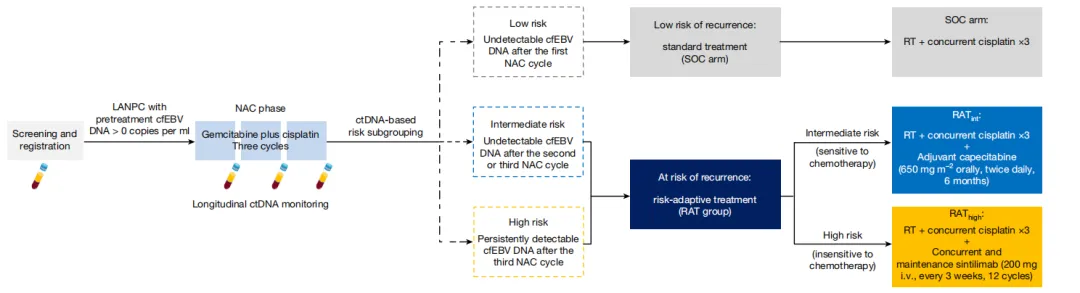
The primary endpoint was failure-free survival, while overall survival, distant metastasis-free survival, locoregional relapse-free survival, safety, quality of life, and cost-effectiveness were secondary endpoints. Median follow-up reached 47.3 months, ensuring robust and stable results.
A Triple Win in Efficacy, Safety, and Cost
After a median follow-up of 47.3 months, EP-STAR delivered highly encouraging results. For the intermediate- and high-risk patients who received RAT, the 3-year failure-free survival rate was 89.1%, including 91.4% in the intermediate-risk group and 86.5% in the high-risk group. Compared with an external cohort of intermediate- and high-risk patients who did not receive RAT, the risk of disease progression or death was reduced by 59% (HR = 0.41). Two-year failure-free survival improved from 81.2% to 92.7%, and 3-year failure-free survival improved from 74.4% to 89.1%. Significant advantages were also seen in distant metastasis-free survival, 93.5% versus about 70% in the untreated group, and in locoregional relapse-free survival, 94.4% versus about 80%.
At the same time, the low-risk group achieved a 3-year failure-free survival rate above 90% with standard treatment alone, further confirming the value of the risk-stratification approach and showing that these patients did not require extra treatment intensification.

