


The 2026 American Society of Clinical Oncology (ASCO) Annual Meeting is currently underway in Chicago. On May 29 local time, at the Gynecologic Oncology session, Prof. Xiaohua Wu from Fudan University Shanghai Cancer Center presented the highly anticipated phase 3 CHIPRO study results, for the first time demonstrating the significant efficacy of the oral multi‑target kinase inhibitor chiauranib in combination with weekly paclitaxel in patients with platinum‑resistant or platinum‑refractory ovarian cancer.
MedJ has compiled the core study data and invited Prof. Wu to provide an in‑depth interpretation, offering new insights for the clinical management of platinum‑resistant ovarian cancer.
CHIPRO Study First to Include Platinum-Refractory Patients, Real-World Data Presented at ASCO
Chiauranib is an oral novel small‑molecule multi‑target kinase inhibitor that inhibits Aurora B, VEGFR1/2, PDGFRα/β, and CSF‑1R, simultaneously acting on tumor cell proliferation, angiogenesis, and the immunosuppressive tumor microenvironment, with a unique triple mechanism of action.
The CHIPRO study is a randomized, double‑blind, placebo‑controlled, multi‑center phase 3 clinical trial designed to evaluate the efficacy and safety of chiauranib plus weekly paclitaxel in patients with platinum‑resistant or platinum‑refractory ovarian cancer. A total of 459 patients were enrolled and randomized 1:1 to receive either chiauranib plus weekly paclitaxel (CP arm) or placebo plus weekly paclitaxel (PP arm). Patients received up to 6 cycles of combination therapy, after which those without disease progression entered maintenance therapy with chiauranib or placebo. The primary endpoints were progression‑free survival (PFS) assessed by blinded independent central review (BICR) per RECIST v1.1 and overall survival (OS).
Efficacy Analysis
As of the data cutoff (July 29, 2025), the median follow‑up duration was 16.0 months (95% CI, 14.3–17.7). The results showed:
1. Primary endpoint PFS:
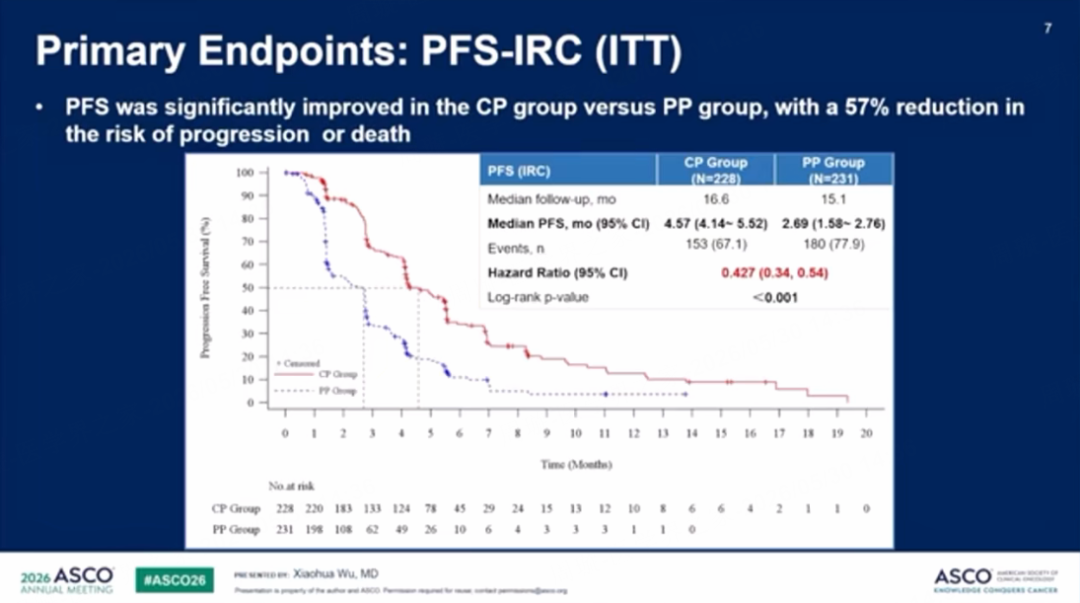
The median PFS in the CP arm was 4.57 months (95% CI, 4.14–5.52), significantly superior to the 2.69 months (95% CI, 1.58–2.76) in the PP arm, with a hazard ratio (HR) of 0.427 (95% CI, 0.34–0.54, P<0.001), representing a 57% reduction in the risk of disease progression. The PFS benefit was consistently observed regardless of prior anti‑angiogenic therapy.
2. Primary endpoint OS:
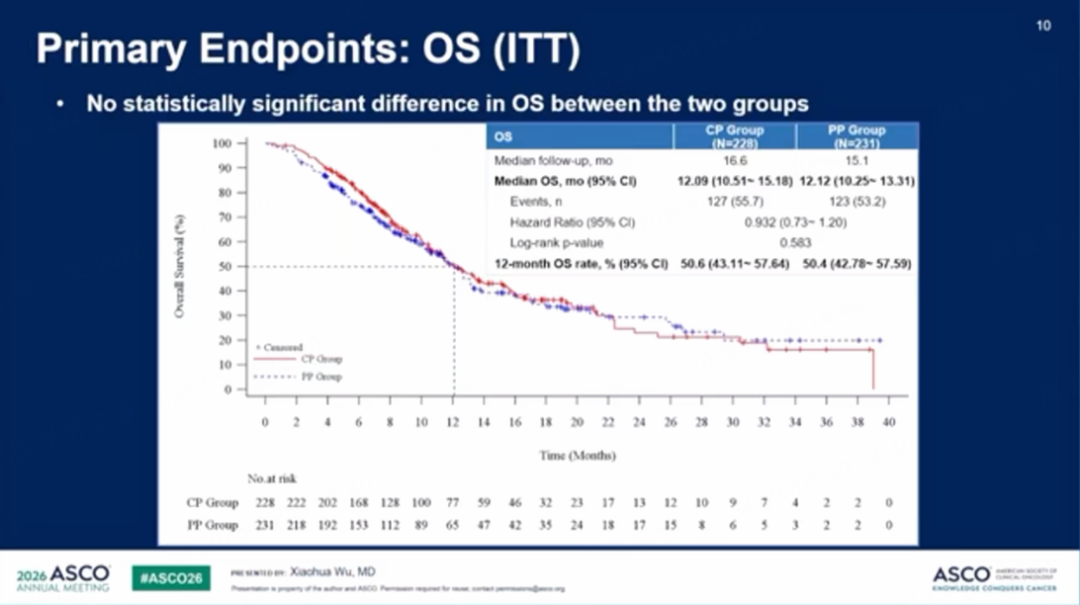
The median OS was 12.09 months (95% CI, 10.51–15.18) in the CP arm and 12.12 months (95% CI, 10.25–13.31) in the PP arm, with an HR of 0.932 (95% CI, 0.73–1.20, P=0.583). However, a significant OS benefit was observed in patients who did not receive subsequent anti‑tumor therapy (HR=0.599, 95% CI, 0.39–0.91, P=0.016). Additionally, favorable OS trends were also observed in patients who had received prior PARP inhibitor therapy and those who subsequently received platinum‑based chemotherapy.
Safety Analysis
The most common grade ≥3 treatment‑related adverse events in the CP arm were leukopenia, neutropenia, and anemia. The safety profile was consistent with prior studies, with no new safety signals identified. Notably, no patient discontinued treatment due to hypertension or proteinuria, suggesting that adverse events can be effectively managed with dose adjustments and supportive care.
In response to this landmark study, MedJ invited Prof. Xiaohua Wu at the ASCO meeting to provide further in‑depth interpretation.
Prof. Xiaohua Wu Interprets the First Success of an Aurora B Inhibitor in Ovarian Cancer
MedJ: Given the growing number of treatment options for platinum‑resistant ovarian cancer, what are the most prominent advantages of the chiauranib plus weekly paclitaxel regimen? Where do you see it fitting into the treatment sequence for platinum‑resistant ovarian cancer?
Prof. Xiaohua Wu, Fudan University Shanghai Cancer Center: Although new advances such as ADCs and immunotherapy have emerged in the platinum‑resistant setting, the chiauranib plus weekly paclitaxel regimen still offers unique advantages.
First, chiauranib is an oral agent with a novel mechanism of action: it primarily targets Aurora B while also modulating the immune microenvironment and angiogenesis, distinguishing it from conventional TKIs. The CHIPRO study is the first to validate the feasibility of this pathway. Second, this study enrolled patients with platinum‑refractory disease (progression within 4 weeks after 6 cycles of chemotherapy) — a population often excluded from large phase 3 trials, yet not uncommon in real‑world practice. In this trial, platinum‑refractory patients accounted for 12% of the treatment arm and 7.8% of the control arm, making this the first phase 3 study to specifically include this difficult‑to‑treat population. Third, the study enrolled patients across a wide range of prior lines of therapy, closely reflecting real‑world clinical practice.
Thus, the core advantages of this regimen can be summarized as: oral convenience, mechanistic novelty, and coverage of real‑world refractory populations.
MedJ: What are your clinical recommendations for dose modification and toxicity management of the chiauranib plus weekly paclitaxel regimen? Beyond the grade ≥3 adverse events mentioned in your presentation, what lower‑grade but persistent adverse events should clinicians pay particular attention to?
Prof. Wu: When chiauranib is combined with weekly paclitaxel, the side effects are additive, primarily manifesting as hematologic toxicities, including leukopenia, neutropenia, and anemia; thrombocytopenia is relatively less common. Additionally, because chiauranib has both Aurora B inhibitory and anti‑angiogenic effects, clinicians should monitor for hypertension and proteinuria.
In the CHIPRO study, although the incidence of hypertension and proteinuria was higher in the combination arm than in the control arm, no patient discontinued treatment due to these events — an encouraging finding. That said, dose adjustments or temporary interruptions were common. However, these adverse events were fully reversible with dose adjustments and supportive care. When this regimen enters routine clinical practice, special attention should still be paid to hypertension and proteinuria beyond the hematologic toxicities.
MedJ: The chiauranib plus weekly paclitaxel regimen has been granted Breakthrough Therapy designation by China's National Medical Products Administration (NMPA). Will the phase 3 data presented accelerate the approval process? And what impact would future approval have on the treatment of advanced ovarian cancer?
Prof. Wu: The treatment of platinum‑resistant/platinum‑refractory ovarian cancer is an extremely challenging and intensely competitive area of clinical research. Currently, Elahere (mirvetuximab soravtansine) has been approved both in the US and China, along with agents targeting FRα, NaPi2b, and other targets. Chiauranib, as an Aurora B inhibitor, is a small‑molecule agent with a completely novel mechanism — no positive results for this mechanism have been reported globally to date.
As the study's principal investigator, like everyone else I am most concerned about whether this regimen will receive regulatory approval, enabling patients in China and around the world to benefit from this new‑mechanism targeted therapy. The CDE currently requires both PFS and OS evidence for platinum‑resistant disease. We are analyzing subgroup evidence for OS benefit. This study was prespecified with dual endpoints of PFS and OS; the positive PFS result already declares the study a success. From a statistical perspective, this is a positive study.
We hope that Chinese regulatory authorities will grant accelerated approval through a fast‑track pathway. In the future, for patients who have received 3‑5 prior lines of therapy, especially refractory patients who relapse within 4 weeks, this will provide a completely new treatment option.
MedJ: Based on the results of this study, what are the next steps for chiauranib in ovarian cancer? How do you see its prospects for global development?
Prof. Wu: First and foremost, the most critical step is whether we can obtain NMPA approval. We are analyzing whether certain subgroups — such as patients who received no subsequent therapy, or those who had prior PARP inhibitors or anti‑angiogenic agents — show a favorable OS trend.
Second, Aurora B inhibition is an extremely innovative mechanism, and no other drug of its kind has succeeded globally. If approved, chiauranib will become the world's first therapy with this mechanism for ovarian cancer. As a multi‑target, novel‑mechanism drug, it could also be explored in other refractory tumors. Clinical trials of chiauranib are already underway in solid tumors such as pancreatic cancer.
Although this study enrolled only Chinese patients, the data clearly demonstrate a significant improvement in PFS, particularly in clinically refractory patients. If approved, we may further explore its use in adjuvant or earlier‑line settings.

