


On June 18, The Lancet Neurology (impact factor: 54.6) published a clinical research achievement in traumatic brain injury surgery from China.
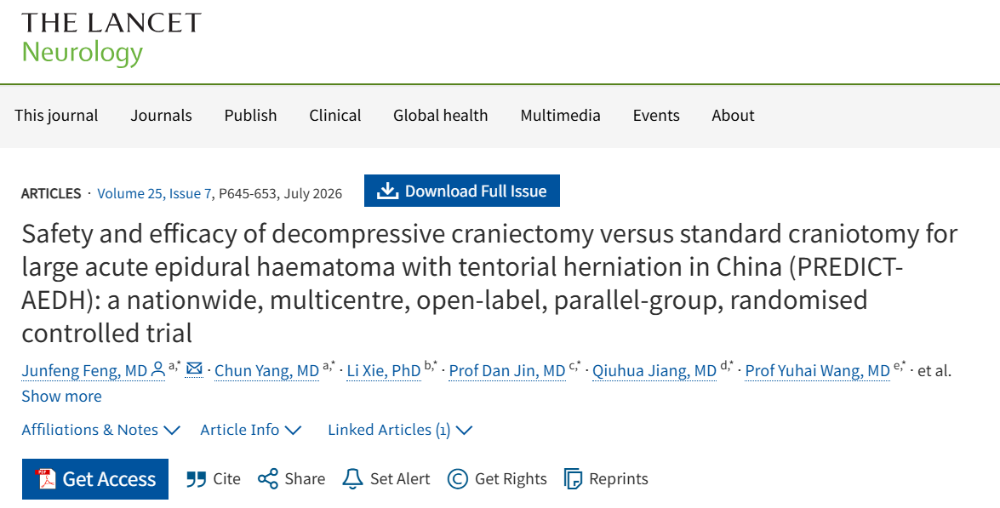
The article, titled “Safety and efficacy of decompressive craniectomy versus standard craniotomy for large acute epidural haematoma with tentorial herniation in China (PREDICT-AEDH): a nationwide, multicentre, open-label, parallel-group, randomised controlled trial,” was led by Prof. Jiyao Jiang, MD, Honorary Chief Expert of the Department of Neurosurgery at Renji Hospital, Shanghai Jiao Tong University School of Medicine, and Director of Shanghai Institute of Traumatic Brain Injury, with participation from 28 hospitals nationwide. It is the world's first multicenter randomized controlled trial (PREDICT-AEDH) on decompressive craniectomy for acute large epidural hematoma with tentorial herniation.
This study used high-level evidence-based medical evidence to overturn the empirically-based surgical strategy that had been used clinically for many years, clearly demonstrating that such patients do not require routine prophylactic decompressive craniectomy, rewriting global neurosurgical thinking for traumatic brain injury.

Fig. Jiyao Jiang, Professor, and Junfeng Feng, Director, Department of Neurosurgery, Renji Hospital. Source: Renji Hospital
A Long-Unresolved Clinical Dilemma
Dr. Junfeng Feng, MD, first author and co-corresponding author, Director of the Department of Neurosurgery at Renji Hospital, explained that in emergency craniotomy for traumatic brain injury, decompressive craniectomy is widely used in patients with malignant intracranial hypertension that cannot be controlled by non-surgical treatment. Foreign scholars have conducted evidence-based medical studies on the efficacy and safety of decompressive craniectomy for acute subdural hematoma and intracerebral hematoma, and the results have been incorporated into the latest edition of the Guidelines for the Management of Severe Traumatic Brain Injury.
However, for patients with acute large epidural hematoma and tentorial herniation, whether decompressive craniectomy or simultaneous bone flap replacement should be chosen, there is currently a lack of high-level evidence-based medical research evidence in both academia and clinical practice.
Acute large epidural hematoma causing tentorial herniation with pupillary dilation can trigger severe brain compression and cerebral ischemia. After hematoma evacuation, secondary cerebral infarction and edema are prone to occur, leading to recurrent intracranial hypertension and even herniation. In such cases, physicians often need a "second operation" to perform decompressive craniectomy again.
To avoid such risks, neurosurgeons at home and abroad have long relied on clinical experience to routinely perform decompressive craniectomy after hematoma evacuation.
But is this practice really necessary? This study attempted to answer this question by evaluating the impact of decompressive craniectomy versus simultaneous bone flap replacement on neurological functional outcomes and safety indicators in such patients.
6-Year Study: No Need for “Prophylactic” Decompressive Craniectomy
In 2020, Prof. Jiyao Jiang, Dr. Junfeng Feng, and Dr. Xianjian Huang, Chief Physician of the Department of Neurosurgery at Shenzhen Second People's Hospital, launched a multicenter randomized controlled study in Shenzhen, with participation from 28 hospitals nationwide and the Clinical Research Institute of Shanghai Jiao Tong University School of Medicine.
After six years of clinical research, the results reached a conclusion contrary to empirical judgment: decompressive craniectomy not only failed to reduce the mortality and disability rate in patients with acute large epidural hematoma and tentorial herniation, but also significantly increased the incidence of postoperative intracranial re-bleeding.
During the study period, 142 patients meeting initial screening criteria were screened, and ultimately 120 were enrolled and randomly assigned: 58 to the decompressive craniectomy group and 62 to the standard craniotomy group.
Six-month postoperative follow-up results showed: in the decompressive craniectomy group, 46 of 58 patients (79%) achieved favorable neurological outcomes (GOSE score ≥5); in the standard craniotomy group, 52 of 62 patients (84%) had favorable outcomes.
There was no statistically significant difference in GOSE scores between the two groups, and 30-day mortality and postoperative cerebral infarction incidence were also similar.
However, the incidence of delayed intracranial hemorrhage after decompressive craniectomy was significantly higher: 21 cases (36%) in the decompressive craniectomy group versus only 8 cases (13%) in the standard craniotomy group.
This completely changed traditional clinical thinking and surgical approaches: patients with acute large epidural hematoma and tentorial herniation do not require routine prophylactic simultaneous decompressive craniectomy.
Moreover, avoiding decompressive craniectomy also eliminates the need for secondary cranioplasty and its related complications, reducing patients' psychological stress and financial burden from repeated surgery.
The research team stated that this will change the surgical approach for patients with acute large epidural hematoma and tentorial herniation worldwide, providing high-level evidence-based medical evidence from China for global standardized traumatic brain injury surgery.

