


On November 16, 2026, the Center for Drug Evaluation (CDE) of China’s National Medical Products Administration accepted the new drug application (NDA) of IxCell hUC-MSC-O injection, a human umbilical cord mesenchymal stem cell (hUC-MSC) product developed by Shanghai IxCell Biotechnology Co., Ltd., for the treatment of knee osteoarthritis. The application, filed under registration number CXSS2600189, is classified as a therapeutic biological product class 1 and is now under review.
Acceptance means the submission has entered the review process; it is not an approval. If cleared, the product would become, on publicly available information, the second stem cell therapy approved for marketing in China, and the first mesenchymal stromal cell product filed under a standard drug pathway for knee osteoarthritis, a large population with degenerative joint disease.
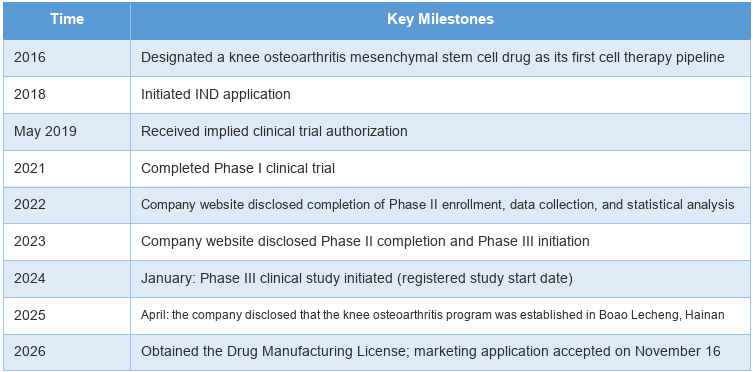
According to public information, the phase 3 study of this product has been completed. The sponsor previously obtained a drug manufacturing license and has conducted clinical translational application of the product in the Hainan Boao Lecheng International Medical Tourism Pilot Zone, where a separate local policy framework applies. Enrolment, completion of dosing, completion of 48-week follow-up and data analysis are distinct study milestones, and the Lecheng application cannot be read as national market access.
Article Key Points
• CDE accepted the NDA for IxCell hUC-MSC-O on November 16, 2026, for knee osteoarthritis
• Phase 3 trial: 398 planned, single 50-million-cell intra-articular injection, 48-week endpoints
• No peer-reviewed phase 3 results are public; the registry still shows the study as recruiting
• Approval would make this China’s second stem cell drug and the first for a degenerative joint disease
• Manufacturing scale, cold chain, cost and payment remain unresolved commercialization barriers
Why Stem Cell Therapy Keeps Drawing Attention but Has Struggled to Commercialize
Stem cells attract attention because of their self-renewal capacity, multipotent differentiation potential and possible roles in tissue repair and immune regulation.
Mesenchymal stromal cells (MSCs) are among the most extensively studied cell types, with sources including bone marrow, adipose tissue and umbilical cord. Umbilical cord tissue is comparatively convenient to harvest and has become an important direction for cell drug development.
The specific mechanisms by which MSCs act in knee osteoarthritis are not yet fully elucidated. Current research suggests that they may participate in tissue repair through differentiation into chondrocytes and through secretion of extracellular vesicles, and may also improve the local joint microenvironment through immunomodulation and paracrine effects, thereby relieving pain and improving joint function.
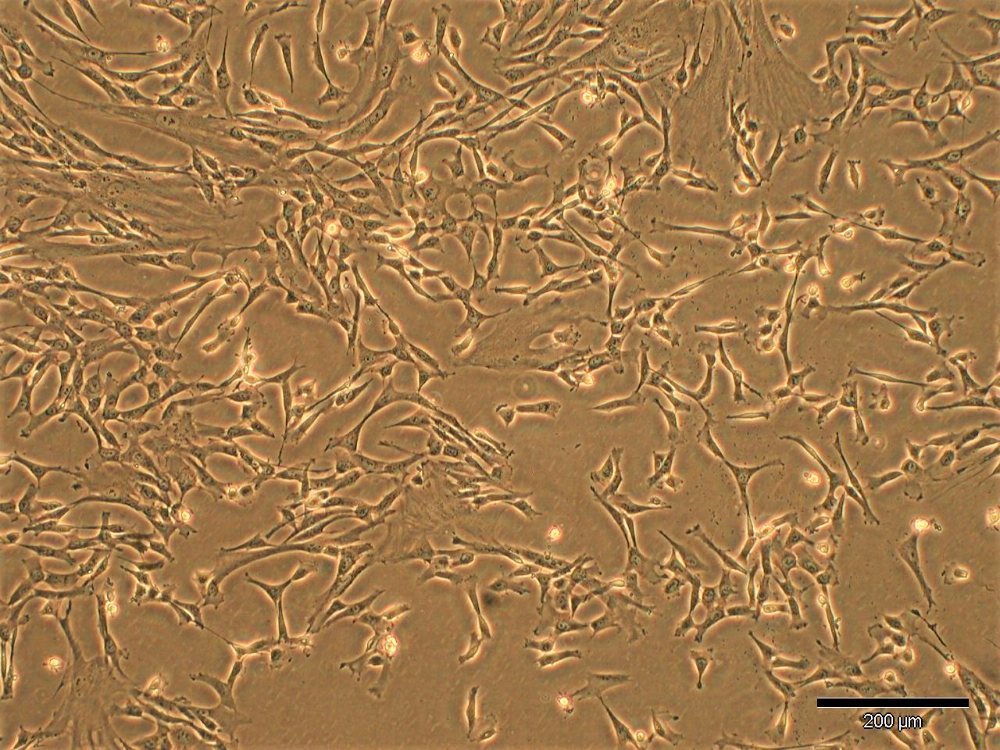
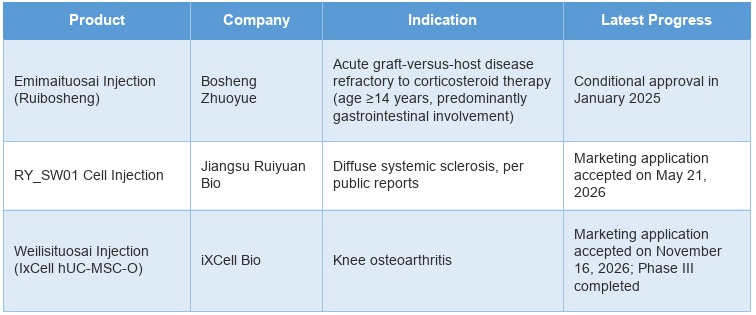 Fig. 1. Microscopy of cultured human umbilical cord-derived mesenchymal stromal cells
Image source: Hannover Medical School (MHH)
Three obstacles stand between the laboratory and a licensed product.
The first is standardization. Donor health status, cell isolation method, culture medium composition, passage number, and cryopreservation and thawing conditions can all affect cell quality, so batches from the same tissue may differ. Second, quality testing cannot rest on cell number and viability alone: whether the cells retain the expected immunomodulatory capacity, and whether biological potency is consistent across batches, both require reliable assays.
Third, clinical evidence is limited. Some studies remain at the animal or early clinical stage, and differences in cell source, manufacturing process, dose and outcome measures make results difficult to compare directly.
The 2015 Administrative Measures for Stem Cell Clinical Research (Trial) established a filing system for institutions and projects, specified that institutions may not charge participants for stem cell clinical research, and stated that research cannot move directly into clinical application once completed; stem cell clinical trials filed as drugs follow the drug registration pathway.
The Regulations on Clinical Research and Clinical Translational Application of Biomedical New Technologies (State Council Order No. 818), published on September 28, 2025, take effect on May 1, 2026. The regulations require clinical research institutions to be tertiary Class A medical institutions, prohibit charging participants during the research phase, and require approval from the National Health Commission for clinical translational application after research completion. Clinical trials conducted to develop drugs or medical devices continue to follow drug and medical device regulations.
Supporting approval rules published in 2026 further require that a technology applying for clinical translational application must already be included in the filing guidance catalogue and meet conditions such as a high degree of individualization or treatment of a rare disease. The boundary between hospital-based research on new technologies and drug registration is now clearer, and whether evidence generated in filed research can be used in device or drug registration is still determined under device and drug registration rules. For the stem cell industry, the space that previously blurred research, clinical application and commercial launch has been compressed, and the compliant route is more explicit.
How the Product Was Developed
IxCell hUC-MSC-O injection is a human umbilical cord mesenchymal stromal cell product given by intra-articular injection into the knee joint. Development had to address cell sourcing, scale-up manufacturing and quality control.
Umbilical cord tissue contains MSCs that can be isolated by tissue dissociation. Harvesting from the cord is relatively convenient, but donor health screening, transmissible pathogen testing, and control of tissue collection and transport conditions are still required.
Standard MSC drug manufacturing proceeds through cell isolation, screening, culture expansion, master and working cell bank establishment, harvest, formulation, cryopreservation and quality testing. Culture conditions, culture duration and passage number all require strict control. Cell sources, culture systems and quality control strategies differ across products, and the sponsor has not published all process parameters for this product, so the sequence above describes the production stage in general terms.
Quality control typically covers cell identity, purity, viability, sterility, mycoplasma, endotoxin, genetic stability and biological potency. For knee osteoarthritis in particular, the immunomodulatory capacity and related biological activity of the cells are the focus.
According to the phase 3 registration on ClinicalTrials.gov, IxCell hUC-MSC-O is given as a single intra-articular injection at a dose of 50 million cells in a volume of 2 mL, with saline as the comparator.
Company disclosures state that the sponsor operates a 4,000 square meter cell drug industrialization base in Shanghai, with platforms for scale-up cell drug manufacturing, quality research and clinical translation, three cell drug pipeline areas built around MSC, induced pluripotent stem cell (iPSC) and immune cell platforms, and more than 40 granted patents. These disclosures describe the manufacturing and development layout of the company; stable commercial supply still has to be demonstrated by actual production records and sustained batch-to-batch consistency.
Company materials also state that production uses automated closed tubing to reduce manual handling and contamination risk.
In 2026 the sponsor obtained a Drug Manufacturing License, number Hu 20260315. Public licensing information shows that the production scope covers therapeutic biological products and IxCell hUC-MSC-O injection, marked for registration use only. Whether the product can be sold nationwide remains a matter for drug registration review.
Does Completing Phase 3 Mean Stem Cells Can Repair Cartilage
This is the central scientific question for IxCell hUC-MSC-O. Knee osteoarthritis involves cartilage degeneration, subchondral bone change and synovial inflammation, and patients present with pain, stiffness and restricted movement. Current treatment includes rehabilitation, medication, intra-articular injections and surgery, with the main aims of relieving symptoms and improving function. There is still no established drug that clearly achieves cartilage regeneration.
MSCs offer a new direction for this field: they may improve the joint microenvironment through immunomodulation and paracrine activity, acting on chondrocytes and the extracellular matrix.
Three dimensions matter in evaluating this class of drug. First, whether symptoms improve. VAS mainly scores pain intensity, WOMAC covers pain, stiffness and physical function, and KOOS extends to daily activity and sports. These measures reflect what patients actually experience.
Second, whether joint structure changes. Less pain and better mobility cannot by themselves demonstrate cartilage repair. MRI can show changes in cartilage thickness, defect area and subchondral bone. Only when clinical improvement and imaging change reinforce each other is the case stronger for disease-modifying potential.
Third, whether the effect is sustained and whether long-term safety holds. Studies must also address injection-site pain, joint swelling, infection and abnormal immune responses, and must include longer follow-up.
According to the ClinicalTrials.gov record, the phase 3 study of IxCell hUC-MSC-O (NCT06716281) is a randomized, parallel-group, placebo-controlled, quadruple-masked multicenter trial with a planned enrolment of 398 participants. Participants receive a single intra-articular injection, with 50 million cells in 2 mL in the treatment arm and saline in the control arm. The primary endpoints are the change in WOMAC total score and the change in cartilage damage area at 48 weeks.
The protocol requires participants aged 40 to 80 years, with Kellgren-Lawrence grade II to III in the index knee, pain persisting for more than half a year or recurring or worsening after conventional treatment, and excludes conditions such as secondary knee osteoarthritis. These entry criteria determine the patient group to which the results will apply first.
When checked on November 23, 2026, the registry page had last been updated on December 6, 2024, still showed a status of recruiting, listed an estimated primary completion date and study completion date of December 31, 2025, and posted no results. This registry status does not reflect the subsequent filing progress, so enrolment, completion of 48-week follow-up, data analysis and acceptance of the marketing application should be stated separately.
As of November 23, 2026, no complete and verifiable phase 3 results report could be retrieved. What can be verified at this stage is the trial design, the study population and the acceptance of the marketing application. The magnitude of pain and function improvement, the change in cartilage damage area, the incidence of adverse events and the differences between groups still require the formal study report or paper.
A systematic review published in Stem Cells International in 2022 included 28 randomized controlled trials of MSCs for osteoarthritis, with 1,494 participants. It found that MSCs may reduce WOMAC pain and VAS at three months (WOMAC pain mean difference -3.81, 95% CI -6.95 to -0.68; VAS -1.11, -1.53 to -0.68), with the effect lasting at least 12 months (WOMAC pain -4.29, -7.12 to -1.47; VAS -1.77, -2.43 to -1.12), and may reduce WOMAC stiffness and physical function at six months (stiffness -1.12, -2.09 to -0.14; physical function -4.40, -6.84 to -1.96), also sustained to at least 12 months. Differences in adverse events between MSC injection and control were not statistically significant (risk ratio 1.20, 95% CI 0.97 to 1.48, P=0.09). The review authors rated the overall quality of the evidence and of the included trials as generally low and cautioned against generalization. IxCell hUC-MSC-O therefore still needs its own randomized controlled trial to confirm efficacy, and the cartilage damage area endpoint in particular requires interpretation alongside imaging methodology, follow-up duration and between-group differences.
For a chronic disease such as knee osteoarthritis, whether symptom relief persists, whether cartilage structure changes, and whether repeat injection is needed will all determine where the product sits in clinical use. Only once phase 3 data are available can clinicians, patients and payers make more specific judgements.
The Real Barriers Between the Lab and the Hospital
Completion of phase 3, issuance of the manufacturing license and acceptance of the NDA mark several important milestones for the sponsor. Four barriers to commercialization remain.
First, batch-to-batch consistency. Every batch must meet requirements for cell identity, purity, viability and biological potency, so master cell banks, process control, batch release and full traceability are indispensable. The theoretical expansion multiples and planned capacity of a laboratory demonstrate technical feasibility and construction targets; commercial supply depends instead on actual qualified batches, batch release rates and sustained inter-batch consistency.
Second, cold chain and terminal use. Cell products are sensitive to temperature, storage duration and thawing conditions, and freezing, transport and thawing can all affect cell viability and function. Off-the-shelf allogeneic products allow centralized manufacturing, with the hospital receiving a cryopreserved product, thawing it at the bedside and then performing the intra-articular injection. Company materials state that the accompanying recovery device completes thawing in 2 to 3 minutes. Thawing speed is only one terminal indicator; hospitals still need to confirm equipment configuration and staff training requirements, verify viable cell quality after thawing, and keep transport, storage and terminal handling consistent.
Third, production cost. The production base, automated equipment, cleanroom environment, personnel, donor screening and quality testing all generate costs. Batch scale, expansion efficiency, actual qualified batches, product yield and batch release rates also affect unit cost. Automation can improve reproducibility, but equipment investment and maintenance require capital in turn.
Fourth, pricing and patient affordability. A large patient population does not necessarily translate into high sales volume. Clinicians and patients are more concerned with how long the benefit lasts, how many injections are needed, the additional benefit over existing treatment, and the price. For a large indication such as knee osteoarthritis, the product also has to enter hospital pharmacy and formulary processes and routine clinical use, and clinicians need to master the eligible population, injection technique, efficacy assessment and management of adverse reactions. National insurance reimbursement, commercial insurance, hospital access, clinician training and long-term follow-up will all affect product availability.
Commercializing a cell drug requires a complete service system from manufacturing and transport through to hospital use.
The acceptance of this application is therefore an important step toward more regulated development of domestic stem cell drugs, but it is only one node in the commercialization process. In practice, for hospitals to use the product and for patients to be able to afford it, what matters first is clear and durable benefit in an appropriate population.

