


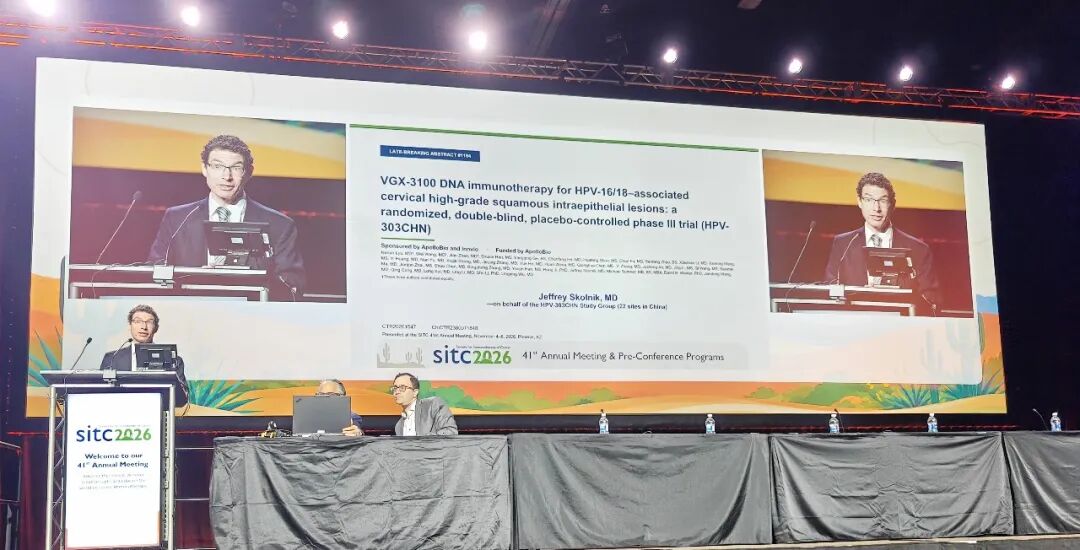
On November 6, the Chinese phase 3 study of VGX-3100 (HPV-303CHN) presented its first core data at the Society for Immunotherapy of Cancer (SITC) annual meeting as a late-breaking abstract oral presentation: the study met its prespecified primary endpoint, with a primary endpoint response rate of 52.5% (73/139) in the VGX-3100 group, a between-group difference of 17.2 percentage points (95% CI 2.7-30.6; P=0.025), and good safety and tolerability. Shortly before the data were released, INO-3107, a product on the same technology platform, received US FDA accelerated approval. How significant is this result?
Article Key Points
- VGX-3100 met its prespecified primary endpoint in the Chinese phase 3 HPV-303CHN trial presented at SITC 2026
- Among 207 randomised patients, the composite response rate was 52.5% (73/139) versus 35.3% (24/68) with placebo
- The between-group difference was 17.2 percentage points (95% CI 2.7-30.6; P=0.025)
- The composite endpoint required both histological reversal and HPV-16/18 clearance at week 36
- All participants had CIN2/CIN3 lesions, with CIN3 accounting for more than half of the group
- HPV-16/18 viral clearance was 55.4% (77/139) versus 38.2% (26/68), a difference of 17.2 percentage points
- TEAEs occurred in 94.2% versus 94.1%, with injection site pain most common; SAEs in 3.6% versus 2.9%
- No treatment-related serious adverse events were reported
- The placebo response rate of 35.3% indicates that a substantial share of lesions regress spontaneously
- Prof. Lingying Wu noted that week 36 primary analysis has been reported and the product is not yet approved
On November 6, the Chinese phase 3 HPV-303CHN clinical study (CTR20201547) of VGX-3100, a plasmid DNA-based therapeutic HPV vaccine developed by Apollo, was presented as a late-breaking abstract oral presentation at the SITC annual meeting. The results showed that among 207 randomised participants, 139 received VGX-3100 with a primary endpoint response rate of 52.5% (73/139), and 68 received placebo with a primary endpoint response rate of 35.3% (24/68). The difference between the groups was 17.2 percentage points (95% CI 2.7-30.6; P=0.025), meeting the prespecified statistical superiority test. Safety and tolerability were good, with no treatment-related serious adverse events.
VGX-3100 is a non-surgical option for cervical precancerous lesions (cervical high-grade squamous intraepithelial lesions, HSIL), with the goal of clearing the lesion while also clearing the HPV infection behind it. Not long ago, INO-3107 (VOCERYQ), another DNA medicine on the same technology platform, received FDA accelerated approval. What stage has the VGX-3100 data reached, and what does it mean?
A Place on the SITC Programme: A Coveted Entry Ticket
SITC, the Society for Immunotherapy of Cancer, was founded in 1984 and focuses on cancer immunotherapy. It is one of the leading international academic organisations in the field. Its annual meeting brings together academia, regulators, government, and industry, and is one of the largest scientific meetings in the area.
SITC 2026 was the 41st annual meeting, held in Phoenix, United States, from November 4 to 8, with hybrid participation, and received close to 1,200 abstract submissions. Against this level of competition, the threshold for a late-breaking abstract (LBA) is higher: only the latest data from interventional clinical trials in humans are accepted, with an emphasis on novelty and the potential to change clinical practice.
The Chinese phase 3 randomised trial of VGX-3100 was selected for an oral presentation in the LBA track of this year’s SITC meeting. An oral presentation means the research team will present the full data to international peers at the meeting and face questions and discussion directly. A therapeutic vaccine for HPV-related precancerous lesions entering the main stage of cancer immunotherapy and passing selection in this category is itself a recognition of VGX-3100, and means its data will be tested in front of international peers.
Data Unveiled: Primary Endpoint Met, and What a 52.5% Response Rate Means
HPV-303CHN is a randomised, double-blind, placebo-controlled phase 3 registration study led by Prof. Lingying Wu at the Cancer Hospital of the Chinese Academy of Medical Sciences and conducted across 22 hospitals nationwide, with a data safety monitoring board. The study enrolled 207 patients: women aged 18 years and older with a cervical diagnosis of HPV-16 and/or HPV-18 infection who were confirmed by a pathology adjudication committee to have cervical HSIL.
Participants received VGX-3100 (6 mg, 1 mL) or placebo by intramuscular injection on day 0, week 4, and week 12, with electroporation delivery using the CELLECTRA 5PSP device after each injection, over a 12-week dosing course. The primary endpoint was the proportion of participants with no histological evidence of cervical HSIL and no HPV-16 and/or HPV-18 evidence by HPV genotyping of cervical samples at week 36, that is, requiring lesion regression and viral clearance to be achieved together. This composite endpoint sets a high bar, and it reflects the two measures clinicians watch at once: patients who are HPV-16/18 positive need referral to colposcopy, with biopsy where indicated, and excision only for those at risk. Secondary endpoints include efficacy measures such as histological regression alone, viral clearance alone, and complete histological regression with no LSIL/HSIL; and safety measures including the incidence and severity of local and systemic adverse events (AEs) within 7 and 28 days after each study treatment and during the study period.
The primary analysis showed that among 207 randomised participants, 139 received VGX-3100 with a primary endpoint response rate of 52.5% (73/139), and 68 received placebo with a primary endpoint response rate of 35.3% (24/68). The difference between the groups was 17.2 percentage points (95% CI 2.7-30.6; P=0.025), meeting the prespecified statistical superiority test and indicating that VGX-3100 is superior to placebo in achieving histological reversal while simultaneously clearing HPV-16/18 infection.
The significance of a 52.5% response rate has to be judged against the population enrolled and the endpoint design. All participants had high-grade cervical lesions (CIN2/CIN3), with CIN3 accounting for more than half of the group, which is harder to treat than mild lesions or HPV infection alone and is the main indication for cone biopsy today. The primary endpoint requires that the lesion no longer show histological evidence of HSIL and that HPV-16/18 is no longer detectable, whereas conisation removes lesional tissue but does not necessarily clear the virus, and persistent viral infection is the main reason for recurrence in some patients after surgery. The study used a randomised, double-blind, placebo-controlled design, and the 35.3% response rate in the placebo arm indicates that a substantial proportion of lesions regress spontaneously. It is precisely the control arm that makes the net benefit of 17.2 percentage points over placebo readable (95% CI 2.7-30.6; P=0.025).
Two international multicentre phase 3 trials conducted in the United States previously did not meet their primary endpoint, because the analysis population for the primary endpoint was the biomarker-positive population. However, the response rates in the overall populations of both phase 3 trials reached statistical significance, and the efficacy trend was highly consistent with that of the Chinese phase 3 trial, whose primary endpoint analysis population is the overall population. The results of the three studies support one another.
Several factors may explain why the primary endpoint response rates were higher overall in both groups in HPV-303CHN:
First, differences in participant compliance are an important element. Compliance in HPV-303CHN was very high, with all patients completing the three injections, which reduced the influence of withdrawal and missing endpoint data.
Second, differences in baseline enrolment may also have played a role. Cervical HSIL is classified pathologically into two grades, CIN2 (moderate dysplasia) and CIN3 (severe dysplasia or carcinoma in situ). Approximately 50% of CIN2 lesions may regress naturally within two years, whereas the regression rate for CIN3 is relatively low. Differences in the distribution of lesion grade across the enrolled populations of the different studies affect spontaneous regression in the control arm, and therefore affect the response levels in both groups.
In addition, genetic background and lifestyle may also be relevant, but all of the above are exploratory hypotheses that await confirmation in subsequent studies.
Among the secondary endpoints, the viral clearance rate deserves particular attention. The HPV-16/18 viral clearance rate was 55.4% (77/139) in the VGX-3100 group, higher than 38.2% (26/68) in the placebo group, a between-group difference of 17.2 percentage points. The proportion achieving histological reversal, including complete histological normalisation, was higher in the VGX-3100 group than in the placebo group, with the direction of the results consistent with that of the primary endpoint. In addition, the results of several prespecified sensitivity analyses were consistent with the primary analysis, further supporting the robustness of the primary endpoint efficacy result.
Persistent HPV infection is the key aetiological factor in the development and progression of cervical precancerous lesions, and the main cause of persistent or recurrent lesions after cone biopsy: in patients whose high-risk HPV does not become negative after surgery, the risk of persistent or recurrent lesions is eight times that of patients who become negative. Achieving viral clearance alongside lesion reversal therefore means that treatment does more than remove the lesion; it points towards treating the cause.
Immunogenicity analyses showed that VGX-3100 induced specific humoral and cellular immune responses against HPV-16/18. Exploratory analyses further observed that changes in HPV antigen-specific T cell responses and in specific subpopulations of these cells were associated with clinical efficacy. These findings are consistent with the design mechanism of VGX-3100, which relies on inducing HPV antigen-specific T cell immunity, and support further understanding of the relationship between its clinical efficacy and its immune response.
On safety, VGX-3100 showed good safety and tolerability. During treatment, treatment-emergent adverse events (TEAEs) occurred in 94.2% of the VGX-3100 group and 94.1% of the placebo group, with injection site pain the most common adverse event (predominantly grade 1-2). Serious adverse events (SAEs) occurred in 3.6% and 2.9% respectively, and none were judged to be related to the study treatment. The overall safety profiles of the two groups were similar.
For comparison, excisional surgery (LEEP and cold knife conisation) is the current standard of care for cervical HSIL. Its efficacy is well established, but it has limitations: residual or recurrent lesions occur after surgery in approximately 7% to 25% of cases, and persistent high-risk HPV infection in 8% to 32.4%. Conisation may also bring bleeding, infection, and cervical stenosis, as well as risks of preterm birth and difficulty conceiving in subsequent pregnancies, and conception is not advised within the first six months after surgery. Although VGX-3100 cannot fully replace surgery, it does offer HSIL patients another treatment option.
The significance of VGX-3100 lies in the fact that it gives us, for the first time, a possible non-surgical pharmacological treatment, clearing the virus and reversing the lesion while preserving the structural integrity and function of the cervix. And those with the fewest effective options are precisely young women with fertility plans, and patients with postoperative recurrence who do not wish or are unable to undergo surgery again.
Prof. Wu said: “As the principal investigator, I am delighted to have had the opportunity to complete this globally first-in-class phase 3 study of a therapeutic HPV vaccine together with investigators from multiple centres across the country. The results met the prespecified primary efficacy endpoint. The results were presented as an LBA oral presentation at the SITC annual meeting in the United States on November 6. But I do need to remind everyone that what has been reported is the primary analysis at week 36, that long-term follow-up is still under way, and that the product has not yet been approved. We also hope VGX-3100 will be approved for marketing, to fill the relevant clinical gap.”
INO-3107 Moves First: What Its Approval Means for VGX-3100
Before the HPV-303CHN data were released, another story was worth attention. On October 30, INOVIO announced that the US FDA had granted accelerated approval to VOCERYQ (INO-3107), to reduce the frequency of surgery in adults with recurrent respiratory papillomatosis (RRP). This is the first DNA medicine approved by the FDA. RRP is caused mainly by HPV-6/11 infection; papillomas repeatedly grow in the airway, so patients often need to undergo one operation after another to remove them.
The approval was based on the RRP-001 study (NCT04398433), which enrolled 32 adult patients, of whom 26 had received at least three surgeries in the 12 months before treatment and were included in the efficacy evaluation. Of these 26 patients, 7 (27%, 95% CI 12%-48%) required no further surgery at 12 months of follow-up, achieving complete response. On safety, the most common adverse reactions were injection site reactions, headache, and fatigue, and no grade 4 or 5 adverse events occurred; all 32 patients completed the study.
INO-3107 and VGX-3100 come from the same platform, which is why its approval is worth discussing here. Both are INOVIO plasmid DNA medicines: a plasmid encoding HPV antigens is delivered into human cells, so that the cells themselves express the antigen and thereby induce specific immunity against HPV. The route of delivery is also the same. Immediately after intramuscular injection, an electrical pulse is delivered with the CELLECTRA 5PSP device, and INO-3107 was approved in combination with this device; the Chinese phase 3 study of VGX-3100 used the same device. The difference lies in the HPV types and indications targeted: INO-3107 targets HPV-6/11 for recurrent respiratory papillomatosis, while VGX-3100 targets HPV-16/18 for cervical high-grade squamous intraepithelial lesions.
The two are, of course, at different stages. The approval of INO-3107 rested on a single-arm study in an efficacy population of 26 patients, whereas the Chinese phase 3 of VGX-3100 is a randomised, double-blind, placebo-controlled registration study, and the trial designs are not the same. These two DNA medicines are the same technological route being tested in different indications.
Even so, the approval of INO-3107 does answer a question the industry shares: can the combination of “plasmid DNA medicine plus electroporation” complete regulatory review and become a marketable drug? The FDA’s answer is yes, although the indication was granted accelerated approval, and confirmatory studies will be needed to verify clinical benefit. For VGX-3100, this means that the platform and delivery method on which it relies are no longer unprecedented.
Beyond the Response Rate
Beyond the response rate, HPV-303CHN carries several larger implications.
For patients, the average age of onset of cervical precancerous lesions is approximately 32 years, which is within reproductive age. The current standard of care is surgical excision, but surgery may bring reduced fertility, difficulty conceiving, and preterm birth, and it removes the lesion without necessarily addressing the HPV infection behind it. If a therapeutic vaccine could address both the lesion and the virus without surgery, these patients would gain an additional treatment option.
For national targets, the World Health Organization’s path towards eliminating cervical cancer turns on “90-70-90”: by 2030, 90% of girls vaccinated against HPV before the age of 15, 70% of women screened with high-quality programmes before the ages of 35 and 45, and 90% of women diagnosed with cervical disease receiving treatment. Beyond vaccination and screening, the treatment side has long been dominated by surgery, and non-surgical treatment is a gap. VGX-3100 addresses precisely the link of high-grade cervical lesions, and the presentation of its Chinese phase 3 data at SITC provides a new possibility for filling that gap.
For the industry, on the same DNA medicine platform, INO-3107 has secured FDA accelerated approval in HPV-6/11-related recurrent respiratory papillomatosis, while VGX-3100 brings phase 3 data in HPV-16/18-related cervical precancerous lesions to SITC: from airway to cervix, the same technological route is undergoing testing in succession in different HPV-related diseases. How far this route can go will require longer follow-up data and regulatory review in different countries. But its potential advantages, avoiding surgery, preserving cervical anatomy, and acting on both the lesion and the HPV infection at once, are no longer merely a concept.

